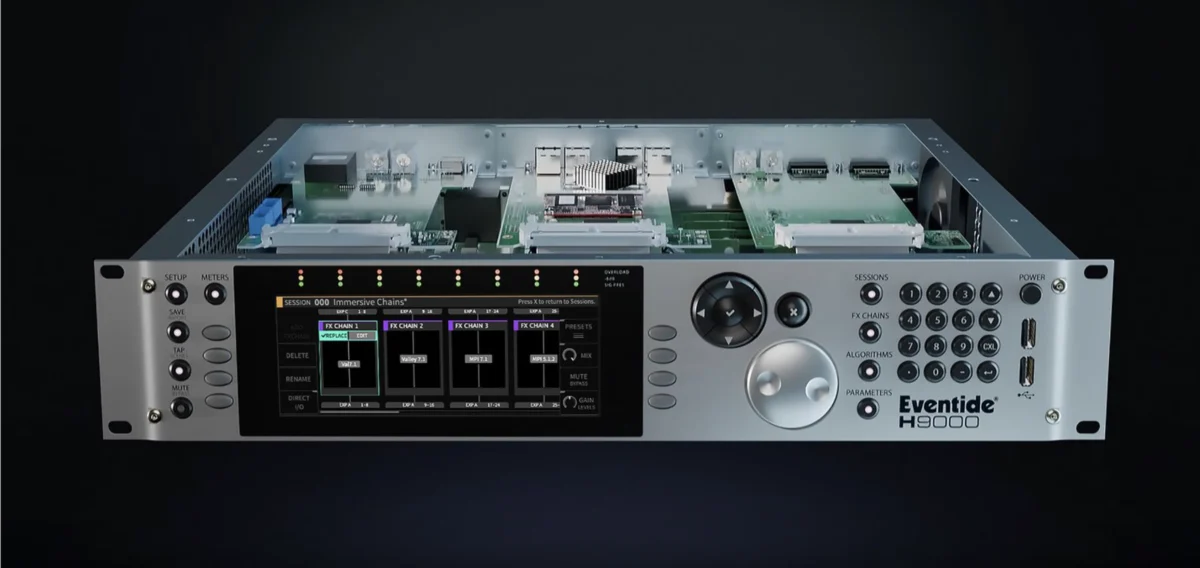
September 17, 2026 — In a major development for spatial audio engineers, post-production mixers, and sound designers, Eventide has announced a substantial expansion for its flagship H9000 and H9000 Gen2 Harmonizer processors. Leveraging the enhanced processing horsepower introduced with the H9000 Gen2 architecture, this new software update injects a comprehensive suite of high-end algorithms designed specifically for immersive, surround, and multichannel production workflows.
The update brings state-of-the-art reverb, pitch-shifting, and upmixing tools tailored for Quadraphonic, 5.1, 5.1.2 (Dolby Atmos-compatible height configurations), and 7.1 formats. Alongside these complex computational tools, Eventide has included a curated library of over 200 new FX Chains and presets, instantly bridging the gap between traditional stereo/surround manipulation and next-generation 3D spatial mixing environments.
Main Facts
The core of this new release centers around bringing Eventide’s legendary signal-processing legacy into modern, multi-speaker spatial paradigms without sacrificing fidelity or introducing latency bottlenecks.
- Hardware Synergy (H9000 Gen2): The update relies heavily on the advanced processing headroom provided by the H9000 Gen2 hardware platform, allowing multiple instances of heavy spatial algorithms to run simultaneously.
- MicroPitch Immersive: An adaptation of Eventide’s iconic spatial pitch-shifting effect, supporting up to eight discrete channels of spatialized, detuned delays. It features independent delay and pitch processing, dynamic modulation, EQ, and crossfeed controls.
- Valley Multichannel Reverb: A brand-new algorithmic reverb built on classic architectures, optimized for spatial environments. It is available in Stereo, Quad, 5.1, and 7.1 configurations, featuring an immersive-specific "Haze" control that distributes reverb energy between adjacent speakers to smooth out the soundfield.
- Advanced Upmixers: New algorithms enabling legacy stereo or discrete multi-track sources to be seamlessly translated into Quad, 5.1, 5.1.2, and 7.1 formats with precise control over spatial imaging and source positioning.
- Factory Presets and FX Chains: More than 200 newly engineered presets and routing chains designed to provide instant starting points for film mixing, music production, and immersive sound design.
Chronology: The Evolution to Immersive Processing
To understand the significance of this 2026 update, it is essential to look at the trajectory of Eventide’s flagship processors and how the industry has shifted toward immersive audio formats over the past decade.
The Foundation: The Birth of the H9000
When Eventide originally introduced the H9000 Harmonizer, it represented a quantum leap in hardware-based audio processing. Equipped with quad DSP engine boards, it was designed to act as a centralized processing matrix for massive professional studios, capable of running multiple complex effects simultaneously across diverse routing scenarios. However, at the time of its initial release, the professional audio landscape was still heavily dominated by stereo and traditional 5.1/7.1 surround sound.

The Rise of Spatial Audio
Over the subsequent years, the adoption of object-based and multichannel immersive formats—driven by the rapid expansion of Dolby Atmos, spatial music streaming on platforms like Apple Music, and advanced VR/AR media—fundamentally altered the demands placed on mixing engineers. Studios needed hardware processors capable of handling multi-speaker layouts natively, without forcing engineers to resort to complex, CPU-heavy plugin chains that could introduce latency or destabilize native digital audio workstation (DAW) sessions.
The H9000 Gen2 and the Immersive Leap
Recognizing this paradigm shift, Eventide developed the H9000 Gen2, upgrading the internal processing architecture to handle the massive mathematical demands of 3D audio algorithms. Today’s release represents the software realization of that hardware potential. By delivering native spatial algorithms directly to the DSP engine, Eventide has transformed the H9000 from a premier stereo/surround effects box into a premier, self-contained immersive spatial processor capable of competing directly with DAW-based immersive mixing tools while retaining the unmatched sonic character of hardware DSP.
Deep Dive: Breaking Down the New Algorithms
The update introduces several standout signal processors, each engineered to address specific pain points in modern immersive mixing.
1. MicroPitch Immersive
Eventide’s "MicroPitch" algorithm has been a studio staple for decades, revered for its ability to widen sources, add subtle chorus-like movement, and create rich stereo imagery through microscopic pitch-shifting and delay offsets.
With MicroPitch Immersive, this concept has been scaled up to handle up to eight discrete channels. Engineers can manipulate spatialized, detuned delays across a multi-speaker array. Crucially, the algorithm provides:

- Independent Delay and Pitch Processing: Allowing different speakers in a 5.1.2 or 7.1 array to receive unique micro-variations, avoiding phase cancellation and static repetition.
- Integrated Modulation and EQ: Giving users the ability to sculpt the frequency content and movement of the spatial field on the fly.
- Crossfeed Controls: Providing a crucial link between discrete channels to glue the immersive image together, preventing sounds from feeling disconnected or localized too harshly to a single physical speaker.
2. Valley Reverb and the "Haze" Control
Reverberation in a multichannel or immersive environment is notoriously difficult to get right. Standard stereo reverbs often collapse or sound disjointed when mapped across multiple physical speakers.
Valley is Eventide’s answer to this challenge. Built upon classic hardware reverb architectures, Valley has been completely rewritten for multichannel production. Available in configurations ranging from standard Stereo all the way to Quad, 5.1, and 7.1, it delivers lush, dense tail characteristics without clouding the direct sound.
Of particular note is the Haze control, available in Quad, 5.1, and 7.1 modes. The Haze parameter intelligently bleeds and distributes reverb energy from each individual speaker into its neighboring channels. This creates a remarkably cohesive, seamless acoustic environment, eliminating the "point-source" anomalies that often plague digital reverbs in multichannel rooms.
3. Native Upmixing Tools
In many post-production and catalog remastering scenarios, engineers are tasked with taking legacy stereo mixes or older 5.1 stems and upmixing them into modern immersive formats like 5.1.2 or 7.1. Doing this poorly results in a phase-y, smeared soundstage.
Eventide’s new upmixing algorithms analyze incoming audio spectra and dynamically position the sonic elements across Quad, 5.1, 5.1.2, and 7.1 soundstages with surgical precision. Engineers retain absolute command over divergence, center channel extraction, and height distribution, ensuring that legacy material can be successfully brought into the immersive era without losing its original artistic intent.

Supporting Data and Production Impact
The integration of these immersive tools into a hardware unit like the H9000 Gen2 addresses several critical bottlenecks in modern professional workflows:
- DSP Offloading: Running complex spatial algorithms—especially multi-instance immersive reverbs—can cripple a computer’s CPU during a busy mixing session. By handling these calculations on the H9000’s dedicated quad DSP architecture, native computer resources are preserved entirely for routing, tracking, and virtual instruments.
- Latency Management: Hardware processing ensures near-zero latency monitoring, a vital requirement for tracking artists or mixing live immersive events where buffer sizes must remain minimal.
- Preset Ecosystem: The inclusion of over 200 factory FX Chains means engineers do not have to build spatial routing matrices from scratch. These presets serve as proven templates for common mixing tasks, drastically reducing setup time in commercial studios working under tight deadlines.
Industry Implications and Official Perspectives
The release of these immersive algorithms highlights a broader industry trend: hardware manufacturers are doubling down on spatial audio compatibility to secure their place in modern studio infrastructure. While the plugin market has been flooded with spatial tools, hardware processors that can seamlessly integrate into high-end analog/digital hybrid studios remain prized assets.
While formal statements from Eventide’s engineering team emphasize their commitment to pushing the boundaries of digital signal processing, feedback from early beta testers in the post-production and spatial mixing communities has been overwhelmingly positive. Early adopters have praised the hardware unit’s ability to maintain absolute phase coherence while widening traditional mono and stereo sources into vast, three-dimensional acoustic spaces.
For commercial recording studios, post-production houses, and live sound venues equipped with the H9000 or H9000 Gen2, this update represents an essential, zero-cost expansion of capability. It future-proofs a significant capital investment, ensuring that Eventide’s flagship processor remains at the bleeding edge of audio engineering technology well into the late 2020s and beyond.
The new immersive algorithm suite is available now directly through Eventide Audio. Users can access the update by logging into their Eventide account and updating their H9000/H9000 Gen2 firmware and associated control software.