
The 2025 Ford Mustang GT stands as a pinnacle of modern American muscle, blending raw V8 power with cutting-edge automotive technology. However, for many audiophiles who find themselves behind the wheel of this latest iteration, the stock sound system—even in the Premium trim—often leaves something to be desired. As enthusiasts seek to bridge the gap between track-ready performance and concert-hall acoustics, the complexities of integrating aftermarket high-fidelity audio into a vehicle laden with advanced electronics become increasingly apparent.
This report examines a project currently in the planning stages: a comprehensive, $2,000-budget audio overhaul for a 2025 Mustang GT. By utilizing AI-assisted research and precise electrical planning, this build aims to balance the demands of a 1,200-watt RMS subwoofer system with the delicate electrical architecture of the modern Mustang.
Main Facts: The Scope of the Build
The objective is to install a high-output, dual-subwoofer system into a 2025 Mustang GT Premium. The selected hardware centers on the Kicker 46CXA1200.1T amplifier, paired with two 10-inch subwoofers in a custom-ported enclosure. The budget is strictly capped at $2,000, which must account for the subwoofers, the amplifier, the Active Noise Cancellation (ANC) bypass modules, integration hardware (PAC module), and high-grade wiring kits.
The central challenge lies in the vehicle’s electrical stability. With modern Mustangs utilizing sophisticated Battery Management Systems (BMS), the project lead has identified the "Big 3" electrical upgrade—upgrading the alternator-to-battery positive, engine block-to-chassis, and battery-to-chassis grounds—as a foundational requirement to ensure the alternator can handle the increased current draw without compromising the vehicle’s onboard computer systems.
Chronology of Research and Planning
The planning phase for this installation has been defined by a methodical, data-driven approach, relying heavily on cross-referencing AI-generated insights with historical Mustang electrical performance data.
Phase 1: The AI-Assisted Discovery
Initial research was conducted using Grok AI to navigate the limited technical documentation available for the 2025 model year. Because the 2025 Mustang is in its infancy, official dealership service manuals often lack specific details regarding alternator amperage. The AI analysis suggested a baseline vehicle draw of 50–80 amps, a figure consistent with previous-generation (2023) GT models. This allowed for a calculated risk assessment, confirming that a 1,200-watt RMS system, while aggressive, falls within the threshold of manageable electrical load provided that the "Big 3" upgrade is implemented.
Phase 2: Integration and Signal Processing
Recognizing that the 2025 Mustang utilizes advanced Active Noise Cancellation (ANC) and Electronic Sound Enhancement (ESE) to mask cabin noise and artificially augment engine notes, the planning process shifted toward signal integrity. The installer must utilize an ANC bypass to prevent the audio system from amplifying low-frequency interference, which would otherwise result in catastrophic subwoofer feedback.
Phase 3: Hardware Selection
The final selection of equipment reflects a preference for legacy durability and proven performance. The user has narrowed the search to two specific Kicker models: the Kicker CVX50102 and the Kicker 44L7S102. Both are 2-ohm dual voice coil (DVC) units, chosen for their ability to present a favorable impedance load to the Kicker amplifier.
Supporting Data: The Technical Hurdle of Enclosure Design
One of the most nuanced debates in this build involves the choice between round and square subwoofers. The Kicker L7 series (square) is lauded for moving more air due to increased cone surface area, but the user has expressed valid concerns regarding the frequency response.
The Frequency Response Dilemma
The Kicker CVX round subwoofers boast a frequency range topping out at 500Hz, whereas the L7 square subwoofers are rated up to 100Hz. While critics might argue that subwoofers are inherently low-pass filtered, the concern regarding sound quality (SQ) is legitimate in a high-fidelity environment. However, since the design objective is a ported enclosure, the physical mechanics of the box will naturally dictate the output curve more than the driver’s upper-frequency limits.
Spatial Constraints
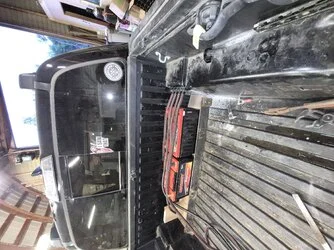
The trunk of the 2025 Mustang is notoriously irregular. Through precise measurement, the available space for an enclosure is approximately 46"W x 35"D x 15-18"H. This footprint is sufficient for a custom-ported dual-10" box, though it requires meticulous craftsmanship to ensure the port tuning frequency complements the vehicle’s cabin gain, which is vital for achieving the desired "loud bass" signature.
Official Responses and Industry Insights
While Ford dealerships have remained largely silent on the specific electrical limits of the 2025 alternator—citing liability and the complexity of the integrated BMS—third-party audio specialists have weighed in on the necessity of the PAC (Peripheral/Pacific Accessory Corporation) module.
Industry experts emphasize that in the 2025 Premium trim, the factory head unit is deeply integrated with the vehicle’s HVAC, navigation, and safety systems. Removing or bypassing these systems without the correct PAC integration module will result in the loss of factory chimes, steering wheel controls, and potentially the reverse camera functionality. Furthermore, while the ANC bypass module is essential, experts note that the ESE (Electrical Sound Enhancement) settings—which pump engine noise into the cabin—often need to be manually disabled via the FORScan software interface. Without this step, the subwoofer system may inadvertently "fight" the synthetic engine noise, leading to phase cancellation or distorted bass response.
Implications: Navigating the Electrical Architecture
The primary implication of this build is the potential for "voltage sag." In a high-performance vehicle like the Mustang GT, the electrical system is optimized for fuel efficiency and emission control, not high-wattage audio.
The Capacitor Question
The project planner has proposed a capacitor to handle transient power demands. While capacitors were once the standard for managing power spikes, modern electrical theory suggests that a high-capacity AGM battery or a high-output alternator is a superior solution. However, given the $2,000 budget and the difficulty of replacing a proprietary 2025 alternator, a high-quality capacitor may serve as a useful "band-aid" to prevent the lights from dimming during intense bass transients.
The "Big 3" Necessity
The success of this project hinges on the execution of the "Big 3" electrical upgrade. By increasing the gauge of the primary power and ground cables, the installer reduces electrical resistance, allowing the alternator to respond more quickly to the current demands of the Kicker 1200.1T amplifier. This is not merely an audio upgrade; it is a maintenance upgrade that preserves the longevity of the vehicle’s charging system.
Conclusion: The Path Forward
The path to a premium audio experience in the 2025 Mustang GT is a narrow one, requiring a balance of mechanical intuition and digital precision. The choice to utilize Kicker components—based on the longevity experienced with previous installations—demonstrates a commitment to reliability.
As this project moves from the research phase to the physical installation, several key factors remain critical:
- FORScan Utilization: Disabling ESE is non-negotiable to ensure the audio signal remains clean.
- Integration Modules: The PAC module is the gatekeeper to maintaining the factory features that define the Premium trim experience.
- Enclosure Tuning: Because the user prefers the output of a ported design, the box volume and port length must be calculated precisely for the 10-inch drivers to avoid "chuffing" or bloated, muddy bass.
Ultimately, this build serves as a case study for the modern Mustang enthusiast. It highlights that while the 2025 GT is a sophisticated machine, it is not beyond the reach of the dedicated hobbyist. By respecting the vehicle’s electrical limitations and investing in high-quality integration hardware, the transition from a stock audio system to a custom-tuned, ported bass experience is not only possible—it is a transformative upgrade that aligns the auditory experience with the vehicle’s aggressive, high-performance nature. The next step for the owner will be the final verification of alternator output during a load test, ensuring that once the subwoofers are installed, the Mustang can provide the power required to drive them without sacrificing the integrity of the ride.