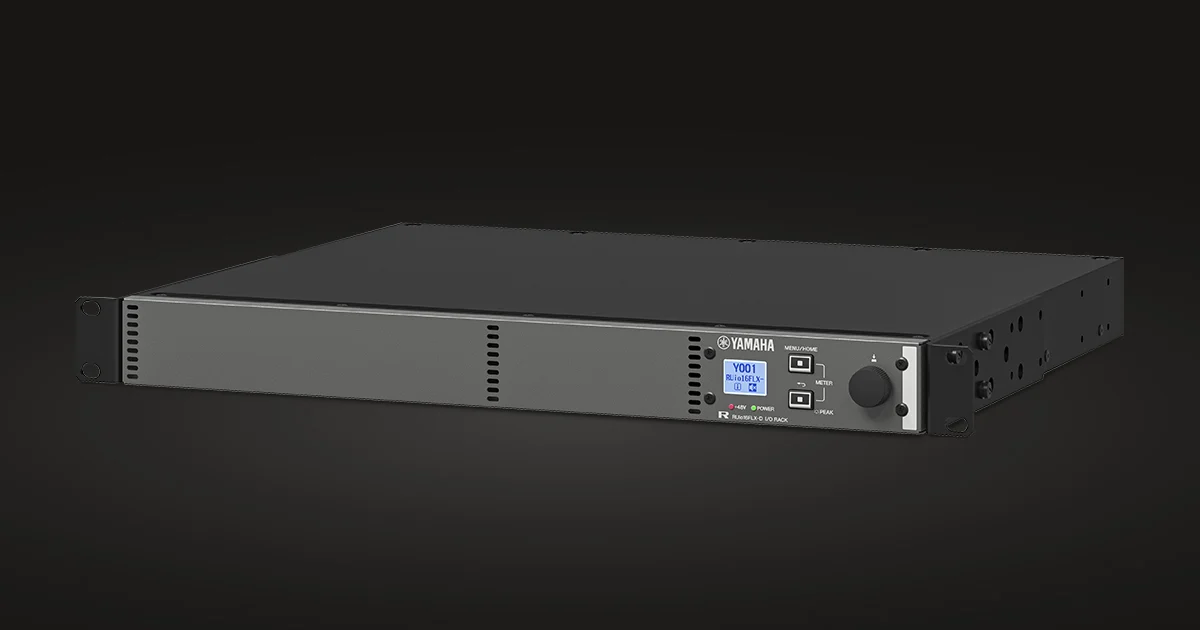
September 11, 2026 — Yamaha Pro Audio has officially announced the launch of the RUio16FLX-D, a versatile 16-channel rack I/O unit engineered explicitly for commercial installations, complex system integrations, and demanding live sound environments. Featuring robust Phoenix connectors and unprecedented per-pair configuration capabilities, the new unit bridges the gap between traditional analog infrastructure and modern networked audio ecosystems.
Designed to adapt seamlessly to the shifting demands of modern audio-visual (AV) spaces—ranging from corporate boardrooms and performing arts centers to hospitality venues and houses of worship—the RUio16FLX-D promises to streamline signal routing, reduce hardware footprint, and eliminate the need for single-purpose conversion boxes.
Main Facts
At its core, the Yamaha RUio16FLX-D is a compact, rack-mountable 16-channel input/output interface built to maximize deployment flexibility.
- Configurable Channel Pairs: The unit’s 16 channels can be configured in independent two-channel pairs. Integrators can dynamically assign each pair to function as analog inputs, analog outputs, or AES/EBU digital outputs, depending on the exact requirements of the project.
- Phoenix Connectors: Tailored specifically for commercial AV and fixed installations, the inclusion of secure Phoenix-style terminal block connectors ensures reliable, quick, and tidy wiring without requiring bulky multi-pin adapters.
- Onboard Control: Channel configurations and routing parameters are easily managed directly from the unit’s integrated, front-panel LCD display, allowing for quick on-site adjustments and status monitoring.
- Dante Network Connectivity: Native integration with Audinate’s Dante audio-over-IP (AoIP) networking protocol enables the RUio16FLX-D to interface effortlessly with broader, multi-channel networked audio systems over standard Ethernet infrastructure.
- System Expansion: The unit serves as an ideal hardware expansion companion for Yamaha’s ecosystem, particularly when paired with digital signal processors (DSPs) such as the Yamaha DME5 and DME3, where additional analog or digital I/O points are required.
Chronology of Development and Release
The path to the release of the RUio16FLX-D reflects Yamaha’s ongoing observation of the commercial AV market, where the lines between IT networks, traditional analog audio, and digital routing continue to blur.
The Evolution of Fixed Installation Challenges
Over the past decade, the commercial sound integration market has experienced a massive shift toward networked audio. Protocols like Dante revolutionized how audio is distributed across large campuses, high-rise corporate facilities, and multi-zone entertainment complexes. However, integrators frequently encountered a persistent bottleneck: the "last mile" conversion.
While core systems operated entirely in the digital domain via IP networks, legacy analog amplifiers, microphones, room-combining processors, and external hardware units still required physical, local connections. System designers were routinely forced to stock multiple, single-function conversion boxes—such as dedicated analog-to-digital or digital-to-analog interfaces—just to handle fluctuating I/O demands on a room-by-room basis.
Prototyping and Engineering Phase
Recognizing the inefficiencies of carrying a diverse inventory of single-purpose interface boxes, Yamaha’s Pro Audio engineering division began conceptualizing a unified, highly adaptable hardware platform. The primary goal was to create a single piece of rack hardware that could dynamically reconfigure its physical terminal blocks on demand.
Engineers prioritized a compact chassis format to ensure the unit could easily slide into crowded equipment racks where space is often at an absolute premium. Furthermore, the integration of an intuitive onboard LCD display was chosen over software-only configuration to ensure that field technicians could troubleshoot and reassign channel pairs rapidly during live commissioning, even if a laptop was unavailable.
Official Market Introduction
Yamaha officially debuted the RUio16FLX-D to the professional audio community on September 11, 2026. Positioned as a premier solution for both commercial integrators and live sound technicians, the unit immediately entered manufacturing schedules with global distribution rolling out through Yamaha’s authorized pro audio dealer network.

Supporting Data and Technical Specifications
To fully understand the utility of the RUio16FLX-D, it helps to examine the underlying specifications and how they translate to real-world deployment scenarios.
| Feature / Specification | Detail |
|---|---|
| Total Channel Count | 16 Channels (managed in 8 independent 2-channel pairs) |
| Connector Type | Phoenix-style detachable terminal blocks (ideal for fixed installations) |
| Configurable Modes (per pair) | Analog Inputs, Analog Outputs, AES/EBU Digital Outputs |
| Network Audio Protocol | Dante (IP-based audio routing and distribution) |
| Local Interface | Onboard LCD display with hardware navigation controls |
| Form Factor | Compact rack-mount chassis |
| Target Ecosystems | Yamaha DME5, DME3 Digital Signal Processors, and wider Dante-enabled networks |
How Channel Flexibility Works in Practice
In a typical 16-channel fixed interface, hardware is statically hardwired—for example, offering 8 fixed inputs and 8 fixed outputs. If an installation required 12 inputs and only 4 outputs, an integrator would either have to waste channels on a second unit or purchase an entirely different model.
The RUio16FLX-D dismantles this limitation. Because each of the eight channel pairs can be independently designated via the LCD menu, a single RUio16FLX-D can be configured as:
- 12 Analog Inputs and 4 Analog Outputs;
- 8 Analog Inputs, 4 Analog Outputs, and 4 AES/EBU Digital Outputs;
- Or any other combination of pairs totaling 16 channels.
This level of customization drastically reduces the Bill of Materials (BOM) for system designers, lowering equipment costs and minimizing spare-part requirements for large-scale integrators.
Official Responses and Industry Commentary
Yamaha representatives have emphasized that the RUio16FLX-D was designed from the ground up to solve persistent, real-world headaches reported by system integrators and field engineers.
"Commercial audio systems often require a combination of different I/O types, and those requirements can change depending on the application," notes Amy Kelly, Yamaha’s Product Marketing Manager for Pro Audio.
Kelly elaborates on the philosophy driving the hardware’s development, highlighting the balance between flexibility and simplicity:
"The RUio16FLX-D gives integrators the flexibility to configure the I/O they need in a single device, while Dante connectivity makes it easy to integrate into a broader networked audio system. It’s a practical solution for expanding systems without adding unnecessary complexity."
Industry analysts and early-access beta testers have echoed these sentiments, pointing out that the elimination of proprietary breakout boxes or complicated software routing matrices for basic hardware adjustments represents a major win for on-site efficiency. Field technicians appreciate that they can walk up to a rack, read the LCD screen, and reassign a pair of channels on the fly if a client requests a sudden change in signal flow during system commissioning.

Implications for Commercial Installation and Live Sound
The release of the Yamaha RUio16FLX-D carries significant implications for several distinct sectors within the professional audio industry.
1. Streamlining Fixed Installations
In commercial architecture—such as corporate multi-media rooms, university lecture halls, and government chambers—space and budget are finite resources. Integrators are constantly challenged to deliver maximum capability with minimal rack footprint. By replacing multiple specialized conversion interfaces with a single, highly adaptable 16-channel unit, installation firms can reduce overall rack weight, lower power consumption, and simplify thermal management within enclosed equipment cabinets.
2. Perfect Pairing with Yamaha DME Processors
Yamaha’s DME series of digital signal processors (such as the DME5 and DME3) are widely recognized as industry powerhouses for complex signal management, acoustic conditioning, and zone processing. However, as venue requirements expand over time, these processors often run out of physical I/O ports long before their internal DSP processing power is fully utilized.
The RUio16FLX-D acts as a natural extension for these systems. Instead of replacing an entire DSP core when a venue needs to add four extra microphones or feed a new array of analog zone amplifiers, technicians can simply drop an RUio16FLX-D onto the Dante network, instantly expanding the physical I/O boundary of the DME system.
3. Future-Proofing AV Infrastructure
As audio technology continues to trend toward complete IP-based distribution, legacy analog hardware will not disappear overnight. Venues routinely feature a mix of cutting-edge Dante-enabled loudspeakers alongside legacy analog mixing consoles, amplifiers, and recording feeds.
By serving as a bidirectional translation bridge that speaks both Dante and configurable analog/AES/EBU, the RUio16FLX-D provides a crucial transitional tool. It allows facility managers to upgrade their infrastructure incrementally rather than being forced into costly, all-at-once system overhauls.
Conclusion
Yamaha’s introduction of the RUio16FLX-D 16-channel rack I/O unit underscores the company’s deep understanding of the practical hurdles faced by modern audio engineers and system integrators. By combining the rock-solid reliability of Phoenix terminal connections, the modern expansiveness of Dante networking, and the unprecedented adaptability of per-pair channel configuration, Yamaha has delivered a uniquely versatile problem-solving tool.
For system designers seeking to optimize rack space, reduce hardware complexity, and future-proof their commercial or live sound installations, the RUio16FLX-D stands out as a powerful, elegant addition to the pro audio landscape.
For further technical specifications, user manuals, and purchasing inquiries, visit the official Yamaha Pro Audio Interface Page.