Main Facts
Saskatoon’s premier convention center and performing arts complex, TCU Place, has marked a major milestone in live audio engineering by becoming home to Canada’s very first permanent deployment of Meyer Sound TIGRA line arrays. Situated in the heart of Saskatchewan, the multi-purpose venue serves as a cornerstone for community gatherings, corporate conventions, and world-class theatrical productions. At the center of this audio renaissance is the facility’s crown jewel: the 2,074-capacity Sid Buckwold Theatre.
The installation replaces the venue’s aging M’elodie line arrays, which reliably served the hall for many years before reaching the technological horizon of their lifecycle. Undertaken by systems integrator Sapphire in close collaboration with Canadian distributor GerrAudio and manufacturer Meyer Sound, the multi-phase upgrade represents a holistic reimagining of how large-scale theatrical venues handle acoustic coverage, power-to-weight ratios, and modern networking.
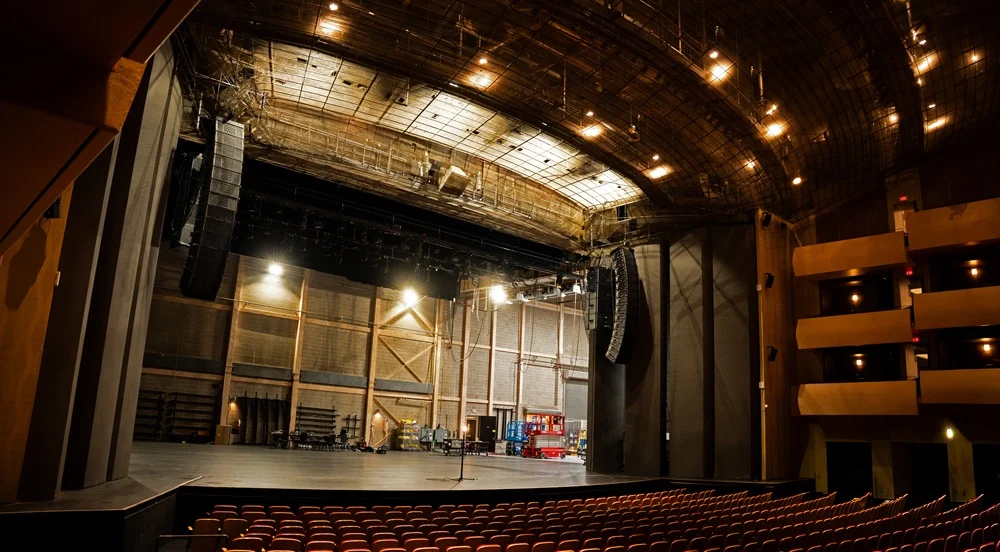
The newly deployed main system is anchored on each side by 12 TIGRA-L and two TIGRA-W loudspeakers, with the wider-dispersion TIGRA-W elements flown gracefully at the bottom of the left and right hangs. Low-frequency impact is handled by 2100-LFC low-frequency control elements flown directly behind the main hangs in a precision cardioid configuration.
To ensure seamless auditory experiences across every seat in the expansive hall, the system incorporates a robust array of supporting components:
- Front Fill: Six ULTRA-X20 point source loudspeakers.
- Out Fill: Two high-output ULTRA-X42 loudspeakers.
- Loge Fills: Three ULTRA-X22XP loudspeakers per side, powered by Meyer Sound’s IntelligentDC technology.
- Processing & Distribution: Two Galileo GALAXY Network Platforms coupled with Milan AVB network connectivity and analog backups.
By blending pristine audio fidelity, advanced DSP (Digital Signal Processing) capabilities, and modern lightweight architecture, TCU Place has future-proofed the Sid Buckwold Theatre for decades to come, setting a new benchmark for performing arts centers across North America.
Chronology of the Project
The journey toward modernizing the Sid Buckwold Theatre’s audio infrastructure was methodical, deliberate, and built upon a foundation of cross-industry collaboration.
Phase One: Defining the Need (Late 2023)
When Devin Ferguson, Technical Services Manager at TCU Place, and Nicholas Hayes, Head of Audio, began evaluating options for an acoustic overhaul, they made a conscious choice to strip brand loyalty out of the equation. Rather than immediately shopping for a direct successor to their older Meyer Sound gear, Ferguson and Hayes adopted a needs-first philosophy. They mapped out the acoustic demands of the 2,074-capacity room, established strict criteria for pattern control, weight limits, and modern networking, and engaged multiple loudspeaker manufacturers in rigorous design discussions.
Phase Two: Collaborative Design and Site Assessment (January 2024)
By early 2024, the technical team narrowed its focus to Meyer Sound’s cutting-edge TIGRA platform. Sapphire—tasked with executing the physical integration—conducted a comprehensive on-site visit in January. Ben Burrell, partner at Sapphire, spearheaded several design review sessions alongside representatives from GerrAudio. Together, the teams fine-tuned the speaker placement, coverage angles, and mechanical load calculations to ensure the architecture of the Sid Buckwold Theatre could be fully maximized without compromising structural safety or sightlines.
Phase Three: Installation and System Tuning (Spring/Summer 2024)
Following the structural preparations, Sapphire executed the physical installation of the arrays, supporting fills, and network architecture. Once the hardware was secured, Ian Robertson of GerrAudio stepped in during the second week of installation to calibrate and tune the system. Robertson’s hands-on approach ensured that every zone of the 2,074-seat auditorium received optimal time-alignment, EQ balancing, and gain staging.
Phase Four: Commissioning and Operational Handover
With tuning complete, the system underwent rigorous testing with various audio sources, establishing a seamless workflow for incoming touring crews and in-house engineers alike. Meanwhile, the retired M’elodie arrays were repurposed to support events across TCU Place’s expansive 104,000 square feet of configurable convention spaces, ensuring that no legacy equipment went to waste.
Supporting Data and Technical Architecture
The technical triumph of the TCU Place installation lies in the marriage of mechanical efficiency and software-driven acoustic control. Evaluating the specific components reveals why this particular configuration was chosen over competing market solutions.
The TIGRA Advantage: Weight and Cardioids
One of the most immediate engineering hurdles in modern theatre design is weight distribution. Older array systems often impose strict limitations on trim heights and line lengths due to heavy cabinet construction. The TIGRA cabinet breaks this mold by offering an extraordinary power-to-weight ratio. Because the boxes are exceptionally light, the Sapphire installation team was able to extend the physical line length of the main hangs, achieving higher box density without exceeding the structural load limits of the Sid Buckwold Theatre’s ceiling grid.
Furthermore, Nicholas Hayes highlighted the importance of low-mid beam control and cardioid dispersion patterns directly within the main hang. Traditional arrays often struggle with low-mid build-up on stage and backstage bleeding. The TIGRA system’s built-in cardioid control mitigates unwanted stage spill, resulting in a cleaner, more intelligible mix for both the audience in the house and performers on stage.
Signal Routing and Redundancy
Reliability is paramount in a busy performing arts venue hosting dozens of diverse acts each year. To safeguard against technical failures, the system design incorporates robust redundancies:
- Processor Redundancy: Two Galileo GALAXY Network Platforms sit at the front of the chain. Following a recommendation by GerrAudio’s Ian Robertson, each array is dedicated to its own independent GALAXY processor. If one processor were to fail mid-performance, a seamless fail-safe mechanism ensures the show can go on without catastrophic interruption.
- Network & Analog Flexibility: Touring engineers frequently arrive with disparate mixing consoles and workflow preferences. The system supports full redundancy over Milan AVB (Audio Video Bridging) alongside a robust analog backup. Multiple patch locations distributed throughout the facility allow house and touring crews to tie into the system in a matter of minutes.
- IntelligentDC Technology: The loge fills utilize Meyer Sound’s IntelligentDC architecture, which delivers balanced audio signals and remote DC power over a single, streamlined cable run. This reduces cable clutter, eliminates the need for local AC power drops in hard-to-reach balcony locations, and ensures pristine signal integrity.
Official Responses and Stakeholder Perspectives
The successful deployment of Canada’s first permanent TIGRA system generated immense enthusiasm among the key stakeholders involved in the project.
Devin Ferguson emphasized that the decision-making process was driven entirely by performance metrics rather than brand momentum. "We took the brand out of the equation," Ferguson stated. "Our design process began with a ‘this is what we need the system to do’ approach. We spoke to different manufacturers about our designs to ensure that we’d get everything we needed."
Nicholas Hayes praised the ecosystem built around the TIGRA platform, pointing specifically to the GEN-1 platform, integrated DSP, and Meyer Sound’s Nebra software platform. "With TIGRA, we see the entire ecosystem of what Meyer Sound’s been working on over the years: the low-mid beam control, and Milan AVB connectivity," Hayes noted. Reflecting on the physical properties of the cabinets, he added, "It’s such a light box. It makes it much more feasible to put it in more places, and those weight savings also allowed us to go with a longer line length… I don’t think we’ll ever see a limit light on it."
Ben Burrell of Sapphire underscored the cooperative nature of the installation process. "It was a very tight collaboration," Burrell remarked. "We met several times to review the project and work on the design collaboratively to help tweak it based on what we thought would be ideal. Then, onsite we made some decisions together and were able to get the performance TCU Place was looking for." Burrell also highlighted the acoustic achievement of the room design: "We were able to hit the whole theatre without delays, which I think is pretty incredible. The higher box density gives us more control, better coverage."
Hayes also commended the ongoing partnership with GerrAudio, praising their dedication to collaborative workflows. "What I love about Gerr is the back-and-forth conversations about what you’re looking for in a product and aligning those needs," Hayes said. "Their follow-up, asking what workflows or other things you found work for you… Gerr has always been very receptive to that and fantastic at passing that knowledge along."
Implications for TCU Place and the Live Audio Industry
The installation at TCU Place carries significant implications both for the venue itself and for the broader North American live sound market.
Elevating the Performer and Patron Experience
For the patrons of the Sid Buckwold Theatre, the upgrade translates to unprecedented speech intelligibility, musical clarity, and balanced tonal coverage from the front rows to the back of the balcony. Because the system achieves total room coverage without the phase anomalies or smear often introduced by complex delay speaker setups, every audience member experiences a unified acoustic image. Furthermore, the compact physical profile of the TIGRA hangs improves sightlines, ensuring that patrons seated in peripheral or upper sections enjoy unobstructed views of the stage.
Streamlining Touring Logistics
Modern touring acts demand speed, adaptability, and high reliability from local venue infrastructure. By implementing an open-architecture front-end capable of ingesting high-channel-count Milan AVB streams alongside traditional analog feeds, TCU Place has eliminated friction points for visiting audio engineers. As Ferguson noted, the standard response to a touring crew’s complex routing request is no longer a logistical headache, but a confident confirmation: "Absolutely. We can do that. Give me three minutes to make it happen."
Setting a Canadian Precedent
As the first permanent deployment of Meyer Sound TIGRA line arrays in Canada, TCU Place serves as a flagship case study for other performing arts centers, civic auditoriums, and convention complexes contemplating infrastructure upgrades. The project demonstrates how venues can successfully leverage lightweight, highly directional array technology to overcome legacy architectural constraints, optimize weight limits, and embrace next-generation AVB networking standards.
Looking forward, Nicholas Hayes is confident that the investment will stand the test of time. Summarizing the journey, he concluded: "It’s been a great journey so far. The system has exceeded expectations. There are things with TIGRA that I haven’t heard with other P.A.s, ever. The fidelity and coverage in the Sid Buckwold Theatre is the best it’s ever been, and we’ve got better sightlines. So, I’m looking forward to the next twenty years or so with this new Meyer Sound TIGRA system and the GerrAudio team."