TOKYO, JAPAN — In a move that further bridges the gap between high-end boutique audio engineering and the burgeoning "maker" culture, Korg has officially announced the NTS-4 Performance Mixer. As the latest addition to the acclaimed Nu:Tekt series, the NTS-4 is a six-channel, palm-sized analog mixer that arrives not as a finished product, but as a DIY kit. Crucially, the kit requires no soldering, allowing musicians of all technical skill levels to assemble their own professional-grade hardware.
Priced at $249 USD, the NTS-4 represents a significant leap forward for Korg’s DIY initiative. While previous entries in the Nu:Tekt line—such as the NTS-1 digital synth and the NTS-2 oscilloscope—focused on individual instrument voices or diagnostic tools, the NTS-4 aims to be the central nervous system of a portable electronic music rig. Encased in a rugged steel chassis and featuring built-in effects, USB-C integration, and Eurorack compatibility, the NTS-4 is designed to meet the demands of live performance and studio integration alike.
The Main Facts: A New Standard for Portable Mixing
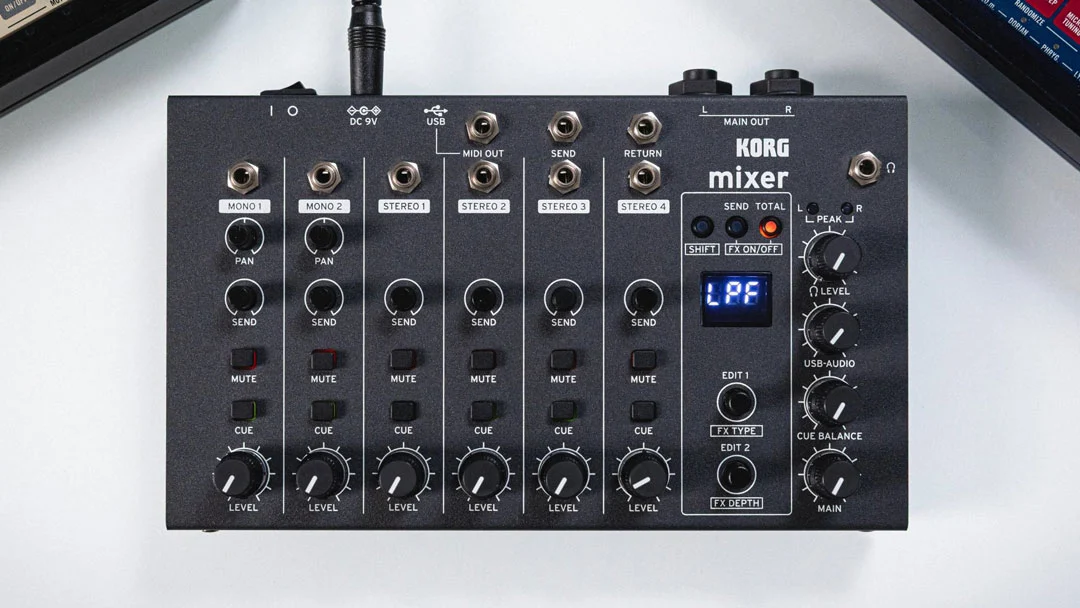
The NTS-4 is a six-channel analog mixer optimized for the "dawless" performer. Its architecture comprises four stereo minijack inputs and two mono minijack inputs. This configuration is specifically tailored for the modern electronic musician who often juggles multiple compact synthesizers, drum machines, and modular units.
Unlike standard utility mixers, the NTS-4 is marketed as a "performance mixer." This distinction is evidenced by its dedicated Cue and Mute buttons for every channel. The Cue system allows performers to monitor a channel privately via headphones before introducing it to the master mix—a feature typically reserved for high-end DJ mixers or large-format consoles. This allows for seamless transitions and "blind" patching during live sets, ensuring that the audience only hears what the performer intends.
The device also serves as a bridge between the analog and digital worlds. Despite its purely analog signal path for mixing, it features USB-C audio and MIDI capabilities. This allows the NTS-4 to function as a compact audio interface, making it possible to record a live jam session directly into a DAW or use MIDI clock to sync internal effects with external hardware.
Chronology: The Evolution of the Nu:Tekt and Volca Ecosystems
To understand the significance of the NTS-4, one must look back at Korg’s decade-long commitment to democratizing electronic music hardware. The journey began in earnest with the release of the Volca series in 2013, which proved there was a massive global appetite for affordable, battery-powered analog gear.
However, as musicians began accumulating multiple Volcas and other "pocket" synths, a problem emerged: how to mix them. Korg’s initial solution, the Volca Mix, was a three-channel utility box that, while functional, lacked the depth required for complex performances.
Recognizing a desire for more "hands-on" engagement with hardware, Korg launched the Nu:Tekt brand. The NTS-1 (2019) was a revelation, offering a powerful digital oscillator and effects engine in a kit that could be assembled in under twenty minutes. This was followed by the NTS-2, a multi-functional tool that combined an oscilloscope with a tuner and signal generator.
The NTS-4 is the chronological culmination of these two lineages. It takes the portability and affordability of the Volca line and marries it with the customizable, "build-it-yourself" philosophy of the Nu:Tekt series. By moving to a steel chassis and expanding to six channels, Korg is signaling that the DIY series is no longer just a hobbyist experiment, but a serious contender for professional setups.
Supporting Data: Technical Specifications and Effects Architecture
The NTS-4’s technical sheet reveals a device that punches well above its weight class. Its ability to handle Eurorack-level signals is perhaps its most significant technical advantage. The two mono inputs feature internal attenuators that can switch between standard line level and the much hotter signal levels produced by modular synthesizers. This eliminates the need for expensive "output modules" in a Eurorack rig, allowing the NTS-4 to act as a direct interface for modular gear.
The Dual FX Engine
The mixer features two independent stereo effect engines that can run simultaneously:
- Send FX (Per-Channel): This engine provides spatial depth and movement. Each channel has a dedicated Send knob to route the signal to one of seven built-in effects:
- Standard Delay
- Ping Pong Delay
- Hall Reverb (Two variations)
- Slap Reverb (Two variations)
- Chorus
- Total FX (Master Bus): This engine shapes the final output. It is designed for aggressive sound design and mix polishing, offering 10 options:
- Low-pass and High-pass Filters
- Isolator (for frequency-specific cuts)
- Flanger and Phaser
- Decimator (Bit-crushing)
- Drive and Distortion
- Compressor and Limiter
The inclusion of a master bus compressor and limiter is a crucial addition for live performers, ensuring that the dynamic peaks of an analog jam session don’t clip the front-of-house speakers or the digital recording.
Physical and Connectivity Specs
- Chassis: Precision-cut steel plates.
- Assembly: Solderless, using included tools and ribbon cables.
- Power: USB-C (bus-powered) or external 5V adapter.
- Outputs: Two unbalanced 1/4” jacks for Main L/R; 3.5mm stereo headphone jack.
- External Loop: Dedicated stereo Send and Return jacks for integrating external pedals or rack units.
Official Responses: Korg’s Design Philosophy
While Korg’s engineering team in Tokyo emphasizes the technical prowess of the NTS-4, the company’s broader messaging focuses on the "joy of assembly." According to Korg’s internal design philosophy for the Nu:Tekt line, the act of building the mixer creates a psychological bond between the musician and the instrument.
"We wanted to create something that felt like a ‘pro’ tool but retained the transparency of a kit," a Korg representative noted during a preliminary briefing. "By assembling the steel chassis and connecting the boards themselves, the user understands the signal flow of their mixer in a way they never would with a sealed, factory-built unit. It’s about demystifying the hardware."
Industry analysts have responded positively to the $249 price point, noting that it undercuts many boutique analog mixers that offer fewer features and lack the NTS-4’s digital integration. The "solderless" aspect is also seen as a strategic move to capture the market of younger musicians who may be intimidated by traditional electronics DIY but desire the aesthetic and pride of a custom-built rig.
Implications: Shaping the Future of Live Electronic Music
The release of the NTS-4 has significant implications for the landscape of electronic music performance.
1. The "Dawless" Movement Gains a Hub
For years, the "dawless" movement—musicians who perform without computers—has struggled with the "mixer problem." Most small mixers are either too cheap (noisy, flimsy) or too large (designed for bands, not synth desks). The NTS-4 provides a middle ground: a high-quality, feature-rich analog mixer that fits in a backpack. Its Eurorack compatibility further cements it as the "missing link" for hybrid modular/desktop setups.
2. The Democratization of Professional Features
Features like "Cue" and "Total FX" (master bus processing) were once the province of mixers costing $1,000 or more. By bringing these to a $249 kit, Korg is raising the bar for what performers expect from entry-level and mid-tier gear. This may force other manufacturers to rethink their portable mixer designs.
3. The Sustainability of DIY
The Nu:Tekt series also touches on the "right to repair." Because the user builds the NTS-4, they are inherently better equipped to maintain it. If a pot becomes scratchy or a jack fails years down the line, the user already knows how to open the chassis and access the boards. In an era of disposable electronics, the NTS-4’s modular, user-assembled nature is a refreshing nod toward longevity.
Conclusion
The Korg NTS-4 is more than just a utility; it is a statement on the current state of music technology. It acknowledges that the modern musician is often a hybrid—part performer, part engineer, and part maker. By providing a rugged, high-fidelity analog path augmented by modern digital conveniences and a rewarding DIY experience, Korg has created a tool that is likely to become a staple on stage and in the studio.
As the NTS-4 begins shipping to retailers worldwide, it stands as a testament to the idea that the best way to understand your sound is to build the machine that shapes it. For $249, the "Jackson Pollock" painters of the soldering world finally have a professional-grade alternative that doesn’t require a steady hand—just a passion for performance.