
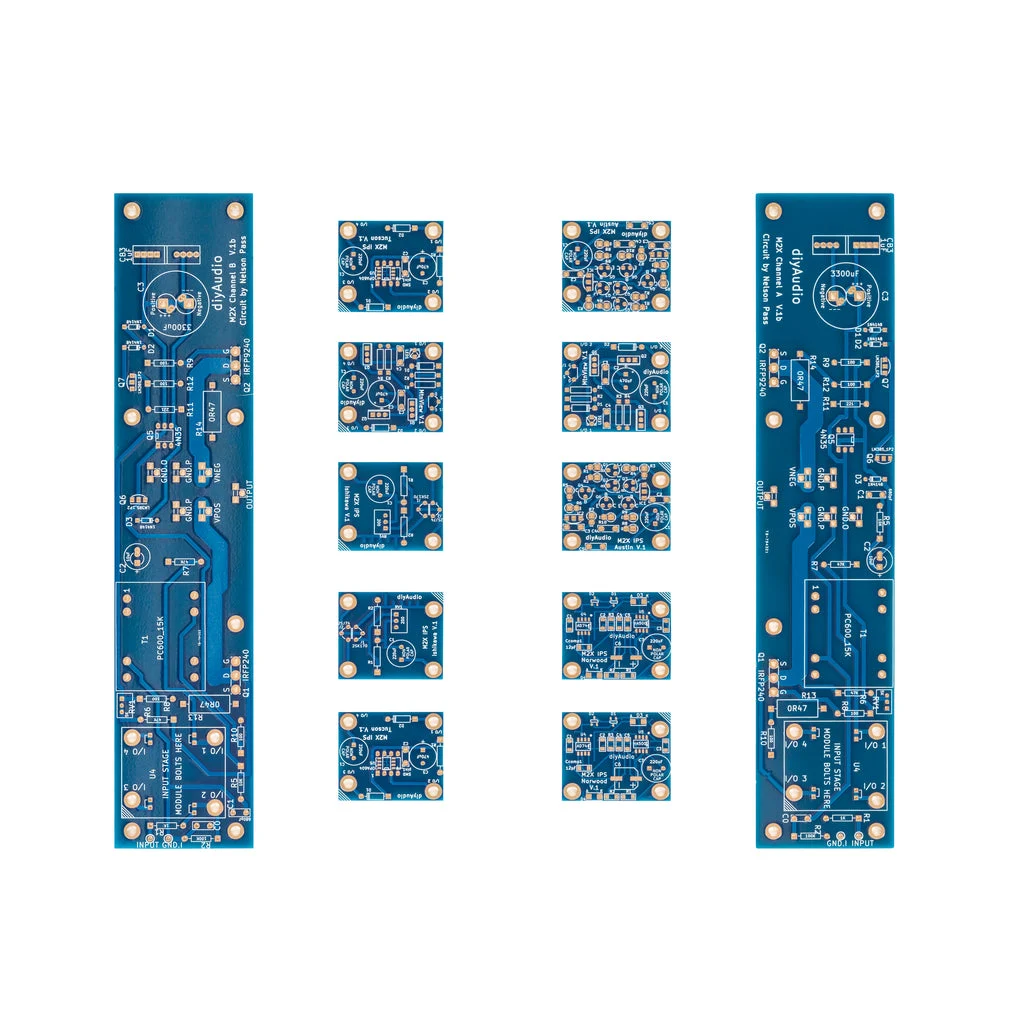
For the dedicated audiophile, the pursuit of sonic perfection is rarely a destination; it is an iterative journey of experimentation and refinement. Nowhere is this more evident than in the community-driven evolution of the First Watt M2X amplifier. Originally designed as a modular platform, the M2X has become a canvas for builders to explore diverse circuit topologies, thanks to an expansive ecosystem of "daughter cards"—input stage modules that fundamentally alter the amplifier’s character.
What began as a foundational project has blossomed into a sophisticated library of nine distinct input stage designs. This report chronicles the technical nuances, design philosophies, and builder-focused insights that have transformed the M2X into a benchmark for modern DIY audio.
The Core Concept: Modularity and the M2X Platform
At the heart of the M2X project is the "daughter board" architecture. By isolating the input stage—the portion of the circuit responsible for signal conditioning and initial gain—from the power output stage, the M2X allows users to swap the "personality" of their amplifier without needing to reconstruct the entire chassis.
The primary goal is to drive the low-impedance primary of the interstage transformer on the M2X motherboard. By experimenting with different topologies—from discrete single-ended followers to complex composite amplifiers—builders can tailor the second-harmonic distortion profiles and transient response of their systems to match their specific loudspeakers and listening preferences.
A Chronology of Innovation: From Ishikawa to Milpitas
The M2X project has seen a steady cadence of releases, each designed to address specific technical challenges or to explore unique design philosophies.
The Early Foundation: Ishikawa, Mountain View, and Norwood
The initial cohort of boards set the tone for the platform. The Ishikawa board introduced the concept of the 200-ohm trimmer potentiometer (RV1). While absent in Nelson Pass’s original M2 schematic, this addition allows builders to perform methodical optimization of the phase of the second harmonic—a feature that, when calibrated with professional audio analysis software, provides an "extra pleasant" sonic signature.
The Mountain View card represents a philosophical anchor, adhering strictly to the "Single-Ended Class A" approach favored by Nelson Pass. By utilizing a single-ended follower with dual-stage bias regulation, it offers exceptional temperature stability and Power Supply Rejection Ratio (PSRR).
The Norwood card marked a shift toward modern surface-mount device (SMD) technology. By opting for the 1206 package for resistors and capacitors, the design remained accessible for hand-soldering while demonstrating that advanced integration could lead to cleaner signal paths.
The Specialized Challenges: Austin, Tucson, and Cedarburg
As the community matured, so did the complexity of the boards. The Austin card serves as a warning for the novice; with a high density of components on a 40mm x 35mm footprint, it is a test of precision. It notably features a circular, symmetric transistor footprint to accommodate various pinouts (ECB, CBE, EBC), placing the burden of responsibility squarely on the builder to verify their components.
The Tucson board introduced "opamp rolling," providing dual footprints for both DIP-8 and SOIC-8 packages. This allows builders to compare the legendary Burr-Brown OPA604 against the ultra-low-noise OPA1611, turning the amplifier into a comparative laboratory.
In 2021, the Cedarburg board was introduced, designed around the notoriously difficult-to-stabilize Analog Devices AD797. Because the AD797 is prone to oscillation, the Cedarburg design employs sophisticated input compensation and elaborate power supply bypassing to tame the chip, standing as a "black diamond" project for advanced builders.
The Modern Era: IPS 6, 7, and Milpitas
The most recent additions, including the Milpitas (IPS 9), represent the cutting edge of the project. Milpitas is a through-hole, readily available alternative to the Norwood design, built specifically to navigate supply chain constraints. It utilizes a composite amplifier topology, which manages global negative feedback through two internal stages to achieve stability without the need for traditional compensation capacitors.
Technical Considerations and Builder Insights
Building an M2X daughter card is an exercise in both engineering discipline and artistic craft. The project documentation, curated by enthusiasts and designers like Mark Johnson, emphasizes several critical areas of practice.
The Necessity of Precision
Across all designs, the recurring theme is the necessity of proper measurement. For cards like Ishikawa, adjustment by ear is discouraged. Instead, the use of audio analysis software—such as ARTA or Electroacoustics Toolbox—or traditional hardware like the HP 339 series distortion analyzer is deemed essential. Without these tools, the fine-tuning of harmonic distribution remains largely speculative.
Thermal and Mechanical Management
The advice provided for JFET installation in the Ishikawa board—mounting them as high as possible off the PCB—is a practical nod to the reality of the DIY process. By leaving the leads long enough to facilitate easy removal without damage, builders protect rare and valuable components from the thermal stress of repeated desoldering.
The "Do Not Substitute" Rule
In boards like Mountain View, the specific choice of LED is non-negotiable. Because the board was characterized using a precise part, the temptation to swap components for "better" or "cheaper" alternatives is identified as a primary cause of build failure. The BOM (Bill of Materials) is not a suggestion; it is the blueprint for success.
Implications for the DIY Audio Community
The M2X project has profound implications for the future of the DIY audio hobby. It effectively lowers the barrier to entry for high-end amplifier design while providing an unlimited "ceiling" for experienced engineers to experiment.
- Knowledge Democratization: By open-sourcing the design files and providing detailed notes on soldering, thermal management, and circuit philosophy, the M2X project acts as an educational incubator.
- Standardization of Quality: The move toward professional-grade footprints and the encouragement of lab-grade measurement ensures that the output quality of these DIY builds is comparable to, or in some cases exceeds, commercial high-end equipment.
- The Aftermarket Ecosystem: The emergence of a "swap meet" culture—where builders trade different daughter boards to experiment with new sound signatures—has created a self-sustaining community that keeps the platform alive long after the initial design phases.
Official Responses and Future Outlook
The community-led nature of the M2X means that "official" guidance often comes in the form of forum documentation and design updates from lead contributors. The consensus remains clear: the M2X is not a kit in the traditional sense, but a living project.
For the prospective builder, the advice remains consistent across all modules:
- For Beginners: Start with boards that offer clear build guides and less dense layouts (such as Norwood or the standard M2X configurations).
- For Advanced Users: The Cedarburg and Austin cards offer the greatest potential for sonic innovation but require a significant investment in test equipment and troubleshooting skills.
- For the Future: As silicon availability fluctuates, the project continues to pivot, with new boards like Milpitas proving that the platform is robust enough to adapt to modern component constraints without sacrificing performance.
In conclusion, the M2X is more than just an amplifier; it is a collaborative masterpiece of engineering. Whether through the pursuit of the perfect second-harmonic phase in the Ishikawa or the stabilization of the AD797 in the Cedarburg, the platform continues to push the boundaries of what is possible in a home workshop, ensuring that the spirit of experimentation remains at the heart of high-fidelity audio.


