More than three years after the explosive launch of ChatGPT brought generative AI into the global mainstream, OpenAI is signaling a major strategic evolution. Moving beyond its roots as a productivity tool for developers, students, and individual professionals, the San Francisco-based AI powerhouse is now setting its sights on a new, high-stakes demographic: the American family.
Recent job listings indicate that OpenAI is actively recruiting a dedicated product manager in San Francisco to lead the development of specialized experiences for families, caregivers, and older adults. This shift represents a transition from viewing AI as a personal assistant to conceptualizing it as a foundational piece of household infrastructure—a move that brings both immense potential and significant regulatory and safety challenges.
The Strategic Shift: From Individual Tool to Household Utility
The decision to hire a product lead for "family experiences" is not merely a staffing change; it is a declaration of intent. According to the job posting, the ideal candidate must possess deep experience in building products for parents, navigating the complexities of multi-generational households, and designing "trust-sensitive" consumer experiences.
Ben Bajarin, chief executive of the technology consultancy Creative Strategies, views this as a watershed moment in the trajectory of consumer AI. "This is similar to the path Google, Apple, and Meta eventually followed as their platforms became embedded in everyday life," Bajarin explains. "However, AI raises the stakes exponentially because the assistant is not just mediating content or devices—it is mediating information and potentially influencing behavior."
By focusing on families, OpenAI is preparing to move its technology into the "shared" space of the household. This suggests that the future of ChatGPT may include features such as family subscription plans, shared digital memories, collaborative AI tutoring, and sophisticated parental oversight tools.
A Changing Demographic Landscape
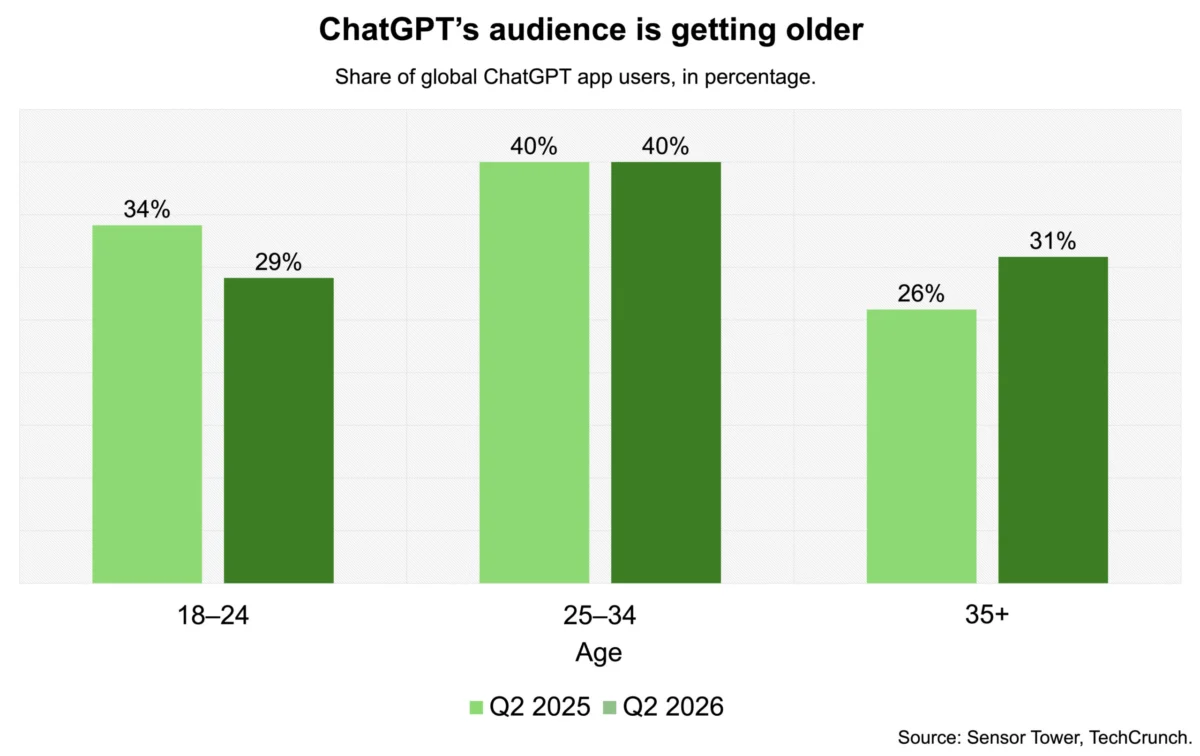
OpenAI’s pivot is backed by shifting user data. While ChatGPT was initially adopted by a younger, tech-savvy demographic, its user base is rapidly aging. Exclusive estimates from Sensor Tower reveal a significant demographic drift: globally, the share of ChatGPT users aged 35 and older rose to 31% in the second quarter of this year, up from 26% just one year prior. Conversely, the 18-to-24-year-old segment saw its share drop from 34% to 29%.
In the United States, the trend is even more pronounced among parents. Nearly one in four smartphone-using parents reported using ChatGPT during the most recent quarter, a notable increase from the 16% penetration rate seen a year ago.
This growth is putting OpenAI in direct competition with rivals like Google (Gemini), Anthropic (Claude), and Microsoft (Copilot). While Gemini currently leads in penetration among parents—reaching 32% of that specific demographic in Q2—ChatGPT is capturing older users at a faster clip than its competitors. This rapid adoption among the "head-of-household" demographic is creating a clear imperative for OpenAI to tailor its product suite to match the needs of families rather than just individual power users.
Chronology of Safety and Scrutiny
The push toward family-centric AI comes at a time of intense scrutiny. OpenAI has faced mounting pressure from regulators and the public regarding the impact of its models on younger users.
- 2023–2024: ChatGPT becomes a fixture in classrooms and homes, leading to widespread concerns regarding data privacy, accuracy, and the psychological impact of AI-human interaction.
- Late 2025: Facing lawsuits from families alleging that ChatGPT played a role in incidents of severe distress and suicide among teens, OpenAI begins a systematic rollout of safety features.
- September 2025: OpenAI introduces a "safety routing" system designed to detect distress in user prompts, directing those queries toward more robust reasoning models.
- May 2026: The company launches an optional "Trusted Contact" feature, allowing users to designate a family member or caregiver to be alerted in instances of potential self-harm.
- Current Day: The search for a dedicated product manager marks the beginning of an era of "safety by design," where products are built with family-specific guardrails from the ground up, rather than having them added as reactionary patches.
The "Safety by Redesign" Imperative
Stephen Balkam, chief executive of the Family Online Safety Institute (FOSI), argues that the industry is at a crossroads. He characterizes the current hiring shift as "safety by redesign."
"You take the initial product or service that was released—which was not really built with kids in mind—and you realize you need a different architecture for younger users," Balkam notes. His research, published this week, highlights the urgency of this transition. A survey of over 4,000 families in the U.S. and Australia revealed a dangerous disconnect: while 27% of parents believe their children have used generative AI in the past week, 38% of the children reported doing so themselves.

This "visibility gap" underscores why standard parental controls are no longer sufficient. Balkam argues that companies must move toward age-appropriate experiences, which include:
- Stronger Content Controls: Hard-coded filters that prevent exposure to adult or traumatic content.
- Contextual Transparency: Constant reminders that the user is interacting with an AI, not a human, to prevent emotional over-attachment.
- Parental Oversight: Dashboard-style controls that allow parents to manage usage time and privacy settings without compromising the user’s autonomy.
Navigating Legal and Ethical Minefields
The path forward is complicated by ongoing litigation. Several high-profile lawsuits have accused OpenAI of failing to prevent its AI from encouraging or exacerbating mental health crises in minors. These cases have forced the company to take a more conservative approach to product updates.
By hiring a dedicated product manager for families, OpenAI is attempting to institutionalize safety. This individual will likely act as a bridge between the engineering teams and the trust-and-safety boards, ensuring that new features—such as voice-mode capabilities or long-term memory functions—are vetted for their impact on minors before they reach the general public.
Implications for the Future of Consumer AI
The broader implications of this hiring decision suggest that the "wild west" era of generative AI is coming to an end.
1. The Rise of Family Plans
Much like Netflix or Spotify, OpenAI will likely introduce family-oriented subscription models. These plans would not only offer financial savings but would also act as the mechanism for account linking, allowing parents to set different safety profiles for different age groups.
2. AI as a Digital Nanny/Tutor
The recent workshop held by OpenAI, the San Antonio Spurs Community Impact organization, and the Positive Coaching Alliance provides a preview of what’s to come. AI is being positioned as a tool for "learning, coaching, and youth engagement." We can expect future iterations of ChatGPT to include features like homework helpers that follow specific pedagogical guidelines or coaching tools that help children develop social-emotional skills in a controlled environment.
3. Generational Memory
As these tools become family-wide, the concept of "shared memory" will become critical. Imagine an AI that remembers a family’s preferences for meal planning, vacation scheduling, or academic goals. This introduces significant data privacy challenges, as the AI would essentially be holding the "digital history" of a family unit.
4. Regulatory Pressures
The hiring also serves as a defensive move against pending legislation. As governments worldwide discuss age-verification laws and stricter AI standards, having a dedicated product team for families allows OpenAI to claim it is being proactive rather than waiting for regulators to impose constraints.
Conclusion
The evolution of ChatGPT from a chatbot for individuals into a technology for households is as inevitable as it is complex. By hiring for this role, OpenAI is acknowledging that it can no longer treat the family as an afterthought.
The success of this transition will depend on whether the company can maintain its innovative edge while simultaneously building the "digital fences" necessary to protect its youngest and most vulnerable users. As Ben Bajarin noted, the stakes have never been higher; when technology enters the home, it doesn’t just change how we work—it changes how we live, communicate, and grow together. For OpenAI, the challenge will be to ensure that in its quest to become the world’s most useful assistant, it remains a safe one as well.