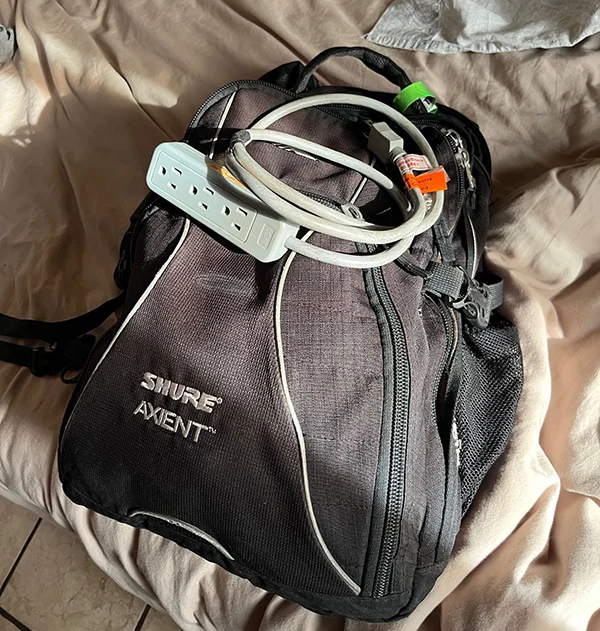
In the high-stakes world of professional RF coordination and live event production, reliability is the bedrock of success. For years, one veteran audio professional relied on a humble, three-foot, 1-to-3 Edison extension cord—a piece of gear so unremarkable that it had been repaired with rubber tape after a soldering iron mishap. It was a staple of his kit, surviving grueling deployments from CFL stadiums to international events in Paris and Rotterdam.
However, in a moment of professional hubris, he decided to “upgrade” his workflow with a standard power bar. This seemingly minor change triggered a cascade of technical failures, leading to a localized power outage, a plume of acrid smoke in a production office, and a lesson in the physics of surge suppression that every technician should heed.
A Legacy of Simplicity
For years, the author’s workflow was dictated by the harsh realities of mobile production. In stadium press boxes or cramped media entrances, power is a finite resource. Often, the only available outlet is one shared with a vending machine or tucked away in an inaccessible corner. The "famed" 3-foot extension cord was the perfect solution: it was compact, reliable, and provided exactly what was needed to run a laptop and a spectrum analyzer.
The simplicity of the device was its greatest strength. It lacked complex circuitry, surge protection, or internal breakers. It was essentially a conduit—a direct physical bridge between the wall and the gear. Because it contained no active components, it was agnostic to the nuances of global power grids, provided the plugs physically mated. It had traveled the world, enduring the 2023 Paris events and the 2024 Rotterdam operations without a single glitch.
The Rotterdam Incident: A Chronology of Failure
The trouble began in Rotterdam in 2024. Having misplaced his specific EU-style AC adapters, the author relied on a chain of adapters: a standard North American Edison-to-UK plug, which was then mated to a UK-to-EU converter. This "daisy-chain" of low-quality plastic adapters was the first crack in the foundation.
When he arrived at the production office, he plugged his new power bar into a temporary power drop. The lack of response from his equipment suggested the venue staff had not yet finished the circuit. Upon investigating the infrastructure, he discovered an incomplete installation. Seeking a working source, he moved to a wall outlet near a photocopier.

The moment of truth arrived with a violent "KA-POW." The power bar’s internal breaker tripped instantly, accompanied by a signature puff of burnt-electronics smoke. Crucially, the surge—or the immediate short-circuiting of the power bar—also tripped the in-house breaker for the entire wall section of the production office.
The author, recognizing the gravity of the situation, quietly retreated to the show floor to perform RF scans. Within an hour, the production group chat erupted. Colleagues, unaware that their colleague had inadvertently sabotaged the power grid, reported their laptops dying one by one as the wall outlets remained dead. The author, witnessing the digital panic from the safety of the venue floor, maintained a strategic silence, contemplating the irony of the situation.
The Science of the Surge: Why the “Upgrade” Failed
The crux of the failure lies in the invisible component found in most modern power bars: the Metal Oxide Varistor (MOV).
Understanding the MOV
An MOV is a device designed to handle voltage spikes. In a standard 120-volt environment, the MOV acts as a high-resistance component, effectively staying out of the circuit. However, its resistance drops exponentially as the voltage rises beyond a specific threshold. When it detects a spike, it "shunts" the excess energy to the neutral/ground wire, protecting the downstream electronics.
The problem arises when a device designed for 120-volt North American power is subjected to the 230-volt standards common in Europe. While a simple extension cord—which is nothing more than copper wire and plastic—doesn’t care about the voltage (provided the insulation is rated for it), an MOV-equipped power bar does.
When the author plugged the 120V-rated power bar into the 230V European outlet, the MOV immediately sensed a voltage far beyond its threshold. It attempted to suppress what it perceived as a continuous, massive surge. Unable to dissipate that much energy, the MOV failed catastrophically—shorting out and triggering the breaker. This was the "pop" and the "smoke" that announced the failure.

Technical Implications for Production Staff
This incident serves as a stark reminder of the differences between "passive" and "active" distribution hardware.
- Passive Distribution: Extension cords, power strips without lights/breakers, and simple splitters are passive. They are essentially extensions of the wall socket. While they lack safety features like surge protection, they are also less prone to "smart" failures in international power environments.
- Active Distribution: Power bars with integrated surge suppression, LED indicators, or internal breakers are active. They introduce complex components that can react unpredictably when exposed to different voltage standards or frequency cycles (50Hz vs 60Hz).
Professional Recommendations
For technicians working globally, the industry standard suggests avoiding the "convenience" of standard consumer-grade power bars when traveling between regions with different voltage standards.
- Regional Compliance: Always use power distribution gear rated specifically for the country of operation.
- The "Extension" Rule: When in doubt, prefer a high-quality, heavy-gauge extension cord and use the manufacturer’s original power bricks for each device. These "bricks" are almost universally "switching" power supplies capable of handling a wide range of voltages (100V-240V).
- Diagnostic Integrity: If a piece of equipment "fails" in a foreign venue, do not immediately assume the building power is the issue. Verify your own adapter chain first.
The Aftermath
The author eventually recovered from the incident. After the venue electricians reset the breakers, he performed a "field repair" by opening the power bar and cutting out the charred MOV. This returned the power bar to a "passive" state, allowing it to function for the remainder of the event.
However, upon the conclusion of the gig, the author discarded both the power bar and the adapters. The risks of transporting burnt electronics through airport security—and the potential for future failure—outweighed the utility of the gear.
The story concludes with the author returning to his tried-and-true, 3-foot, 1-to-3 Edison extension cord. It may not have surge protection, it may not be "smart," and it may look a bit worse for wear, but it possesses the most important trait in professional production: reliability.
In an industry defined by the need to "save the day," this narrative serves as a humble reminder: sometimes, the most sophisticated solution is simply a piece of heavy-duty copper wire. The urge to upgrade, while well-intentioned, must always be tempered by an understanding of the underlying physics—or you might find yourself as the anonymous protagonist of a production office blackout.