
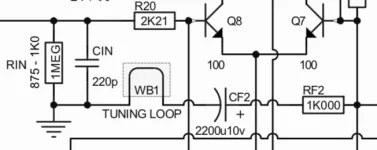
In the high-fidelity audio community, few manufacturers command the respect and curiosity of Canada’s own Bryston. Known for their legendary reliability, robust power amplifiers, and long-standing warranties, the company has built a reputation on engineering transparency and build quality. However, even the most seasoned DIY enthusiasts and veteran audio technicians have recently been stumped by a recurring, enigmatic feature found in several Bryston amplifier schematics: the so-called "tuning loop."
For years, eagle-eyed hobbyists pouring over service manuals have noted a specific, box-enclosed wire connection labeled "WB1" located near the signal ground at the amplifier’s input stage. Despite its presence in high-end circuits, the purpose of this component has remained largely anecdotal, sparking intense speculation across enthusiast forums like DIYAudio. Is it a secret adjustment point for factory calibration? A hum-nulling mechanism? Or perhaps a sophisticated diagnostic port for proprietary test equipment?
The Anatomy of an Enigma: What are Tuning Loops?
At its core, a "tuning loop" in a Bryston schematic appears as a simple, dedicated wire bridge—a physical loop of conductor placed strategically within the circuit topology. The label "WB1" appears consistently across both channels of various amplifier models, suggesting a standardized design element rather than a one-off modification.
The confusion stems from the nomenclature. In engineering, "tuning" implies a variable adjustment, such as a potentiometer or a trim capacitor. However, these loops appear to be fixed, non-variable wire bridges. This has led to a flurry of hypotheses regarding their actual function.

The Theory of Humbucking and Field Nulling
One early theory posited that these loops serve as "humbucking" coils. In high-power amplifiers, the massive power transformer generates electromagnetic fields that can induce unwanted hum into sensitive input stages. Some technicians speculated that the loop might be physically oriented to pick up this interference and inject a "counter-signal" into the ground path to nullify the hum. While technically possible in a laboratory setting, such a precise implementation would be notoriously difficult to maintain in mass production, leading many to remain skeptical of this explanation.
The Feedback and Stability Hypothesis
A more technically grounded theory suggests that the loop is an injection point for frequency response or stability analysis. By utilizing a current clamp, an engineer could inject an RF test signal directly into the feedback network without physically breaking the connection. This would allow for real-time monitoring of the loop gain and phase margin, ensuring the amplifier remains stable across the entire audible spectrum and beyond. Given Bryston’s rigorous testing standards, the need for a non-intrusive diagnostic port is highly plausible.
A Chronology of Discovery
The public discourse regarding these mysterious loops reached a fever pitch in late June and early July 2026, when users on technical forums began dissecting specific schematics that explicitly labeled these loops.
- June 30, 2026: The conversation begins with a direct query from a user named "spookydd," who identified the "tuning loops" in a Bryston schematic and questioned their function, specifically asking about the "WB1" label.
- July 1, 2026: The debate widens. Contributions from users like "KSTR" suggest the injection-point theory, while others compare the cryptic naming convention to other Bryston-specific acronyms, such as "DOA" (Discrete Op Amp), which serves as a testament to the company’s internal design language.
- July 2, 2026: The discussion shifts toward the practical implications of the loop’s existence. Does the removal of the wire bridge cause the amplifier to malfunction? Simulations performed by users suggested that removing the bridge could force the gain to drop to unity, potentially leading to instability or oscillation.
- July 5, 2026: The conversation concludes with a lingering question: if this is indeed a diagnostic tool, what proprietary equipment does Bryston use to interface with it? The community agrees that standard multimeters and scopes are likely insufficient for the specialized testing this loop appears to facilitate.
Supporting Data: Why "WB1" Matters
To understand the function of WB1, one must look at the circuit environment in which it resides. The loop is typically situated at the input signal ground, a critical node where any noise or impedance variation can manifest as audible distortion.

The Role of the Wire Bridge (WB1)
"WB1" stands for "Wire Bridge 1." In PCB design, wire bridges are common tools used to route signals over other traces without necessitating an expensive multi-layer board. However, in the context of Bryston’s input stage, its specific placement implies a "serviceability" design philosophy.
If the loop is intended to be used as a test point, it acts as a gatekeeper. By removing the bridge, a technician can isolate the input stage from the output feedback loop, allowing for independent testing of the Discrete Op Amp (DOA) modules. This level of modularity is a hallmark of high-end audio engineering, allowing a factory technician to quickly pinpoint whether a failure exists in the input section or the output power stage.
Simulation Findings
Advanced circuit simulations conducted by enthusiasts provided the most concrete data to date. When the "WB1" bridge was modeled as an "open" circuit, the amplifier’s feedback loop was effectively compromised. In most configurations, the gain plummeted to unity, and while some simulations remained stable, others showed signs of oscillation. This confirms that the loop is not merely an optional feature; it is an integral part of the signal path’s integrity.
Implications for the Audio Industry
The mystery of the Bryston tuning loop highlights a broader trend in the high-fidelity industry: the gap between the "black box" of proprietary engineering and the curiosity of the DIY community.

Bridging the Knowledge Gap
For the average audiophile, these loops are irrelevant. But for the technician, they represent a window into the manufacturer’s quality control process. The fact that Bryston includes these features suggests they prioritize the long-term repairability of their units. By providing clear isolation points, they enable their own service centers—and perhaps eventually independent repair shops—to maintain the amplifier’s performance specifications for decades.
The Ethics of "Secret" Schematics
There is also a philosophical debate regarding these "mysteries." Should manufacturers provide exhaustive documentation for every component on a circuit board? While many consumer electronics companies move toward "disposable" hardware, Bryston’s inclusion of these loops suggests an commitment to longevity. Even if the exact nature of the "tuning" remains a trade secret, the mere existence of the point is a signal that the device is built to be serviced, not replaced.
Conclusion: The Final Verdict
While a definitive, official statement from Bryston engineers regarding the exact calibration procedure for the "WB1" loop remains elusive, the consensus among the technical community is clear. These loops are almost certainly high-precision diagnostic ports, designed to facilitate factory-level testing of feedback stability and signal integrity.
They represent a bridge between two worlds: the consumer world of "plug and play" audio and the professional world of precision engineering. For the DIY community, the "tuning loop" remains a tantalizing puzzle—a reminder that in the world of high-end audio, the smallest component on a circuit board can carry the most significant engineering intent. As for the "tuning" itself, it seems that for now, the secret remains safe within the walls of the Bryston factory, leaving the rest of us to admire the complexity of the art they produce.
Summary of Key Findings
- Identification: The "tuning loop" is a wire bridge (WB1) located at the input stage.
- Function: Likely serves as an injection point for diagnostic stability testing and a modular isolation point for factory repair.
- Operational Necessity: The loop is essential for proper feedback loop operation; removing it can result in gain collapse or amplifier instability.
- Engineering Philosophy: The inclusion of such features reflects Bryston’s commitment to product longevity and serviceability, a rarity in modern electronics.


