The history of the Glastonbury Festival is often told through the lens of its legendary headliners—Bowie, T. Rex, and Radiohead—or its transformation from a muddy hippie commune into a global cultural phenomenon. Yet, behind the spectacle of the Pyramid Stage and the rhythmic pulse of the dance fields lies a more technical, albeit spiritual, narrative. It is the story of sound as a medium for human connection, spearheaded by audio pioneer Tony Andrews. From the makeshift scaffolding of 1971 to the precision engineering of Funktion-One, Andrews’ journey tracks the very evolution of live concert reinforcement.
The Genesis: 1971 and the Birth of an Icon
In 1971, Glastonbury—or "Glasto," as it would become colloquially known—was a far cry from the multi-million-pound operation of today. Held on Sir Michael Eavis’ 150-acre Worthy Farm, the inaugural event was a non-commercial gathering rooted firmly in the idealism of the late 1960s. It was a time when the "festival" concept was an experimental frontier, and there were no rulebooks for managing the logistics of sound for thousands of people.
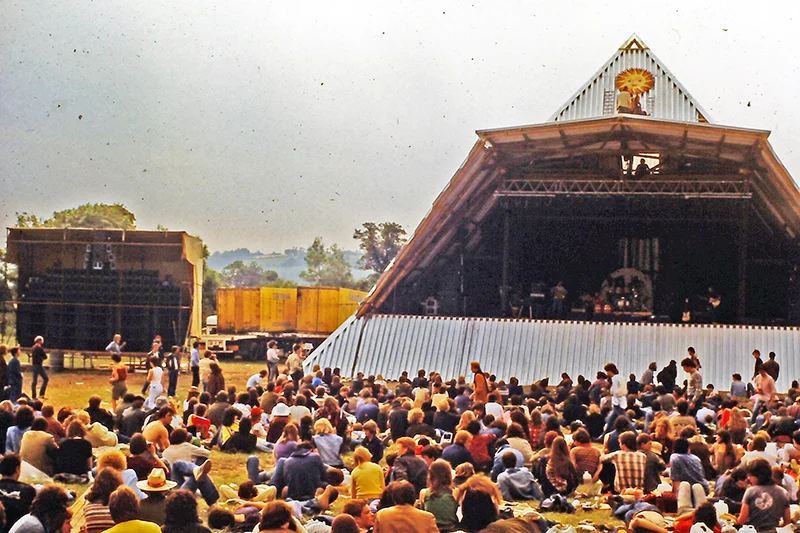
The 1971 edition was notable for two enduring legacies: the roster of performers, which included David Bowie, Traffic, Hawkwind, and the Pink Fairies, and the introduction of the Pyramid Stage. Conceived in a dream by set designer Bill Harkin, the original Pyramid was a one-tenth scale replica of the Great Pyramid of Giza. Built from scaffolding and metal mesh, it was strategically positioned on a ley line—a path believed by many to be a conduit for spiritual energy.

For Tony Andrews, who was just 22 at the time, this was the crucible. "I believe the most interesting and creative things in life happen along boundaries and thresholds," Andrews recalls. "It was an exhilarating time to be alive and working among so many dedicated and creative people. Everything was makeshift; there were no hard and fast rules."
Chronology of a Sonic Pioneer
The professional life of Tony Andrews is a study in audacity. After a brief, three-week stint at university, he abandoned academia for the psychedelic explosion of the era, finding his calling in the nascent world of live audio.
- 1971: Andrews arrives at Worthy Farm as a fledgling audio engineer, battling embryonic transistor amplifiers and the logistical nightmares of a first-of-its-kind event.
- 1978: Andrews co-founds Turbosound alongside Tim Isaac and John Newsham. The company begins by designing and building its own rental systems, eventually revolutionizing the industry with the "Festival System," the TMS3, and the iconic Flashlight and Floodlight systems.
- 1981: Following years of technical failures with early Pyramid iterations, Andrews and his team construct a permanent version of the stage, utilizing telegraph poles and reclaimed Ministry of Defense corrugated metal. This structure serves the festival until its accidental destruction by fire in 1994.
- 1992: After the acquisition of Turbosound by Harman Professional, Andrews and Newsham depart to form Funktion-One. The brand becomes synonymous with high-fidelity, horn-loaded audio, finding homes in legendary venues like Berghain (Berlin), Space (Ibiza), and Output (New York).
- 2023: Andrews continues his involvement with Glastonbury, installing state-of-the-art Vero VX vertical arrays at The Glade stage, proving that his drive for sonic perfection remains as sharp as ever at 77.
Supporting Data: The Physics of Connection
Andrews’ approach to sound is fundamentally anti-establishment. While much of the modern industry pivoted toward DSP-dependent (Digital Signal Processing) line arrays, Andrews remained a staunch advocate for high-efficiency, horn-loaded systems.

"The whole approach with audio for me is to do as little as possible with the signal," Andrews explains. "You have to get it right at the source and then don’t mess about with it. Everything should always be done within a sphere of natural geometries."
This philosophy stems from the "Turbosound era," where the Festival System set a new benchmark for vocal clarity. By utilizing 2×18-inch folded horn bass speakers and horn-loaded compression drivers, the system could throw sound over vast distances without losing the articulation required for a truly immersive experience. These innovations were not merely about decibels; they were about minimizing distortion to create a "clean and pure" signal, which Andrews believes is essential for triggering shared human consciousness.
The High-Stakes Reality of Early Festivals
The early days of Glastonbury were often chaotic, defined by a "fearless approach" to disaster management. Andrews recounts a harrowing incident during the 1979 festival involving the legendary band Spirit.

When the primary sound generator failed, the only available power source was a live trailer carrying 240 volts of electricity—a system so dangerous that no one could safely disconnect the wires. With the crowd turning restless and the drummer keeping the peace with an improvised, extended solo, Andrews made a split-second decision to perform a live, bare-wire changeover.
"I said to myself, ‘one slip here, mate, and these pliers will be molten in your hand,’" Andrews recalls. He successfully managed the switch, a feat of "cowboy" engineering that would be unthinkable under modern health and safety regulations, but one that perfectly captures the "live on the edge" spirit of the 1970s.
Implications: The Evolution of Legacy
As Glastonbury grew, so too did the tension between the festival’s hippie roots and its commercial aspirations. By the mid-1990s, Andrews began to drift away from the Main Stage. "Spiritually, it wasn’t advancing," he notes. "We were being told we had to put this band and that band on, and these bands didn’t fit into the vibe of anything the festival had ever stood for. It was turning into a circus."

However, his legacy is not defined by the corporate expansion of the Main Stage, but by his continued contribution to the festival’s smaller, more experimental corners. By focusing on areas like The Glade and the Experimental Sound Field, Andrews has maintained a direct line to the festival’s original purpose: the creation of a communal, transformative space.
The Modern Standard
Today, the influence of Tony Andrews is felt in virtually every high-end dance venue globally. The distinctive purple cabinets of Funktion-One are not just hardware; they are the result of decades of trial and error in the mud of Somerset. For Andrews, the technology is merely a vehicle for an emotional shift. He argues that without the specific sonic palette developed over the last 50 years, the "change of consciousness" experienced by thousands of festival-goers would have been impossible.
In a world of digital algorithms and increasingly compressed audio, the story of Tony Andrews serves as a reminder of the human element in engineering. It is a testament to the belief that sound, when treated with the right reverence, can be the glue that binds a community together. Whether standing in the rain in 1971 or fine-tuning arrays in 2023, Andrews remains a steadfast guardian of the "communal consciousness"—a pioneer who proved that while the festival landscape may change, the power of a perfectly delivered note remains constant.