For decades, the space industry was defined by an exclusive, risk-averse culture where failure was not an option and innovation was measured in decades rather than quarters. Today, that paradigm has been shattered by a revolution in launch economics and a surge in commercial interest. At the center of this transformation is Microchip Technology, a semiconductor giant that has quietly powered human reach into the cosmos since the dawn of the Space Age.
In a recent discussion, Tim Morin, Senior Director of Marketing and Applications at Microchip, provided a comprehensive look at how the company is recalibrating its strategy to meet the demands of a $1.8 trillion space economy. With a career that spans forward-looking infrared military applications and pivotal roles at Atmel and Actel, Morin offers a unique vantage point on the convergence of terrestrial semiconductor prowess and the extreme requirements of orbital engineering.
A Legacy of Reliability: From Sputnik to Today
The story of modern space electronics is often told through mission successes, but the foundational work occurs deep within the supply chain. Microchip’s involvement in space dates back to 1957—the same year the USSR launched Sputnik 1, the world’s first artificial satellite. While the era has evolved from the Cold War space race to the era of private enterprise, the core requirement remains unchanged: hardware must survive the brutal environment of space.
For years, this meant a heavy reliance on radiation-hardened components that were often several generations behind terrestrial tech. The industry’s risk-averse DNA was a product of necessity; when a mission costs hundreds of millions of dollars and a launch opportunity is once-in-a-decade, you cannot afford to experiment with unproven silicon. This culture of "tried and true" dominated until very recently.

Chronology of a Corporate Evolution
Understanding Microchip’s current authority in the space sector requires tracing the consolidation of the industry. The technological landscape of today is the result of years of corporate integration:
- 2010: Microsemi acquires Actel, bringing high-performance FPGAs (Field Programmable Gate Arrays) into its portfolio.
- 2016: Microchip Technology acquires Atmel, expanding its reach in microcontrollers and low-power processing.
- 2018: Microchip acquires Microsemi, cementing its position as a dominant provider of high-reliability, space-grade silicon.
These acquisitions were not merely about market share; they were about vertical integration. By bringing together disparate but complementary technologies—from radiation-tolerant FPGAs to high-end microprocessors—Microchip has positioned itself as a "one-stop-shop" for satellite and probe manufacturers who require a diverse, integrated suite of components.
The Economics of the "Flywheel Effect"
The single most significant catalyst for the current space boom is the radical reduction in launch costs. In the 1960s, the cost per kilogram of payload was astronomical. Even through the Shuttle era, prices remained largely stagnant. However, the introduction of reusable launch vehicles and a dramatic increase in launch frequency have triggered what Morin describes as a "self-reinforcing flywheel effect."
This cycle is straightforward: cheaper launches allow for smaller, more frequent, and less expensive payloads. These new payloads enable novel applications—such as global high-speed satellite internet, orbital climate monitoring, and commercial space stations—which in turn attract venture capital and government interest. This increased demand drives further launch volume, which continues to drive down the cost of access to orbit.

According to data from the World Economic Forum, this shift is expected to propel the global space economy from approximately $630 billion in 2023 to an estimated $1.8 trillion by 2035. As space transitions from a domain of national prestige to a theater of commercial enterprise, the hardware inside these craft must evolve accordingly.
High-Profile Missions and Proven Performance
Microchip’s influence is not theoretical; it is embedded in the most ambitious missions of the modern era. The company’s portfolio is currently supporting critical operations:
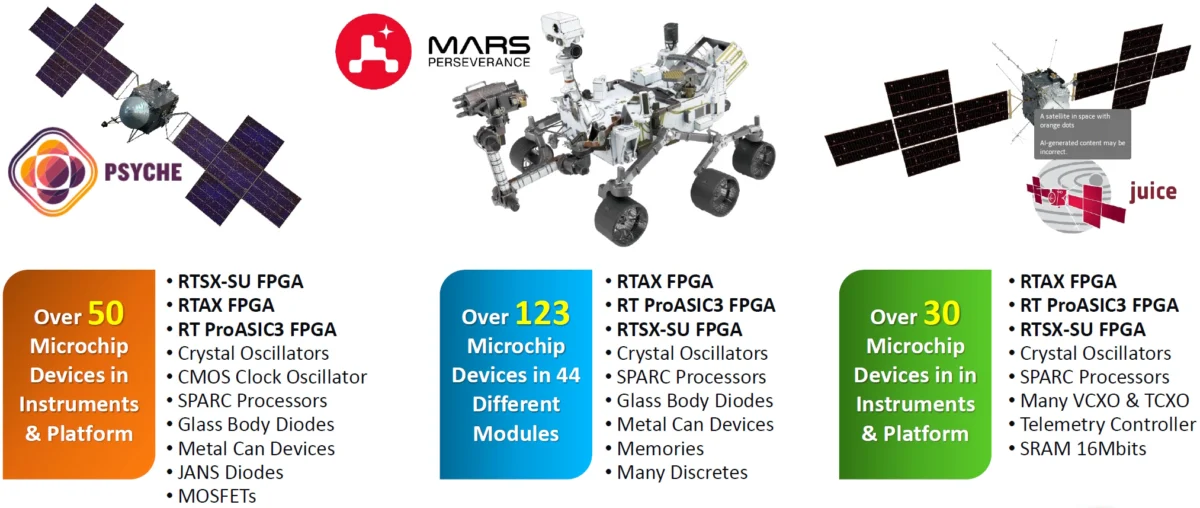
- NASA’s Psyche Mission: Navigating to a metal-rich asteroid, this mission relies on over 50 Microchip devices to manage complex orbital navigation and scientific data collection.
- Perseverance Rover: The Mars rover utilizes over 123 Microchip devices across 44 distinct modules, proving that these components can withstand not only the vacuum of space but also the extreme thermal cycling and radiation of the Martian surface.
- ESA’s JUICE Mission: The Jupiter Icy Moons Explorer utilizes more than 30 Microchip devices to manage its sophisticated suite of instrumentation as it explores the Jovian system.
These missions demonstrate that while the industry is changing, the requirement for absolute reliability remains the bedrock of space engineering.
The Edge-AI Imperative: Computing in the Void
As space platforms become more complex, the bottleneck has shifted from "getting there" to "what we do when we arrive." Modern satellites are no longer passive relay stations; they are active, intelligent nodes. They must perform real-time object tracking, debris avoidance, autonomous navigation, and high-resolution image processing.

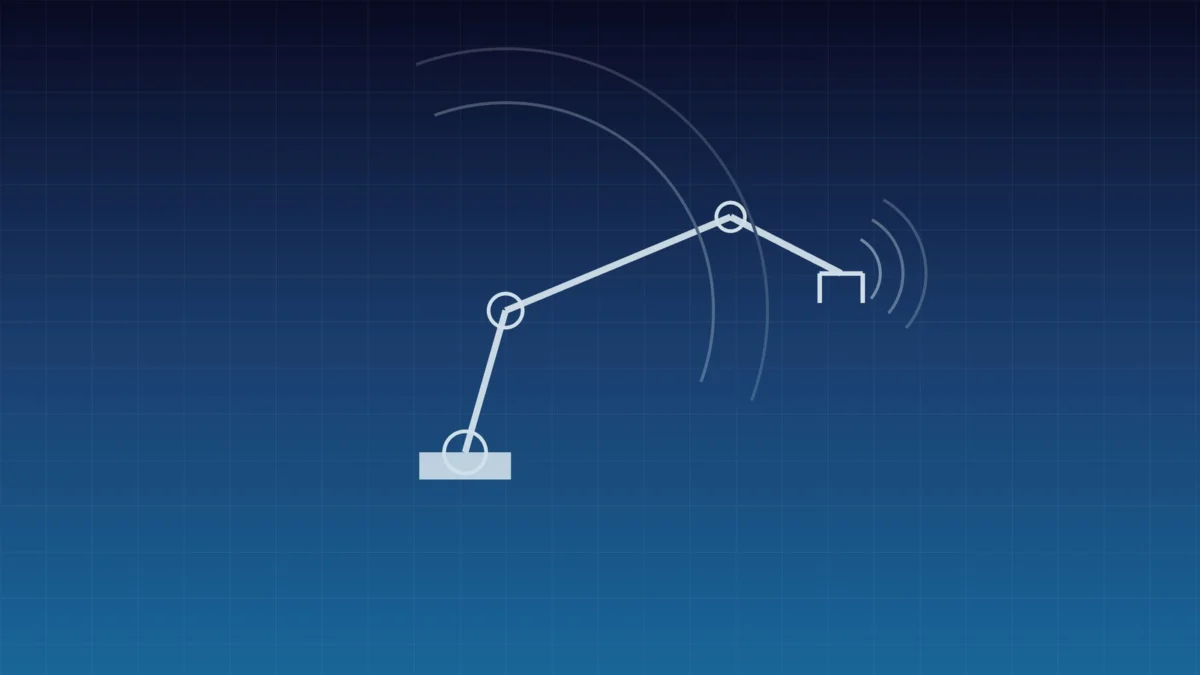
A major challenge in this evolution is the limitation of RF (Radio Frequency) downlinks. Transmitting massive volumes of raw sensor data back to Earth is slow, expensive, and often impractical. The solution is "Edge AI"—processing data locally on the spacecraft and transmitting only the synthesized conclusions.
However, as Morin points out, this leads to the classic engineering dilemma encapsulated by the acronym TANSTAAFL (There Ain’t No Such Thing As A Free Lunch). Increased computational capability requires more power, and more power generates more heat. In the vacuum of space, heat management is arguably the most difficult challenge. Without air for convection or fans for cooling, every watt of power used requires additional, heavy, and costly radiator surface area. Consequently, Microchip’s strategy centers on creating high-performance, low-power FPGAs that offer the necessary compute density without triggering a thermal meltdown.
Security, Supply Chains, and Orbital Contestation
Beyond performance, security has moved to the forefront of space architecture. In the past, security meant hardening against cosmic rays. Today, it means hardening against adversaries.
Supply-chain integrity is now a critical pillar of design assurance. Aerospace engineers require absolute certainty that no malicious backdoors or unauthorized hardware modifications exist in their components. As systems become more autonomous, the "trusted supply chain" becomes a national security imperative.

Furthermore, the physical environment is becoming increasingly precarious. The Kessler Syndrome—the theoretical scenario where orbital debris leads to a cascading series of collisions—is no longer a fringe concern but a primary driver for satellite design. As space becomes more crowded and contested, the ability of a satellite to autonomously maneuver and maintain its operational integrity is a life-or-death capability for the platform.
Implications: The Future of Space Infrastructure
Microchip’s strategy is a direct reflection of the changing nature of the industry. By maintaining a robust portfolio of radiation-hardened solutions for mission-critical control systems, while simultaneously pushing the boundaries of power-efficient, high-performance FPGA processing for AI, the company is bridging the gap between the "old space" of high-reliability, static missions and the "new space" of agile, intelligent, commercial constellations.
The era of the "unreachable" satellite is ending. As we look toward 2035, the infrastructure of our civilization is increasingly moving off-planet. For semiconductor providers, the challenge will be to keep pace with the exponential growth in demand for intelligence at the edge, all while operating within the unforgiving constraints of the orbital environment. As Tim Morin’s insights suggest, the winners in the next decade of the space economy will be those who can provide the necessary compute power to make space not just a destination, but a functional, efficient, and secure extension of the global digital economy.