
The pursuit of high-fidelity audio is often a quest for the perfect synergy between components. Recently, a notable technical discussion emerged within the DIY audio community, centered on a common audiophile dilemma: how to successfully integrate a custom-built vacuum tube preamplifier with a high-performance solid-state integrated amplifier—specifically the formidable Dussun V8i.
The challenge, initiated by an enthusiast seeking to replicate or improve upon the gain characteristics of the V8i’s internal preamp stage, highlights the complex interplay between tube topology, impedance matching, and the nuanced requirements of vintage-inspired signal chains.
The Core Challenge: Impedance and Gain Matching
At the heart of the discussion is the Dussun V8i, an integrated amplifier renowned for its robust power stage and sophisticated internal architecture. The user, identified as "mehdism," sought to design a standalone tube preamplifier that could seamlessly interface with the V8i’s power amplifier input.
The primary design goal was to match the voltage gain of the V8i’s built-in preamp section while ensuring that the output impedance would be low enough to drive the power amplifier stage without signal degradation. The user expressed a specific interest in utilizing the classic 6SN7 dual triode, a tube revered for its linearity and rich, musical harmonic profile.
However, moving from a solid-state preamp to a tube-based design introduces several engineering hurdles. Solid-state stages are typically characterized by extremely low output impedance and high current drive, whereas vacuum tube circuits, particularly those using voltage-gain-focused topologies like the 6SN7, often struggle to achieve similar drive capabilities without additional buffering stages, such as a cathode follower.
Chronology of the Technical Dialogue
The technical consultation unfolded on a prominent audio engineering forum, tracing a clear path from initial inquiry to expert intervention.

- June 23, 2026, 7:54 PM: The user opens the discussion, outlining the desire for a 6SN7-based preamplifier that mimics the gain profile of the Dussun V8i. The post explicitly asks about the feasibility of such a design while maintaining "good performance and compatibility" with the existing power stage.
- June 23, 2026, 8:01 PM: Veteran contributor "andyjevans" pivots the conversation. Rather than sticking strictly to the 6SN7, he proposes the use of the 2P29L, a Directly Heated Triode (DHT). He argues that its gain characteristics are better suited for the task and suggests a simple voltage stage, effectively arguing that a cathode follower is unnecessary given the 100k-ohm input impedance of the target amplifier.
- June 23, 2026, 8:30 PM: The original poster requests supporting documentation, including schematics and specific operating points for the 2P29L.
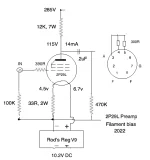
- June 23, 2026, 9:04 PM: "andyjevans" provides a schematic and guidance on filament bias, pointing the user toward specialized regulators from Lyrima.
- June 24, 2026, 6:52 AM: Expert contributor "artosalo" raises a critical clarifying question: whether the preamplifier should be inverting or non-inverting. This is a vital distinction for ensuring absolute phase integrity in the final audio signal.
- June 24, 2026, 7:36 AM: The user clarifies that inverting versus non-inverting is secondary to the primary requirements of gain and output impedance matching.
Supporting Data: Why the 2P29L?
The shift from the 6SN7 to the 2P29L represents a significant departure in design philosophy. To understand the implications of this shift, one must analyze the technical specifications of both tubes.
The 6SN7: The Traditional Choice
The 6SN7 is a "workhorse" dual triode. It features a moderate gain (mu) of approximately 20. It is widely used because it is readily available and produces a very pleasing, balanced sound. However, in a standard common-cathode configuration, its output impedance is relatively high, which can lead to roll-off in the high frequencies if the cable capacitance or the following stage’s input impedance is not optimal.
The 2P29L: The Modern Alternative
The 2P29L is a Directly Heated Triode that has gained a cult following in the DIY community. As noted by the experts in the thread, it offers a gain of approximately 10. While lower than the 6SN7, this gain is often sufficient for modern digital sources, which output higher voltages than legacy phono stages.
Crucially, the 2P29L’s performance is bolstered by the use of "filament bias." Unlike cathode bias, which uses a resistor and capacitor at the cathode, filament bias uses the filament circuit itself to set the operating point. This results in a cleaner, more transparent signal path. As "andyjevans" pointed out, because the filament requires only 100mA, it is highly manageable with modern, high-precision regulators.
Implications for System Synergy
The integration of a custom tube preamp into a solid-state system like the Dussun V8i creates a "hybrid" sound signature. This is a common goal for audiophiles who enjoy the dynamic power of solid-state amplification but crave the "air" and harmonic richness of tubes.
The Role of Impedance
The Dussun V8i’s power amplifier section is designed to accept signals from a wide range of sources. By targeting a design that works well into a 100k-ohm load, the DIYer ensures that the preamp will not struggle to maintain signal voltage. However, the designer must remain vigilant about the "Miller effect"—a phenomenon where input capacitance is multiplied by gain—which can affect high-frequency response. A well-designed 2P29L stage with a low-impedance power supply will mitigate these risks.

Phase Integrity
The inquiry from "artosalo" regarding phase inversion is perhaps the most overlooked aspect of DIY preamplifier design. Many tube topologies are inherently inverting. If the preamplifier flips the phase of the signal, the soundstage can collapse or appear "hollow" to the listener. While the user indicated that inverting/non-inverting was not a primary concern, any serious designer must ensure that the output signal is correctly phased with the input signal to maintain the intended stereo image.
Expert Consensus: Is it Feasible?
The consensus among the forum participants is that designing a tube preamplifier for the Dussun V8i is not only feasible but highly achievable. The move away from the 6SN7 toward the 2P29L suggests a transition from "classic" design to "high-performance" design.
By utilizing a DHT like the 2P29L, the builder avoids the necessity of a complex cathode follower stage, which would otherwise add extra components to the signal path. A simpler, "pure" signal path is generally preferred in high-end audio, as it reduces the potential for phase distortion and non-linearities.
Recommendations for Implementation:
- Filament Regulation: The use of high-quality regulators (such as those from Rod Coleman/Lyrima) is essential. Because the 2P29L is a DHT, any noise in the filament supply will be directly injected into the audio signal.
- Operating Points: Careful selection of B+ and anode resistor values is necessary to keep the tube in its most linear operating region.
- Input/Output Buffering: While a cathode follower is not strictly necessary for a 100k-ohm input, using a high-quality output coupling capacitor is vital to protect the Dussun V8i from DC leakage.
Future Outlook
The technical exchange highlights a recurring trend in the audiophile world: the desire for "custom-tailored" sound. While mass-market integrated amplifiers like the Dussun V8i provide excellent value and performance, they represent a "one size fits all" approach.
For the enthusiast, the journey of building a preamplifier is as much about the process as it is about the sound. By engaging with experts and rigorously debating the merits of different tubes and topologies, users like "mehdism" are pushing the boundaries of what is possible in their home audio systems. The transition from the 6SN7 to the 2P29L is a testament to the fact that, in the world of high-end audio, sometimes less is indeed more—provided that the engineering is sound and the implementation is precise.
As the project progresses, the community will likely see further developments regarding the power supply design and the chassis construction, both of which will play a final role in the performance of this bespoke preamplifier. For now, the blueprint has been established: a DHT-based design, optimized for a high-impedance load, prioritizing signal purity and musicality over the brute-force gain of more conventional tubes.


