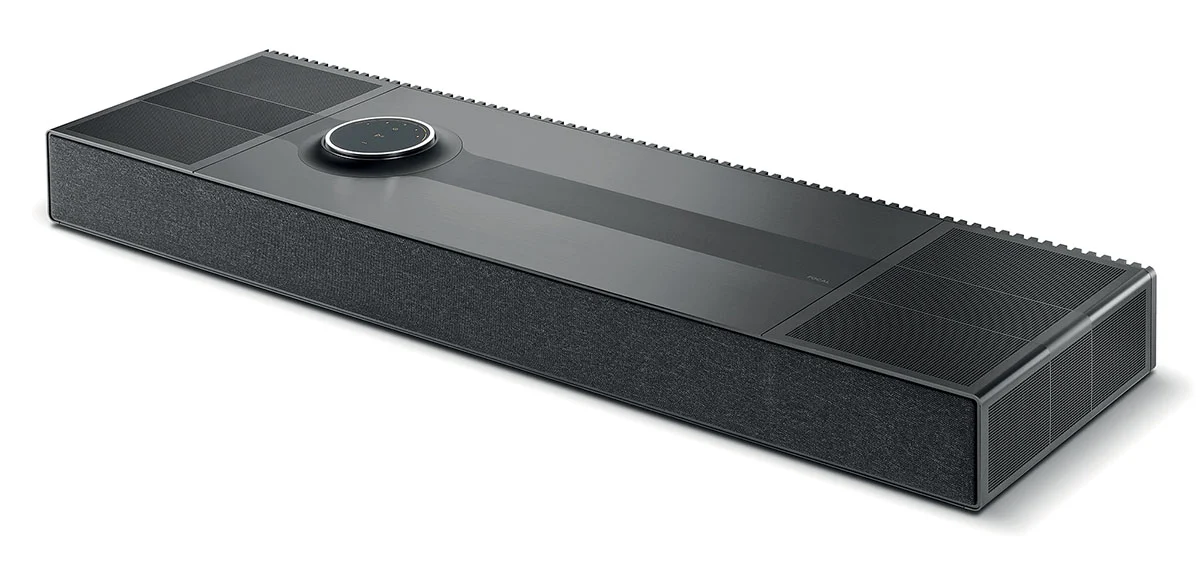
The landscape of high-fidelity home audio has long been defined by a fundamental trade-off: the pursuit of uncompromising sound quality usually required a labyrinthine collection of bulky amplifiers, tangled cabling, and multi-speaker arrays. Focal, the French audio powerhouse, has sought to shatter this paradigm with the announcement of the Mu-so Hekla—a singular, all-in-one sound system that promises to bring cinematic immersion and audiophile-grade musicality into the living room without the clutter of a traditional theater setup.
By merging Focal’s acoustic engineering prowess with Naim’s legendary electronics, the Hekla represents more than just a new product; it is a manifesto for the future of domestic entertainment.
Main Facts: A Convergence of Engineering Excellence
The Focal Mu-so Hekla is a tour de force of industrial design and acoustic engineering. At its core, the system utilizes a staggering 15 individual drivers, meticulously arranged within a single, elegantly finished chassis to provide a comprehensive soundstage.
The system’s primary strength lies in its "one-box" philosophy. Rather than requiring external receivers or discrete channel amplification, the Hekla houses sophisticated Naim electronics, engineered to provide clean, high-current power to all 15 drivers simultaneously. This integration ensures that the digital-to-analog conversion and amplification paths are perfectly matched to the transducers, eliminating the impedance mismatches that often plague custom-built component systems.
Key technical specifications include:
- Driver Array: 15 custom-engineered speakers optimized for 3D spatial audio.
- Acoustic Calibration: Proprietary ADAPT room correction software.
- Connectivity: HDMI eARC, Wi-Fi, Bluetooth, Chromecast, and AirPlay 2.
- Frequency Response: Bass extension down to 30 Hz, supported by a high-velocity bass port.
- Streaming Integration: Native support for Qobuz, Tidal, and Spotify.
The aesthetic profile of the Hekla reflects Focal’s commitment to premium materials. With metal-finished surfaces and the iconic, glowing Naim volume dial crowning the top, the unit acts as a centerpiece, designed to sit atop a credenza or media console rather than being hidden behind a rack of gear.
Chronology: The Evolution of the Focal-Naim Synergy
To understand the significance of the Mu-so Hekla, one must look back at the historical trajectory of both brands. Focal, established in 1979 in Saint-Étienne, France, spent decades refining speaker technology, particularly through their signature inverted-dome tweeters and high-excursion woofers. Naim Audio, meanwhile, earned its reputation in the British high-end hi-fi scene by focusing on the "PRaT" (Pace, Rhythm, and Timing) factor in amplifier design.
When the two companies formed a strategic partnership, the industry anticipated a shift in lifestyle audio. The initial results were promising—specifically, the Diva Utopia wireless speakers demonstrated that high-end performance did not strictly require tethered components. However, those early forays were often niche or priced beyond the reach of the average enthusiast.
The Mu-so Hekla represents the maturation of this partnership. It is the culmination of years of R&D focused on digital signal processing (DSP) and miniaturization. While the earlier Mu-so iterations brought the Focal-Naim sound to a broader market, the Hekla is the first to directly challenge the "home theater in a box" segment, moving from mere convenience to genuine audiophile performance.
Supporting Data: The Science of ADAPTive Sound
The most compelling feature of the Mu-so Hekla is the ADAPT acoustic calibration system. In traditional systems, room acoustics are the "final frontier" of audio quality; standing waves, reflections, and uneven surfaces can turn a $20,000 system into a muddy mess.
The Hekla’s ADAPT system changes this by leveraging the processing power of the user’s smartphone—in this case, utilizing the advanced sensor arrays found in modern devices like the iPhone 17. The setup process involves a systematic sweep that measures the room’s physical dimensions and the system’s placement within that space across seven distinct parameters.

Once the data is captured, the Hekla’s onboard DSP applies a complex mathematical filter to the signal. This creates what Focal calls "Sphere" playback modes—a series of 3D sound profiles that manipulate the 15-driver array to bounce sound off walls and ceilings. This virtualizes a surround-sound environment that effectively mimics a traditional 5.1.2 or 7.1.4 setup. For users seeking even more visceral low-end performance, the system includes a dedicated RCA subwoofer output, allowing for the integration of a standalone sub, though the internal 30 Hz extension is sufficient for the vast majority of media.
Official Responses and Industry Reception
Early testers have been quick to note the dramatic shift in setup time. Where a traditional theater system might take a full weekend of positioning speakers, running wires through walls, and balancing channel levels, the Hekla requires only a power connection and a single HDMI cable to the display.
"The Hekla arrived on my doorstep in an impressively large box, but inside is just one large component and a power cord," noted an early reviewer. "I set it up on a table in my theater and had sound within minutes."
Industry analysts point to the Hekla as a direct response to the "minimalist luxury" trend. As urban living spaces shrink and the appetite for high-fidelity audio grows, consumers are no longer willing to sacrifice square footage for the sake of an immersive experience. Focal’s decision to include high-resolution streaming services like Qobuz directly in the hardware, rather than relying on phone-based streaming alone, shows a commitment to the "purist" demographic who value high-bitrate playback.
Implications: The Death of the Component Rack?
The arrival of the Focal Mu-so Hekla poses a profound question for the audio industry: is the traditional component rack becoming obsolete?
For decades, the "separate" philosophy—a dedicated preamp, a dedicated power amp, and a dedicated processor—has been the gold standard. However, the Hekla proves that with modern DSP and high-density amplification, those lines are blurring. By bringing professional-grade room correction into a consumer-friendly package, Focal is effectively lowering the barrier to entry for high-end audio.
The Shift in Consumer Behavior
Consumers today prioritize "ecosystem" over "individuality." The ability to control the entire Hekla experience via a single application, while simultaneously accessing global music libraries, aligns with the expectations of a modern, tech-savvy user. The implications are clear: the future of high-end audio is not just about the quality of the speaker, but the intelligence of the software driving it.
Impact on Competitive Pricing
By packaging 15 drivers, Naim electronics, and high-end room correction into one unit, the Hekla competes not just with soundbars, but with entry-to-mid-level high-end systems. If the Hekla succeeds in convincing the market that a single chassis can provide a convincing 3D sphere of sound, competitors in the high-end space—such as Bang & Olufsen or Bowers & Wilkins—will likely need to pivot their strategies toward similarly integrated, AI-driven acoustic solutions.
The Future of "Lifestyle" Hi-Fi
The Mu-so Hekla is not merely a piece of furniture that produces sound; it is a sophisticated computer that happens to be an audiophile instrument. As we move forward, the "lifestyle" category of audio will likely see increased reliance on machine learning for room correction. The Hekla’s ability to measure a room and adjust its output in real-time is the logical successor to manual EQ settings.
In conclusion, the Focal Mu-so Hekla stands as a beacon for the modern listener. It acknowledges the complexity of contemporary media—where a user might switch from a 4K Atmos film to a high-resolution jazz album in seconds—and provides a unified, elegant, and uncompromising solution. Whether this marks the end of the traditional component rack remains to be seen, but for those who demand excellence without the excess, the Hekla has effectively set the new industry benchmark.