In the world of high-fidelity recording, the capture of a symphonic ensemble is widely considered the "gold standard" of technical achievement. Legends of the industry—such as Jack Renner of Telarc Records and Marc Aubort of Nonesuch Records—have long championed the spaced-omnidirectional microphone technique as the premier method for achieving a lush, expansive sound. For the recording engineer, selecting a stereo configuration is not merely a logistical choice; it is a fundamental decision that dictates the sonic "perspective" of the final product.
This article explores the mechanics, advantages, and limitations of the primary stereo miking techniques, providing a roadmap for engineers seeking to master the art of spatial audio.
Main Facts: The Physics of Spatial Perception
At its core, stereo recording is the art of translating a three-dimensional soundstage onto a two-dimensional playback system. To achieve this, engineers rely on the human auditory system’s ability to decode spatial information through three primary mechanisms: time differences, level differences, and spectral (frequency) differences.

- Time Differences: When a sound source is off-center, it reaches the ear closer to the source before the farther ear. In stereo recording, spacing microphones apart creates a time-of-arrival difference that the brain interprets as directional data.
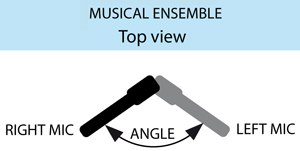
- Level Differences: If a microphone is directional (such as a cardioid), it is more sensitive to sound arriving on-axis. By angling two directional microphones, the engineer creates a situation where an off-center source is louder in one channel than the other.
- Spectral Differences: Obstructions, such as the human head or a physical baffle, create a "shadow" for high frequencies. This mimics how our ears perceive sound, providing critical cues for localization.
Chronology and Evolution of Stereo Techniques
The evolution of stereo miking can be traced back to the early days of broadcasting and the subsequent rise of high-fidelity classical recording. As recording technology moved from monaural to stereophonic, engineers experimented with various geometric configurations to overcome the limitations of the "phantom center."
The Spaced Pair (AB Technique)
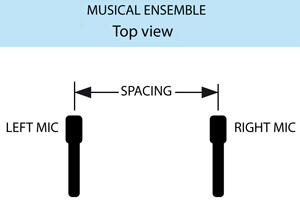
Historically the most favored for orchestral recording, the spaced pair involves placing two identical microphones—usually omnidirectional—a few feet apart. By adjusting the distance between these mics, engineers can manipulate the "stereo spread."
- Small spacing (2–3 feet): Provides a natural, coherent image.
- Wide spacing (10+ feet): Often results in the "ping-pong" effect, where instruments are unnaturally pulled to the far left or right speakers, leaving a hole in the middle.
The Coincident Pair (XY Technique)
Emerging as a response to the phase issues inherent in spaced miking, the coincident technique involves mounting two directional capsules with their grilles touching and diaphragms vertically aligned. By angling these mics, the engineer relies almost exclusively on level differences. Because the capsules are in the same physical space, they are inherently phase-coherent, making them exceptionally "mono-compatible"—a critical factor for television and radio broadcast.
The Rise of Near-Coincident and Baffled Techniques
As engineers sought to bridge the gap between the "warmth" of spaced pairs and the "sharpness" of coincident pairs, the near-coincident method was born. Systems such as the French O.R.T.F. (110-degree angle, 17cm spacing) became industry standards for their ability to balance spatial envelopment with precise image localization.
Supporting Data: Comparative Technical Analysis
To understand the trade-offs, one must examine the correlation between physical placement and the resulting signal. A correlation meter serves as an essential tool for the modern engineer.
- Spaced Pairs: Often show near-zero correlation on a meter, indicating that the two channels are "incoherent." While this sounds technically flawed, this lack of phase correlation is precisely what creates the "diffuse" and "spacious" sense of a concert hall.
- Coincident/XY: Typically show high correlation. The result is a pinpoint, sharp image that is highly stable but can occasionally feel "dry" or lacking in the ambient depth provided by time-delay techniques.
- Low-Frequency Response: A critical, often overlooked factor is the microphone polar pattern. Omni-directional condenser microphones typically offer a flat response down to 20 Hz, whereas small-diaphragm cardioids often begin to roll off around 100 Hz. For an ensemble requiring deep, orchestral power, the omni-based spaced pair remains difficult to beat.
The Mid-Side (MS) Advantage
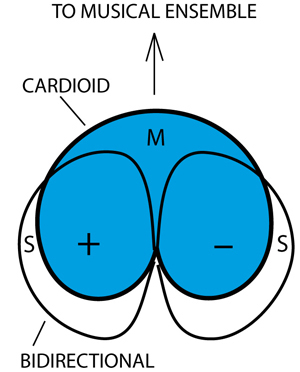
The MS technique, a specialized form of coincident recording, uses one cardioid mic (mid) and one bidirectional mic (side). Through a matrix circuit or software, the engineer can adjust the ratio of mid-to-side signals to widen or narrow the stereo image after the recording has taken place. This flexibility is invaluable in live concert environments where the engineer cannot physically move the mics once the performance has begun.
Official Perspectives and Professional Insights
Recording engineers like Jack Renner have long emphasized that "naturalism" is the primary goal of symphonic recording. In a direct comparison between techniques, the spaced-omni method often wins in terms of "envelopment"—the feeling that the listener is sitting in the middle of the concert hall rather than listening from a seat in the audience.
However, the choice depends on the room. In a venue with poor acoustics, the diffuse nature of a spaced pair can result in a "muddy" or indistinct recording. In such scenarios, the sharp, focused localization of a near-coincident array (like the N.O.S. or D.I.N. systems) is often preferred to cut through the room’s unwanted reflections.
The Binaural Frontier
At the extreme end of "baffled" recording lies the binaural technique, utilizing an artificial head with microphones placed in the ear canals. While primarily intended for headphone listening, this method provides the most realistic spatial recreation currently available. It accounts for the way the human pinna (outer ear) filters sound, allowing for incredible depth and verticality in the sonic image.
Implications for Modern Production
The modern engineer must weigh the "correctness" of the image against the "pleasantness" of the sound. If the final product is destined for a streaming platform where it might be collapsed into mono, the coincident or MS methods offer a safety net against phase cancellation. If the project is a high-resolution classical release meant for critical home listening, the spaced-omni technique remains the gold standard for its sheer, visceral realism.
Summary of Technique Characteristics
| Technique | Primary Factor | Localization | Mono Compatibility |
|---|---|---|---|
| Coincident | Level | Sharp | Excellent |
| Spaced | Time | Diffuse | Poor |
| Near-Coincident | Level + Time | Accurate | Fair |
| Baffled Omni | Level + Time + Spectral | Precise | Fair |
Ultimately, the best approach is informed experimentation. The O.R.T.F. system remains a favorite for its balance, while the spaced-omni pair continues to hold the crown for capturing the "air" and scale of large orchestral ensembles. By understanding how these techniques manipulate time and phase, the engineer transforms from a mere technician into a curator of the listener’s acoustic experience.
Whether you prioritize the razor-sharp imaging of a Blumlein array or the warm, enveloping embrace of a spaced-omni pair, the physics of your microphone placement remains the most vital tool in your creative arsenal. As digital tools continue to advance, the ability to control the stereo soundstage remains a foundational skill that defines the difference between a recording that is heard and one that is felt.