
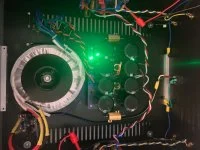
In the world of high-end DIY audio, where enthusiasts strive for the perfect signal-to-noise ratio and sonic purity, one adversary remains notoriously difficult to defeat: transformer mechanical hum. A recent inquiry on the DIYAudio community forum has sparked a deep-dive investigation into why high-quality components, specifically Antek toroidal transformers, may produce audible buzzing in custom-built amplifiers.
For the audiophile, a silent background is not merely a preference—it is a requirement. When a component that is supposed to be the "heart" of the power supply begins to audibly vibrate, the integrity of the listening experience is compromised. This article examines the ongoing struggle of a builder attempting to silence a power supply for a class-A amplifier, shedding light on the complex interplay between mains quality, load dynamics, and transformer physics.

The Core Issue: When Silence Isn’t Silent
The incident began when user "Matt_Green" reported a persistent, annoying buzz emanating from an Antek 4220 toroidal transformer integrated into an Aleph J-ZM amplifier build. Despite using a robust power supply design—incorporating a CRCRC filter with 22,000µF capacitors and a dedicated DC blocker—the transformer exhibited a mechanical vibration audible from several feet away.
The primary frustration for the builder lies in the paradox of the setup: every precaution to ensure "clean" power had been taken. The system was isolated from the mains via an isolation transformer and a DC blocker. Yet, the hum persisted. As the discussion evolved, it became clear that this was not a localized anomaly but a multi-faceted engineering puzzle involving electrical, mechanical, and systemic variables.

Chronology of the Investigation
The troubleshooting process unfolded over several days of intense debate among seasoned audio engineers and hobbyists:
- Initial Discovery: Matt_Green identifies a buzzing sound from the Antek transformer. He attempts to isolate the noise, noting it is audible even with professional-grade filtering.
- Audio Verification: After initial confusion regarding link sharing, audio evidence is provided, confirming that the noise is a mechanical vibration—a "buzz" rather than an electrical ground loop hum through the speakers.
- Systemic Analysis: The builder details the configuration: an Aleph J-ZM amplifier, Antek 4220 (400VA) transformer, and a low-resistance CRCRC filter.
- Expert Intervention: Community members suggest potential causes, ranging from DC bias on the AC line and harmonic distortion in the grid to core saturation and mechanical loose laminations.
- The "Dual-Channel" Revelation: The turning point in the investigation occurs when the builder notes that the system is silent when powering only one channel but begins to buzz immediately upon connecting the second channel.
- Debate on Specifications: The discussion shifts toward whether the 400VA rating of the transformer is being pushed to its physical limit by the high-current demands of the Class-A amplifier.
Supporting Data: The Physics of the Buzz
To understand why the Antek transformer hums, one must look at the technical specifications and the physical environment of the build.

1. DC Offset and Mains Quality
Mark Tillotson, a frequent contributor to the discussion, highlighted that mains quality is rarely "clean." Modern households are saturated with Switched-Mode Power Supplies (SMPS) from LED lights, computers, and appliances. These devices inject high-frequency noise and harmonics back into the AC line. If the incoming AC waveform is distorted or contains a DC offset, the toroidal core of the transformer can be pushed into asymmetrical magnetization. Once the core enters this non-linear region, it loses efficiency and produces the characteristic "mechanical buzz."
2. Core Saturation
A transformer’s core is designed to operate within a specific magnetic flux density. If the voltage is too high, or if the load draws too much current, the core reaches saturation. Once saturated, the transformer can no longer effectively transfer energy, leading to increased heat and significant mechanical stress on the windings and laminations. The observation that the buzz occurs only when both channels are loaded suggests the transformer is likely operating near the "knee" of its saturation curve.

3. Mechanical Construction
While Antek transformers are generally regarded as high-quality, every transformer is a mechanical assembly. "OrchardAudio" pointed out that if the windings are not tightly secured or if the laminations are not properly varnished, they can vibrate at the frequency of the power line (50Hz or 60Hz) or its harmonics. This mechanical looseness turns the transformer into a speaker, broadcasting the vibration throughout the chassis.
The "Dual-Channel" Implications
The most revealing piece of data is the silence during single-channel operation versus the buzz during stereo operation. This implies that the transformer is capable of delivering the required current for a single channel without hitting the saturation limit. However, the total current draw of two channels in a Class-A configuration may be exceeding the "sweet spot" of the 400VA rating.

In Class-A amplification, the power draw is constant, regardless of the music volume. If the bias is set too high, the transformer is under a constant, heavy load. If that load is just slightly above what the transformer can handle without inducing core saturation, the result is exactly what the user is experiencing: a transition from silence to noise as the load increases.
Recommended Remedies and Expert Insights
The community consensus suggests a systematic approach to diagnosing and fixing the issue:

- Verify Bias Settings: Before replacing hardware, the builder must ensure the amplifier’s idle bias is correct. If the bias is set higher than the design requirements, it will create unnecessary load, pushing the transformer to its limit.
- Test with an External Resistor: As suggested by user "ron68," inserting a 22-to-47 ohm, 10-watt resistor in series with the mains (for testing purposes only) can help determine if the transformer is saturating. If the buzz decreases, it confirms that the transformer is struggling with the voltage or current demands.
- Check for DC Blocking: While the user claims to use a DC blocker, its efficacy must be verified. A true DC blocker uses high-value electrolytic capacitors to stop any DC component from reaching the transformer primary. If the blocking circuit is under-specified for the current draw of the amplifier, it will not function as intended.
- Mechanical Dampening: If the electrical side is confirmed as sound, the transformer itself may need physical isolation. Mounting the transformer on a thick rubber gasket or a "soft-start" mounting plate can help decouple the vibration from the chassis.
Conclusion: The Path Forward
The quest for a silent amplifier is a rite of passage for many in the DIY community. The "buzz" in Matt_Green’s build serves as a valuable case study in how power supply design is not merely about choosing the right VA rating, but about understanding the holistic relationship between the utility grid, the transformer’s core, and the power requirements of the amplifier circuit.
While the temptation to blame the component manufacturer is high, the evidence suggests that the solution likely lies in optimizing the load or further refining the AC conditioning. As the community continues to support the builder, the goal remains clear: to eliminate the mechanical noise without sacrificing the sonic performance of the Aleph J-ZM.

For the builder, the next steps are clear: measure the idle current draw of the dual-channel configuration, verify the DC blocker’s performance under load, and consider whether a higher VA-rated transformer or a more aggressive decoupling strategy is required to achieve the elusive silence of a truly high-fidelity power supply.


