The global race to decarbonize the energy grid is no longer just a policy challenge; it has become a monumental industrial logistics puzzle. As countries scramble to deploy solar arrays and battery storage systems to mitigate the existential threat of climate change, they have hit a hard, physical ceiling: a profound labor shortage. In the high-stakes world of utility-scale construction, there simply aren’t enough hands to meet the exponential demand for installation.
Enter Gritt, a robotics startup emerging from stealth with a $26 million Series A round, armed with a bold vision to solve the construction industry’s labor crisis through the marriage of off-the-shelf industrial hardware and cutting-edge artificial intelligence.
The Core Mission: Scaling Civilization’s Infrastructure
Founded by Carnegie Mellon-trained roboticists Puneet Puri and Vishal Dugar, Gritt is positioning itself as the "intelligence layer" for the construction site. The startup has secured a total of $34 million in funding—including backing from Obvious Ventures, Union Square Ventures, and Active Impact Investment—to tackle the "dirty, dull, and dangerous" tasks that define the solar boom.
"Our thesis is that if we truly want to speed up construction, you need an intelligence that can work in the outdoor, chaotic environments of these construction sites," says CEO Puneet Puri. "It has to be generalizable enough that it can work in these varied environments."
Unlike the controlled, sterile environment of an automotive assembly line, a construction site is dynamic, unpredictable, and harsh. Historically, industrial robots have struggled to navigate such unstructured spaces. Gritt’s breakthrough is not in inventing new, expensive robot bodies, but in developing the software "brain" that allows existing machinery to handle complex, real-world tasks with superhuman efficiency.
Chronology of a Startup: From Stealth to Scale
The trajectory of Gritt reflects the rapid evolution of the AI sector. The founders spent their early development phases in stealth, perfecting their machine vision and manipulation models. Their strategy eschews the "build everything from scratch" mentality that has plagued previous robotics ventures, opting instead to leverage reliable, off-the-shelf hardware.
- Seed Stage: Backed by First Round Capital, Climactic, Congruent Ventures, and VSC Ventures, the company focused on proving that AI models could manage the physical manipulation of heavy solar infrastructure.
- The Pivot to Deployment: Gritt began field-testing its systems, utilizing rented skidders and robotic arms from industry stalwarts like Kawasaki.
- Series A Milestone: With $26 million in fresh capital led by Obvious Ventures, the company is transitioning from pilot projects to large-scale deployment.
- The Future Roadmap: Within the next 18 months, Gritt is contracted to assist in the installation of 2.8 gigawatts of solar power, with plans to scale their active fleet to 48 units in the next half-year.
Data-Driven Efficiency: Quantifying the Impact
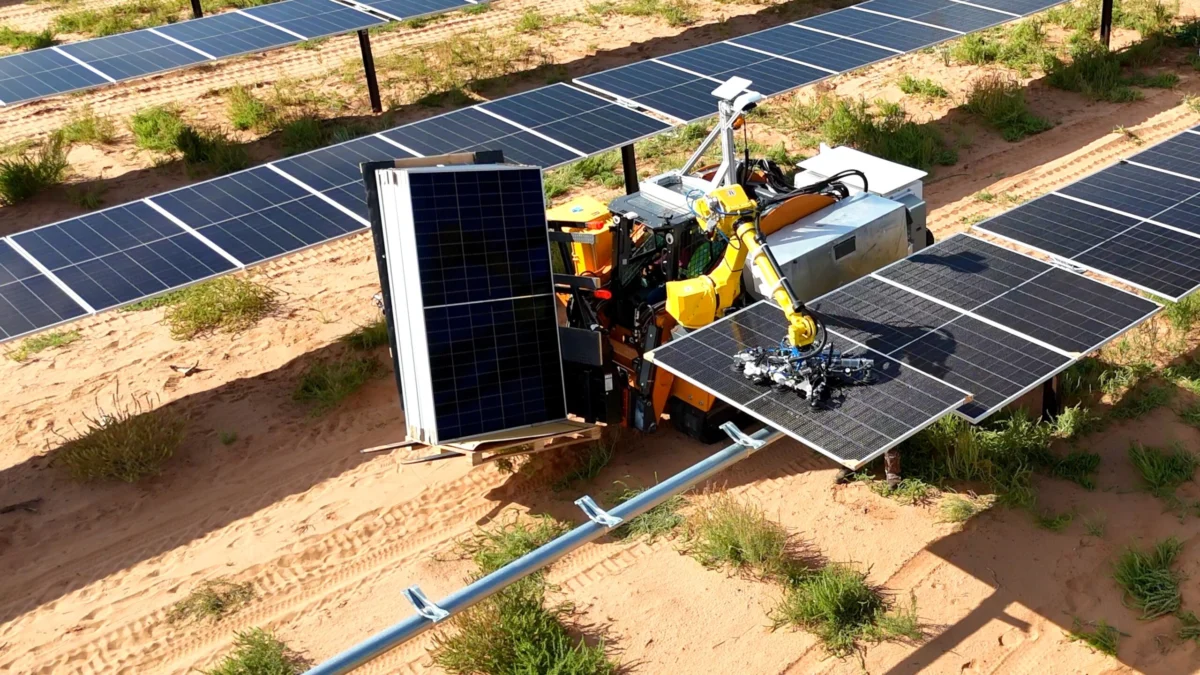
The metrics behind Gritt’s performance are compelling. In a traditional setting, a manual crew of eight workers is generally expected to install roughly 800 solar panels in a single workday. When augmented by Gritt’s robotic systems, that same crew’s productivity skyrockets, hitting between 3,000 and 4,000 panels daily.
This four-to-five-fold increase in output is driven by the system’s ability to handle the "heavy lifting"—literally. The robots are currently tasked with unloading massive glass solar panels, maneuvering them into position, and placing them on metal mounting frames with sub-millimeter precision. This allows human workers to pivot from exhausting, repetitive labor to higher-value tasks, such as final fastening and quality control.
Official Responses and Industry Reception
The industry’s response to Gritt’s technology has been characterized by cautious optimism and rapid adoption. Three of the top 10 power construction companies in the United States have already signed on as customers.
Andrew Beebe, a partner at Obvious Ventures who led the Series A round, highlights the specific qualities of the founding team that set them apart from traditional robotics engineers. "There are people who used to build rockets that went into space and had infinite budget for the smallest little part, and then there are people who know what it means to get into dirty, dull, and dangerous jobs and scale them like mad," Beebe noted. "These guys are in the second camp."
For the customers, the benefits extend beyond pure speed. One anonymous industry leader reported that the technology is a game-changer for remote worksites where labor recruitment is notoriously difficult. Beyond the economic benefits, there is a clear safety dividend: by automating the process of lifting 100-pound panels, the system drastically reduces the risk of musculoskeletal injuries and onsite accidents.
The Competitive Landscape: Hardware vs. Intelligence
Gritt enters a crowded field. Startups like Luminous Robotics, Cosmic, and China’s Trinabot are also racing to automate solar installation. However, the core differentiator for Gritt is its "asset-light" approach. While competitors often develop proprietary hardware—a process that is capital-intensive and slow to scale—Gritt focuses on the AI software layer.
This strategy allows Gritt to remain flexible. If a newer, better robotic arm hits the market, Gritt’s software can theoretically be adapted to it. This modularity could prove decisive in a market that demands rapid, low-cost scaling.
Implications for the Future of Work and Construction
The success of Gritt serves as a bellwether for the "Physical AI" revolution. The founders believe the current generation of AI models has finally bridged the gap between theoretical robotics and practical, real-world utility.
"Making a system for one solution was still possible to some extent five years ago," Puri says, noting that the shift today is toward generalizability. As evidence, he points to the speed at which the system learns new tasks: while teaching a robot to stack cinder blocks previously took weeks, the current AI pipeline allowed the team to train the system for rebar-tying in just a single day.
Beyond Installation: The "Site Manager" of the Future
Gritt’s long-term vision is to move beyond mere assembly. The company views its robots as mobile, intelligent sensors that can provide a comprehensive view of the entire construction site.
The founders envision a future where the system:
- Predicts Site Hazards: Recognizing an open trench before a predicted storm and alerting workers to cover it, preventing structural damage.
- Logistics Management: Automatically flagging missing inventory or misaligned materials.
- Structural Versatility: Evolving from panel installation to drilling posts, building racking systems, and performing delicate tasks like tying rebar.
As Gritt scales, it is effectively turning the construction site into a data-rich environment. By combining the dexterity of physical robotics with the foresight of AI, the startup is not just building solar farms; it is pioneering a new way to build physical infrastructure.
In the face of climate change, the ability to build faster, cheaper, and safer is not just a commercial opportunity—it is a necessity for the modern world. Gritt’s emergence from stealth marks a shift in how we approach the built environment, suggesting that the future of construction lies not in replacing human ingenuity, but in providing it with an intelligent, robotic exoskeleton. As the company expands its fleet and adds new capabilities, it may well become the backbone upon which the next generation of renewable energy infrastructure is built.