By Tech Policy Desk
October 8, 2026
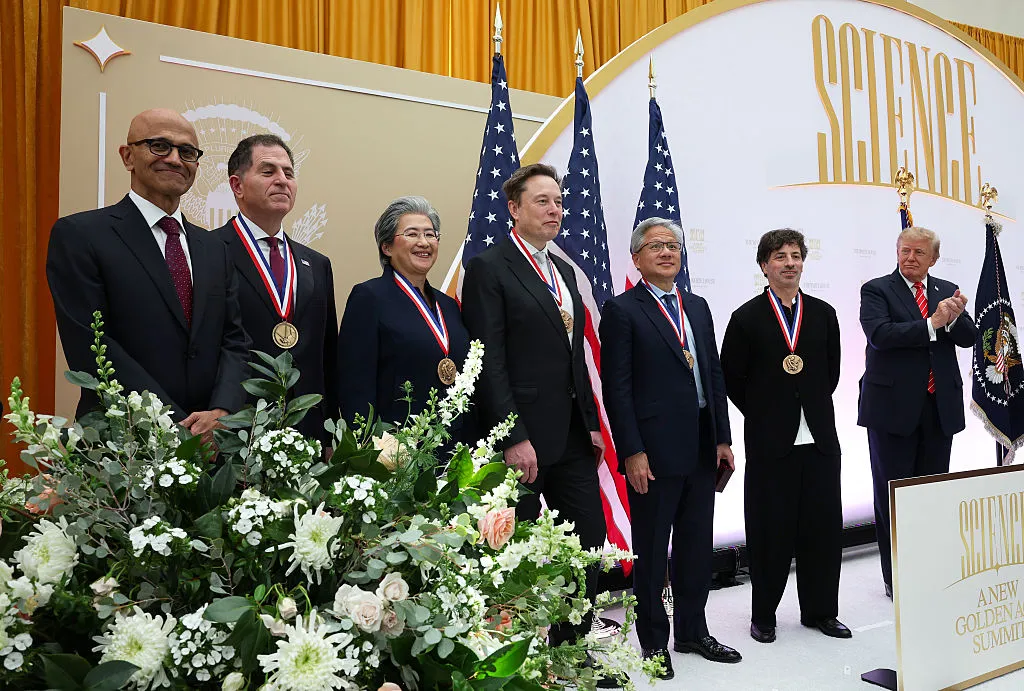
In a ceremony that underscored the increasingly blurred lines between American industrial leadership and political allegiance, President Donald Trump presided over the "Golden Age of American Innovation Summit" on Thursday. During the event, held at the White House, the President bestowed the nation’s highest honors for scientific and technological achievement upon a cohort of the world’s most prominent tech titans.
While the awards—the National Medal of Science and the National Medal of Technology and Innovation—are traditionally reserved for individuals who have made transformative contributions to human knowledge and economic progress, this year’s selection process has ignited a firestorm of debate. Critics and ethics watchdogs are pointing to a staggering convergence of data: the honorees and their corporate entities have collectively funneled nearly $6 billion into initiatives and funding vehicles aligned with the Trump administration.
The Honorees: A "Who’s Who" of Silicon Valley
The list of recipients represents the vanguard of the current technological era, spanning artificial intelligence, aerospace, and high-performance computing.
Receiving the National Medal of Science were:
- Elon Musk: Cited for his contributions to space exploration and electric vehicle infrastructure.
- Jensen Huang: Recognized for his foundational work in GPU architecture that powers the modern AI revolution.
- Sergey Brin: Honored for his pioneering role in search engine technology and the early development of modern internet infrastructure.
- Lisa Su (AMD): Awarded for her transformative leadership in the semiconductor industry and the advancement of high-performance computing chips.
Simultaneously, the National Medal of Technology and Innovation was presented to:
- Michael Dell (Dell Technologies): Recognized for his impact on global hardware supply chains and enterprise computing.
- Satya Nadella (Microsoft): Honored for steering Microsoft through a historic pivot toward cloud computing and generative AI integration.
During his address, President Trump lauded the recipients, stating that they had "pioneered an incredible future for America." He added, "Because of the work done by these individuals, we will always be on top. No one else can compete with us."
Chronology of a Controversial Recognition
The lead-up to the ceremony was marked by a flurry of administrative actions and financial disclosures that have now become central to the public discourse surrounding the awards.
Late 2025 – Early 2026: Throughout the preceding year, several of the selected executives and their respective companies engaged in significant philanthropic and political spending. Reports from The New Republic and Time highlight that these contributions were not merely standard corporate lobbying but were specifically tied to administration-backed programs.
September 2026: Rumors of the upcoming summit began to circulate in Washington D.C., coinciding with intensified scrutiny regarding the "Trump Accounts," a signature administration program focused on long-term savings for American children. Michael and Susan Dell’s pledge of $6.25 billion to these accounts became the largest single private donation to a government-aligned project in recent history.
October 7, 2026: In a move that observers found deeply contradictory, the Department of Labor and the White House announced the indefinite suspension of Microsoft from the H-1B visa program. This program is essential for tech firms to recruit specialized foreign labor.
October 8, 2026: The summit took place. Despite the ongoing tension regarding the H-1B suspension, Satya Nadella appeared at the White House to accept his medal, standing alongside the President in an event that combined high-level policy theater with national recognition.

Supporting Data: The Cost of Recognition
The scale of the financial support provided by these honorees to the administration is unprecedented in the history of these prestigious awards. The nearly $6 billion figure cited by analysts is composed of various distinct streams of capital:
- Philanthropic Pledges: The $6.25 billion pledge from the Dells represents the most substantial anchor for the administration’s "Trump Accounts" initiative.
- Infrastructure Support: Alphabet (Google) and Microsoft were both instrumental in funding the renovation of the White House ballroom, as well as providing significant capital to the President’s inaugural transition funds.
- Political Action Committees (PACs): AMD, under the leadership of Dr. Lisa Su, was noted for its contributions to pro-Trump Super PACs, signaling a departure from the traditional political neutrality often maintained by semiconductor giants.
Critics argue that when the primary criteria for national honor align so perfectly with the primary donors to the executive branch’s pet projects, the integrity of the medal itself is compromised. "The National Medal of Science is supposed to be the Nobel Prize of America," says a professor of political science at Georgetown University. "When it becomes a trophy for donors, it risks losing its status as a measure of objective scientific merit."
Official Responses and Administrative Logic
The White House has defended the selections, characterizing the relationship between the donors and the administration as a "partnership for the future." Press Secretary briefings have emphasized that the medals are "thematic" to the administration’s goal of restoring American manufacturing and technological dominance.
Regarding the specific case of Satya Nadella and the Microsoft H-1B suspension, administration officials stated that the two events are "entirely separate tracks." According to a spokesperson, the H-1B suspension is part of a broader "America First" labor policy, while the medal recognition is a tribute to Microsoft’s contributions to domestic cloud security and AI sovereignty.
The honorees themselves have largely remained silent on the controversy. Most issued brief, pre-written statements of gratitude, focusing on the honor of being recognized by the country for their life’s work. Microsoft, in a brief statement following the ceremony, noted that it remains committed to "working with the administration to find a path forward for our global workforce," despite the current visa challenges.
Implications: The Future of Tech-Government Relations
The implications of these events are profound, suggesting a shift in how the U.S. government interacts with its largest tech companies.
1. The Politicization of Innovation
By tying national honors to financial contributions, the administration may be setting a precedent where scientific achievement is measured by one’s willingness to align with executive policy. This could deter future candidates from accepting such awards if they fear the political "stain" associated with the current administration.
2. Regulatory Leverage
The Microsoft H-1B situation provides a glimpse into a new form of "transactional governance." By suspending a key immigration benefit while simultaneously awarding the company’s CEO a high honor, the administration is effectively demonstrating its ability to exert pressure while maintaining the appearance of corporate partnership. This creates a volatile environment for CEOs who must balance shareholder interests with the need to remain in the administration’s good graces.
3. The Erosion of Institutional Credibility
The National Medal of Science and the National Medal of Technology and Innovation have historically enjoyed a high degree of bipartisan respect. As these awards are increasingly perceived as tools for political patronage, their value as a signal of excellence may diminish. If the scientific and engineering communities stop viewing these awards as authentic, the incentive for true "disruptive innovation" may be replaced by an incentive for "political alignment."
4. Market Consequences
Investors are watching closely. The fact that firms like AMD and Dell are so heavily intertwined with the current administration’s financial initiatives suggests that the regulatory landscape will remain highly favorable for these specific players, potentially creating a "crony-tech" ecosystem. This could lead to a two-tier market: firms that play the political game and enjoy preferential treatment, and those that remain independent but face increasing regulatory headwinds.
As the dust settles from the Golden Age of American Innovation Summit, one thing remains clear: the traditional separation between the pillars of American industry and the seat of government power has fundamentally changed. The 2026 ceremony will likely be remembered not just for the individuals who were honored, but for the complex, expensive, and deeply controversial web of influence that preceded their moment in the spotlight. Whether this "Golden Age" produces lasting scientific progress or merely serves as a historical case study in the power of influence remains a question for future historians to determine.