By the Headfonics Review Desk
Published following official evaluation guidelines.
Main Facts: The Rise of SIVGA’s Latest Avian Creation
SIVGA has officially expanded its audio product lineup with the introduction of the SIVGA Lyrebird, a $149 quadbrid in-ear monitor (IEM) that brings a complex multi-driver array to a fiercely contested price category. Following in the footsteps of the acclaimed Nightingale and Que UTG models—as well as their respective PRO iterations—the Lyrebird continues SIVGA’s thematic avian naming convention while breaking new ground in driver implementation at this price point.

The Lyrebird is built around a sophisticated quad-driver hybrid configuration housed inside aircraft-grade aluminum and stabilized wood shells. Each earpiece integrates:
- A Dynamic Driver (handling low-end frequencies)
- A Balanced Armature (BA) driver (managing the midrange)
- A Micro-Planar Driver (assisting the upper frequencies)
- A Multilayer Piezoelectric Ceramic Driver (delivering ultra-high-frequency extension)
Priced at $149.00, the Lyrebird enters an extremely crowded sub-$150 market segment currently populated by heavyweight contenders like the Hidizs MP145 PRO, the Juzear Fiesta, and the EarAcoustics SPA Hi-End. Despite the intense competition, SIVGA’s latest offering aims to stand out through a neutral-bright sound signature, high-end technical performance, and distinctive artisanal aesthetics.

Chronology and Market Launch
The journey of the SIVGA Lyrebird from concept to consumer release reflects the typical pacing of the portable audio industry, punctuated by major international audio expositions:
- Initial Debut: The Lyrebird made its very first public appearance at CanJam London 2026, where it drew attention from audiophiles and industry reviewers for its unusual driver architecture and lightweight metal-and-wood chassis.
- Official Launch: Following positive early impressions in London, SIVGA officially launched the IEM to the global market on July 15, 2026.
- Review Evaluation Period: Review units, including the sample evaluated by Headfonics, were subsequently dispatched to independent critics to assess real-world performance against established benchmarks in the $135–$149 tier, such as the SIMGOT SuperMix 4.
Supporting Data and Technical Specifications
To understand how the SIVGA Lyrebird achieves its acoustic profile, one must examine its hardware specifications, physical design, and accessory suite.

Specifications and Driver Allocation
On paper, the Lyrebird boasts consumer-friendly specifications designed to ensure high compatibility with portable sources:
- Impedance: 14 Ω (Low impedance)
- Sensitivity: 108 dB
- Cable: Approximately 1.2 meters, utilizing a 0.78mm 2-pin connection and terminating in a 4.4mm balanced plug.
- Cable Core Composition: A 50-core round interlaced hybrid design consisting of 30-core Furukawa OFC, 10-core silver-plated copper, and 10-core enamel gold-plated silver-copper.
Design, Ergonomics, and Aesthetics
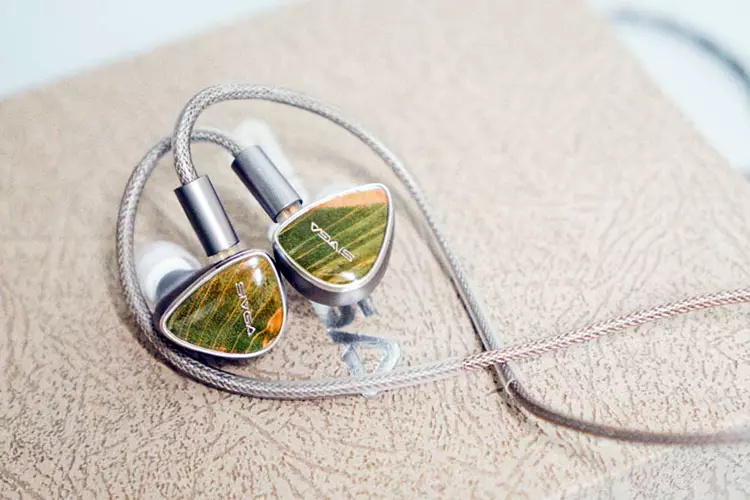
SIVGA has built a reputation for its mastery of stabilized wood faceplates, and the Lyrebird is no exception. Each unit features a unique grain pattern. While traditional woody brown tones are common, review units displayed a striking greenish birch-in-the-forest aesthetic.

The faceplates are capped with a metallic SIVGA logo and sealed under a smooth layer of clear resin. The main housing is carved from aircraft-grade aluminum, featuring strategic venting near the nozzle and sides to prevent driver flex and equalize internal pressure.
Despite packing four distinct driver types, the Lyrebird maintains a remarkably compact, ergonomic form factor. It easily outperforms many bulky planar or multi-driver IEMs in long-term wearability.

Accessories and Packaging
Unboxing the Lyrebird offers a sensory experience, beginning with the natural woody scent of the minimalist paper packaging bearing the Chinese characters for "lyrebird" (qū niǎo). Inside, buyers find:
- A premium Crazy Horse leather storage case.
- Three pairs of liquid silicone ear tips (featuring a sticky surface for enhanced grip).
- Four pairs of wide-bore matte silicone ear tips.
- The custom 4.4mm balanced hybrid stock cable.
Official Reviewer Impressions & Performance Breakdown
Independent evaluations highlight a distinct sonic personality for the SIVGA Lyrebird, characterized by strong technicalities, expansive soundstaging, and a neutral-bright frequency tilt.

1. Low-End (Bass)
Driven by a dedicated dynamic driver, the bass response delivers an elevated low-end with substantial physical weight and impact. Crucially, it remains tightly controlled, avoiding any unwanted bleeding into the lower midrange. A subtle bifurcation exists within the low frequencies: the sub-bass offers greater sustain, warmth, and physical mass, whereas the mid-bass exhibits a faster, more punchy attack on rapid kick drums.
2. Midrange
Managed by the balanced armature driver, the midrange leans dense and warm through the lower and central registers. This density gently tapers off as frequencies rise toward the upper midrange, granting vocals a colorful, engaging presentation rather than a cold, clinical transparency. Male vocals possess convincing depth, while female vocals maintain good body and clarity, standing out clearly even in complex multi-instrumental arrangements.

3. Treble
The combination of the micro-planar and piezoelectric ceramic drivers handles the high frequencies. This region exhibits forward energy that moves smoothly out of the upper mids without becoming grating or harsh. Electric guitars and cymbals sound brilliant and textured without slipping into excessive sibilance—though users are advised that wide-bore tips can increase upper-register crispness, while narrow-bore tips help tame potential sharpness.
4. Soundstage, Imaging, and Dynamics
The undisputed crown jewel of the Lyrebird’s performance is its spatial presentation. It projects a remarkably wide, holographic soundstage complemented by generous depth and height. Imaging is pin-point accurate, giving both vocalists and instruments clearly defined coordinates in a 3D space. Transient response is rapid, allowing the IEM to handle dynamic shifts in music without congestion.

Implications for the Portable Audio Market
The release of the SIVGA Lyrebird carries several implications for the sub-$150 IEM landscape:
1. Democratization of Quadbrid Technology
Historically, quadbrid configurations (combining dynamic, balanced armature, planar, and piezoelectric drivers) were restricted to flagship or high-end mid-tier IEMs commanding several hundred—if not thousands—of dollars. By packing this complex multi-driver architecture into a $149 package, SIVGA is pressuring competitor brands to raise their technical standards at entry-to-mid-tier price points.

2. Source Matching and Connectivity Considerations
The Lyrebird’s inclusion of a stock 4.4mm balanced cable underlines the industry-wide shift toward balanced portable sources (such as dedicated DAPs and dongle DACs). However, users reliant on traditional 3.5mm single-ended outputs will require an adapter. Furthermore, because its piezoelectric and planar treble drivers are sensitive to source brightness, pairing the Lyrebird with neutral, warm, or tube-amplified gear (such as the iBasso PB6 MACAW) is strongly recommended to extract the best possible performance.
3. Standing Out Against Heavy Competition
At $149, the Lyrebird goes head-to-head with established favorites like the single-planar Hidizs MP145 PRO, the dynamic-BA Juzear Fiesta, and the titanium-dynamic EarAcoustic SPA Hi-End. While competitors often lean into heavier bass shelves or purely clinical planar resolutions, SIVGA has carved out a distinct niche by offering a wider, more holographic stage paired with organic wood-and-metal craftsmanship.

Summary Verdict
| Category | Highlights |
|---|---|
| Pros | • Wide, holographic 3D staging and precise imaging • Vocal-forward midrange with exceptional detail retrieval • Warm, coherent, and fatigue-free tuning • Premium aesthetic with stabilized wood and aluminum shells |
| Cons | • Treble presentation is sensitive to ear-tip selection and source pairing • Stock cable is terminated exclusively in 4.4mm balanced |
Ultimately, the SIVGA Lyrebird proves that budget-conscious audiophiles do not need to compromise on technical capability or aesthetic luxury. For listeners seeking a spacious soundstage, rich micro-detail retrieval, and a touch of artisanal elegance under $150, the Lyrebird represents a formidable entry into the flock.