May 12, 2026 — More than four decades after its tumultuous arrival on the rock landscape, Van Halen’s eccentric 1982 release, Diver Down, continues to polarize, fascinate, and challenge listeners. Released during a high-pressure era for one of hard rock’s most volatile acts, the album has long been viewed as a commercial stopgap—a quirky collection of cover songs, instrumentals, and hurried originals thrown together on the fly.
Yet, as audiophile technology advances and critical reassessments take root, Diver Down is experiencing a cultural and sonic renaissance. Thanks to a recent comparative analysis of various pressings—culminating in Mobile Fidelity’s ultra-premium One-Step vinyl edition—sound engineers and die-hard fans alike are discovering that this misunderstood record was far more than a contractual obligation. It was a masterclass in tone, tension, and musical dexterity hiding in plain sight.
Main Facts
At its core, Diver Down represents an anomaly in the catalog of one of the 20th century’s most dominant arena-rock bands. Issued on Warner Bros. Records on April 14, 1982, the album peaked at No. 3 on the Billboard 200 and eventually went quadruple platinum. However, unlike its predecessors—which relied heavily on powerhouse original compositions—Diver Down heavily leaned on cover versions of classic tracks, including Roy Orbison’s “Oh, Pretty Woman,” Terry Gilkyson’s Western standard “Happy Trails,” and a sludgy, atmospheric take on The Kinks’ “Where Have All the Good Times Gone.”
Despite its commercial success, the record was initially greeted with raised eyebrows from critics who wondered if the legendary quartet—guitar virtuoso Eddie Van Halen, charismatic frontman David Lee Roth, powerhouse drummer Alex Van Halen, and steady bassist Michael Anthony—was running out of creative steam.
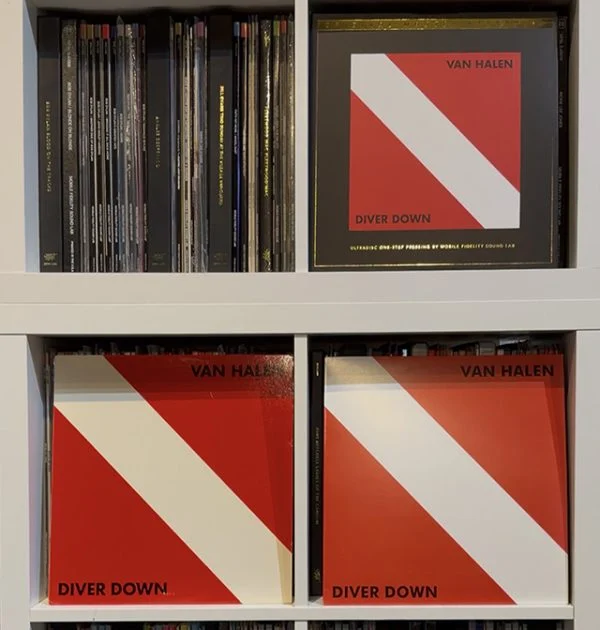
Fast forward to May 2026, and the conversation has shifted dramatically. Modern critical reassessments look past the perceived "filler" status of the album to examine its production values, its unique place in rock history, and how different generations of mastering have unlocked hidden dimensions within the original master tapes. Recent shootout tests contrasting the 1982 original vinyl pressing against the critically acclaimed Chris Bellman remaster and the definitive Mobile Fidelity (MoFi) UltraDisc One-Step release have proven that beneath the surface-level eccentricities lies a remarkably complex sonic document.
Chronology of an Impromptu Masterpiece
To understand Diver Down, one must understand the chaotic environment from which it emerged. The timeline of Van Halen’s early 1980s output reveals a band caught in a relentless cycle of recording and touring that left virtually no room for breathing.
1978–1981: The Breakthrough and Burnout
- February 1978: Van Halen releases their self-titled debut album, introducing the world to Eddie Van Halen’s revolutionary tapping technique and permanently altering the trajectory of hard rock guitar. The record features a brilliant cover of The Kinks’ "You Really Got Me," setting an early precedent for the band’s penchant for reimagining classic tracks.
- 1979–1981: The band drops Van Halen II (1979), Women and Children First (1980), and Fair Warning (1981). Each record pushes their ferocious, blues-inflected heavy metal sound further into darker, more aggressive territory. By the end of the Fair Warning tour, internal friction—particularly between the perfectionist Eddie Van Halen and the party-hard frontman David Lee Roth—is at an all-time high, and the band is thoroughly exhausted.
1982: The Birth of ‘Diver Down’
- Early 1982: Exhausted from relentless global touring and facing immense pressure from Warner Bros. to deliver a follow-up to Fair Warning, Van Halen had written very little new material. David Lee Roth, ever the showman and opportunistic mastermind, suggested recording a slate of cover songs to satisfy the label, buy time, and keep their momentum alive.
- Spring 1982: Entering Sunset Sound Recorders in Hollywood, the band whipped up the album in a matter of weeks. Alongside the covers, they managed to squeeze in blistering originals like "Little Guitars," "Hang ‘Em High," and the instrumental masterpiece "Cathedral." The album’s iconic cover art featured a diver descending into murky waters, paired with a yellow warning flag—a tongue-in-cheek nod to the erratic nature of the project.
- April 14, 1982: Diver Down hits store shelves worldwide. Buoyed by the massive MTV rotation of the "Oh, Pretty Woman" music video (which was briefly banned by MTV for being too racy, only fueling its popularity), the album skyrockets up the charts.
Supporting Data and Audiophile Analysis
For decades, purists argued that Diver Down suffered from a subpar mix and muddy instrumentation. Recent side-by-side audiophile evaluations of the record’s physical iterations have shed new light on what was captured on those multi-track tapes back in 1982.
| Pressing / Edition | Era / Release Year | Low-End Response | Midrange & Clarity | Overall Sonic Character |
|---|---|---|---|---|
| Original Pressing | 1982 (Warner Bros.) | Truncated, thin | Compressed | Built for AM/FM radio play; aggressive compression favored mid-highs. |
| Chris Bellman Remaster | Later release | Restored punch | Noticeably wider soundstage | A major corrective step; breathes new life into muddy passages. |
| MoFi ONE-Step Vinyl | Current standard | Deep, resonant, flawless | Exceptional instrument separation | Unlocks the master tapes; reveals microscopic production details and acoustic warmth. |
Unpacking the Formats
When examining the original 1982 pressing, listeners are immediately struck by its sonic limitations. Like many rock records of that era pressed for mass-market vinyl and optimal radio transmission, the low end is noticeably truncated. Audiophiles have long debated the root cause: was this dynamic compression a passive-aggressive mixing choice designed to bury Michael Anthony’s bass guitar in the mix, or simply a byproduct of standard industry practices aimed at maximizing radio loudness?
Conspiracy theories aside, the physical limitations of those early vinyl cuts robbed songs like "Hang ‘Em High" and "Secrets" of their natural heft.
When comparing the original to the Chris Bellman remaster, the improvement is instantly palpable. Bellman’s mastering work restores much of the lost dynamic range, opening up the upper registers and giving Alex Van Halen’s snare drum the snap it always deserved.
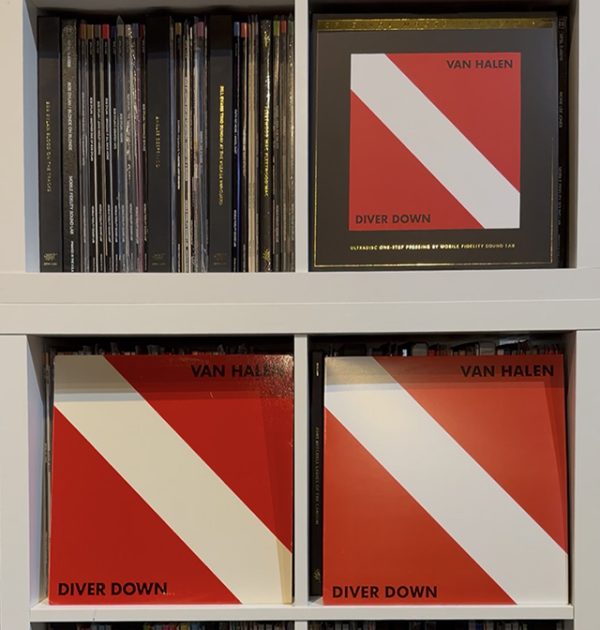
However, the current gold standard belongs to the Mobile Fidelity UltraDisc One-Step pressing. Listening to deep cuts like "Big Bad Bill (Is Sweet William Now)" reveals the true genius of the MoFi engineering team. Not only does the One-Step pressing restore the missing bottom end with terrifying accuracy, but it also elevates the organic instrumentation. Most astonishingly, the velvety, smooth tone of Jan Van Halen’s (Eddie and Alex’s father) clarinet performance on "Big Bad Bill" shines through with breathtaking clarity, blending seamlessly into the jazz-infused blues shuffle. While MoFi’s high-resolution digital SACD offerings are remarkably clean, this particular release proves that the physical warmth and dynamic air of analog vinyl rule the day.
Official Responses and Industry Perspectives
In the years following its release, members of Van Halen offered contrasting views on Diver Down, reflecting the band’s notoriously fragmented internal dynamics.
David Lee Roth has historically championed the album as a stroke of marketing and conceptual genius. In various retrospective interviews, Roth maintained that Diver Down was an intentional exercise in deconstructing the traditional pop-rock record structure. By taking disparate musical styles—ranging from traditional folk and jazz standards to heavy blues-rock—and filtering them through the hyper-energetic Van Halen aesthetic, the band proved they could interpret anything and make it their own.
Eddie Van Halen, on the other hand, displayed a more ambivalent attitude toward the project during his lifetime. While fiercely proud of his guitar work on tracks like "Little Guitars" (where he utilized a miniature Spanish guitar fitted with a custom pickup to achieve a hybrid acoustic-electric tone) and the mind-bending finger-tapped instrumental "Cathedral," Eddie occasionally expressed frustration regarding the rushed nature of the album. He viewed it as a necessary evil born out of industry demands, lamenting that the band wasn’t given the luxury of time to flesh out a full album of entirely original material.
Music critics of the 1980s initially dismissed the record as an artistic misstep, viewing the heavy reliance on covers as a sign of creative fatigue. Yet, contemporary musicologists and modern rock historians view Diver Down through a much kinder lens. It is now frequently cited as a transitional document—a bridge connecting the blistering, raw heavy metal of their early years to the polished, synthesizers-and-pop-hooks era that would yield 1984 just two years later.
Implications for the Legacy of Van Halen
Forty-four years after its debut, the endurance of Diver Down holds significant implications for how modern audiences consume and evaluate classic rock catalogs.
First, it challenges the obsession with uniform original material. In an era where streaming services encourage single-track consumption and algorithmic playlists, Diver Down’s eclectic, mixtape-like sequencing feels surprisingly modern. It demands to be evaluated not as a cohesive thematic concept album, but as a high-wire performance showcase by four musicians operating at the absolute peak of their technical abilities.
Second, the audiophile resurgence surrounding releases like the MoFi One-Step highlights the enduring value of physical media in an increasingly digitized world. As music lovers search for deeper connections to legacy recordings, the ability to peel back decades of compression and hear the microscopic nuances of Eddie Van Halen’s guitar rig, Michael Anthony’s rhythmic foundation, and even guest clarinet performances provides an entirely renewed appreciation for rock history.
As internet search algorithms continue to categorize opening tracks like "Where Have All the Good Times Gone?" simply as a "Song by Van Halen," music enthusiasts are left to ponder the deeper cultural footprint of this oddball record. Diver Down may have started as a hurried exercise for a band on the run, but over four decades later, it stands tall as a testament to the fact that even when Van Halen was improvising, they were effortlessly outplaying everyone else in the room.