By Audio Journal Desk
Published: October 2026
Main Facts
The personal audio landscape continues to experience a paradigm shift, where entry-level gear increasingly punches well above its weight class. In this competitive arena, TempoTec has introduced an updated iteration of its popular compact desktop digital-to-analog converter and headphone amplifier: the TempoTec March III M3 (2025 Edition).

Retailing at a standard suggested retail price (SRP) of $119.90, the device has frequently been observed on promotional sales for as low as $85.90, presenting a compelling value proposition for desktop audiophiles and headphone enthusiasts.
Building on the architecture of its 2023 predecessor, the 2025 Gen II model brings substantial internal hardware revisions. TempoTec has swapped the original AK4493SEQ DAC chips for a dual Cirrus Logic CS43198 arrangement, alongside an upgrade from four OPA1688 op-amps to four SGM8262 op-amps.

Despite its diminutive physical footprint—measuring just 100 mm × 85 mm × 34 mm and weighing 198 grams—the unit delivers an impressive output of up to 1 watt per channel into a 32-ohm load via its 4.4mm balanced output. Furthermore, it incorporates modern connectivity features, including Bluetooth 5.2 with high-resolution LDAC support, versatile USB-C inputs compatible with UAC 1 and UAC 2 protocols, and a comprehensive array of digital and analog I/O options.
Chronology and Hardware Evolution
To fully understand the significance of the March III M3 2025 edition, it is necessary to trace its development lineage within TempoTec’s product ecosystem.

The 2023 Predecessor
When TempoTec initially released the March III M3 in 2023, it was positioned as a versatile, ultra-compact desktop hub capable of driving a variety of transducers without dominating desk space. Built around the AKM AK4493SEQ DAC architecture paired with OPA1688 operational amplifiers, the original unit earned praise for its features and form factor. However, market demands for lower distortion metrics, higher perceived resolution, and improved transient response pushed the manufacturer back to the drawing board.
The 2025 Gen II Revision
The transition to the 2025 model year brought internal upgrades designed to modernize the device’s sonic profile. By integrating dual CS43198 DAC chips—components widely celebrated in the portable and desktop audio segments for their pristine measurement capabilities and sonic transparency—TempoTec shifted the unit’s tonal identity away from the gentle warmth of the AKM implementation.

Concurrently, the adoption of four SGM8262 op-amps established a fully differential, true balanced amplifier stage. Reviewers and early adopters noted that this hardware refresh successfully yielded a quieter noise floor, improved channel separation, and a more uncolored, reference-grade presentation.
Supporting Data and Technical Specifications
A rigorous examination of the March III M3 2025 reveals a robust engineering blueprint designed to accommodate diverse desktop and mobile workflows.

Connectivity and Input/Output (I/O) Array
Despite its modest chassis size, the March III M3 2025 functions as a comprehensive control center for modern listening stations:
- Digital Inputs: USB-C (supporting UAC 1 and UAC 2), Bluetooth 5.2 (LDAC, AAC, SBC).
- Headphone Outputs: 3.5mm single-ended (delivering 260 mW into 32Ω; 0.15Ω output impedance) and 4.4mm balanced (delivering 1,000 mW into 32Ω; 0.3Ω output impedance).
- Line and Digital Outputs: Analog RCA line-out, digital coaxial output, S/PDIF optical output.
- Decoding Capabilities: High-resolution PCM up to 768 kHz/32-bit, DSD512, and 8x MQA rendering.
User Interface and Ergonomics
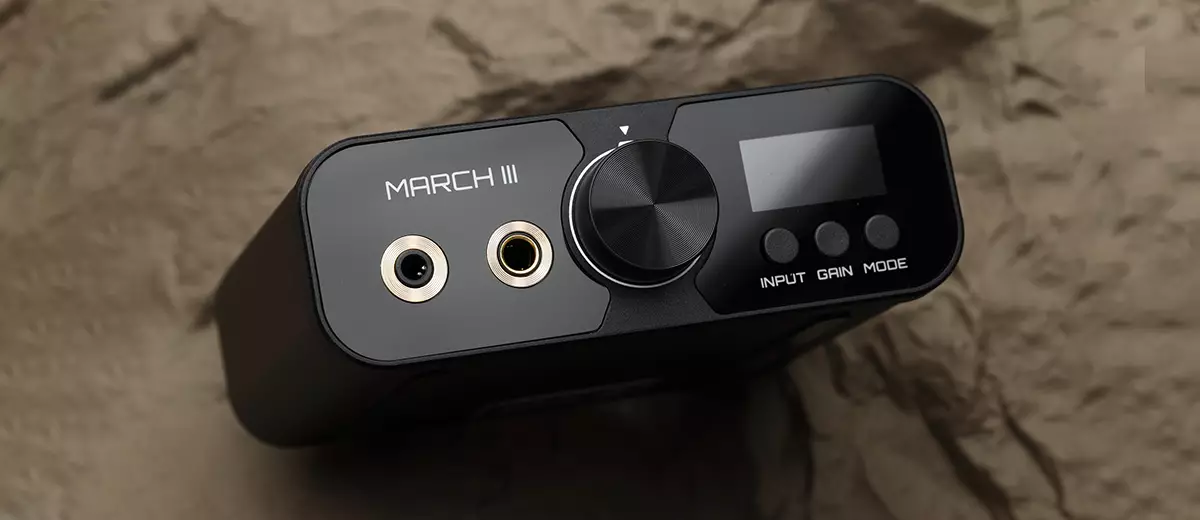
The front panel is anchored by an inlaid glass faceplate housing a large volume potentiometer, dual headphone jacks, status LEDs, and a sharp, high-contrast monochrome LCD display. The screen clearly indicates volume levels, active inputs and outputs, selected digital filters, EQ presets, and USB audio class modes.

Operationally, the unit includes physical tactile buttons for input selection, gain adjustments, and digital filter cycling. A physical rocker switch on the rear panel controls power delivery, mitigating the risk of accidental activation associated with soft-touch push buttons. Notably, the device also features a smart sensor that automatically pauses playback when a headphone jack is disconnected—preventing abrupt sound leakage to connected desktop speakers, albeit with a minor half-second audio buffer quirk prior to the pause state.
Official Responses and Expert Impressions
Critical evaluations from independent review platforms, such as Headfonics, have highlighted the March III M3 2025’s unexpected acoustic maturity.

Sound Signature and Transparency
Industry analysts initially anticipated a warm, rolled-off, and forgiving sound profile typical of entry-level gear in the sub-$100 price bracket. Instead, listening tests revealed a remarkably neutral, transparent, and uncolored signature.
- Bass Performance: The low end is characterized by tight control, excellent articulation, and authoritative weight without artificial bloat or overhang. It pairs exceptionally well with sensitive in-ear monitors (IEMs), extracting deep textural cues.
- Midrange: Vocals and acoustic instruments are rendered with natural note weight, avoiding thinness while maintaining an expansive, airy presentation.
- Treble: High frequencies extend smoothly with impressive air and transparency, avoiding harsh sibilance while capturing micro-details effectively.
Soundstage and Dynamics
Thanks to its low noise floor and clean topology, the device constructs a wide soundstage with notable lateral width and vertical headroom. Depth layering is competent, allowing listeners to easily distinguish between primary vocalists, backing harmonies, and instrumental arrangements. Dynamic performance remains largely neutral, relying on the inherent characteristics of the transducer rather than imposing artificial compression or coloration.

Implications for the Personal Audio Market
The release and subsequent reception of the TempoTec March III M3 2025 carry several noteworthy implications for the budget audiophile sector:
- Democratization of High-Resolution Audio: By offering dual-DAC architecture, balanced output capability, and LDAC Bluetooth streaming at a price point hovering around $85 to $120, TempoTec lowers the barrier of entry for consumers seeking desktop-class performance.
- The Rise of Compact Integration: Traditional desktop stacks often require dedicated footprint space for separate DACs, preamplifiers, and headphone amplifiers. Multifunctional mini-desktops like the March III M3 demonstrate that significant power and routing flexibility can be achieved in a chassis no larger than a novel.
- Hardware Iteration Speed: The rapid transition from the 2023 model to the 2025 Gen II revision underscores the fast-paced nature of component availability in modern audio manufacturing, where swift adoption of superior ICs (such as the CS43198 and SGM8262) can instantly revitalize a product line’s competitive edge.
Conclusion
The TempoTec March III M3 (2025 Edition) successfully bridges the gap between budget accessibility and audiophile-grade transparency. While minor operational quirks—such as startup times and the auto-pause delay when disconnecting headphones—exist, they do little to overshadow the device’s stellar build quality, versatile connectivity, and refined acoustic signature. For desktop enthusiasts operating on a strict budget, it stands out as a formidable contender in the current audio landscape.