Published: May 12, 2026
Category: Music History / Audiophile Reviews / Vinyl Releases
Main Facts
More than forty-four years after its initial spring release in 1982, Van Halen’s polarizing fifth studio album, Diver Down, occupies a fascinating and unique space in the band’s legendary discography. Often characterized by critics and fans alike as the band’s "wackiest" project—largely due to its heavy reliance on cover songs—the record has transitioned from a rushed contractual obligation into a compelling historical document of a powerhouse band operating at peak velocity.
While tracks like "Where Have All the Good Times Gone!", "Pretty Woman," and the acapella closer "Happy Trails" initially baffled mainstream music critics who expected the fiery original hard rock of Van Halen I or Fair Warning, modern listeners view Diver Down through a different lens. It is now celebrated as an experimental playground for guitar virtuoso Eddie Van Halen, charismatic frontman David Lee Roth, powerhouse drummer Alex Van Halen, and the steadfast bassist Michael Anthony.
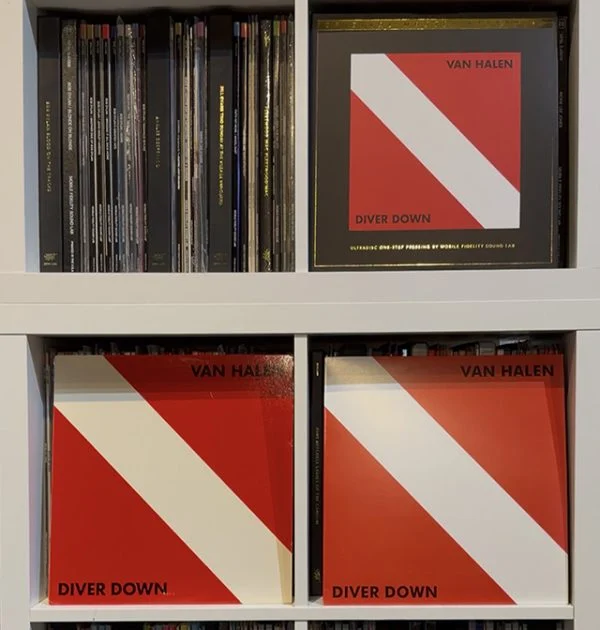
Compounding this re-evaluation is the modern audiophile renaissance. A recent comparative listening session evaluating the original 1982 vinyl pressing, the celebrated Chris Bellman remaster, and the definitive Mobile Fidelity Sound Lab (MoFi) UltraDisc One-Step 180g 45RPM vinyl box set has laid bare the technical realities of the album’s creation. Far from a mere novelty act, Diver Down houses dynamic sonic architecture that is only now being fully uncovered through modern mastering techniques, offering startling revelations on tracks ranging from heavy-hitting covers to the unexpected inclusion of Jan Van Halen’s clarinet on "Big Bad Bill (Is Sweet William Now)."
Chronology
To understand the polarizing legacy of Diver Down, one must examine the chaotic timeline of its creation and subsequent audiophile milestones:
- April 1981 – October 1981: Van Halen wraps up an exhaustive, high-intensity world tour supporting their fourth studio album, Fair Warning. Exhausted and creatively drained, the band enters the studio with a mandate from Warner Bros. Records to produce a follow-up album immediately to maintain their commercial momentum.
- Early 1982: With little time to write an entire album of original material from scratch, the band relies on studio jam sessions, reworked blues and pop covers, and previously unreleased fragments. The recording sessions at Sunset Sound Recorders in Hollywood are fast-paced and improvisational.
- April 14, 1982: Van Halen releases the non-album single "Pretty Woman," accompanied by a controversial music video that is briefly banned by MTV. The single acts as a major commercial catalyst, driving anticipation for the upcoming LP.
- May 14, 1982: Diver Down is officially released to record stores worldwide. It rockets up the Billboard 200 chart, ultimately peaking at No. 3 and achieving multi-platinum status, proving that any Van Halen release—regardless of its unconventional tracklist—is an automatic commercial success.
- 1982–2010s: Through the eras of compact discs, digital downloads, and early digital remasters, Diver Down remains a cult favorite. However, its original mix is frequently criticized by purists for lacking low-end warmth and dynamic headroom.
- The Chris Bellman Remaster Era: Renowned mastering engineer Chris Bellman tackles the Van Halen catalog for high-end vinyl reissues, stripping away decades of digital murk and restoring foundational elements of the original master tapes.
- Mid-2020s (Present Day): Mobile Fidelity Sound Lab releases its definitive One-Step vinyl edition of Diver Down, sparking renewed critical discourse and allowing modern audiophiles to experience the 1982 master tapes with unprecedented fidelity.
Supporting Data
The technical evolution of Diver Down across various physical formats reveals a fascinating engineering narrative. When comparing the original 1982 pressing to modern audiophile editions, several distinct acoustic characteristics emerge:
1. The Original 1982 Pressing
Purchased on its day of release by dedicated fans and collectors, the first-generation vinyl pressing of Diver Down exhibits hallmark traits of early-1980s major-label mastering.
- Dynamic Compression: To ensure compatibility with standard consumer stereo systems, car radios, and AM/FM broadcast standards of the era, the overall dynamic range was heavily restricted.
- Truncated Bottom End: Bass frequencies—particularly Michael Anthony’s bass guitar lines and Alex Van Halen’s kick drum punches—were rolled off significantly. Whether this was an intentional creative choice, an oversight designed to optimize radio airplay, or a byproduct of passive-aggressive mixing dynamics within the studio remains a point of debate among hardcore fans.
2. The Chris Bellman Remaster
Chris Bellman’s intervention marked a massive turning point for the album’s physical legacy.
- Restoration of Space: Bellman’s cuts successfully reclaimed much of the air and separation lost on the original commercial pressings.
- Midrange Clarity: Eddie Van Halen’s signature "brown sound" gained structural integrity, allowing listeners to discern the nuance of his amplifier settings and natural room acoustics. It represented a major step forward, bridging the gap between historical artifact and high-fidelity listening.
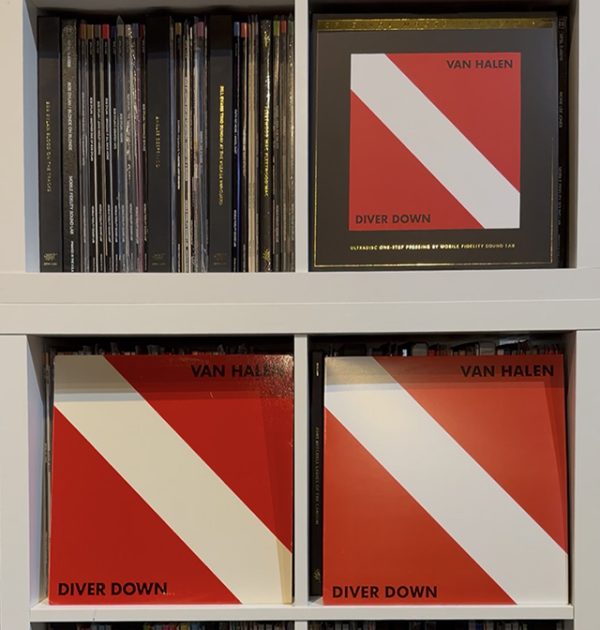
3. The MoFi UltraDisc One-Step Edition
The pinnacle of Diver Down’s sonic journey arrives with Mobile Fidelity’s ultra-premium One-Step release. Mastered directly from the original analog master tapes:
- Bass Recovery: The lost bottom end is fully restored. The rhythm section finally possesses the authoritative weight that matches the band’s live performances of that era.
- Timbral Accuracy: Nowhere is this more apparent than on "Big Bad Bill (Is Sweet William Now)." The track features Jan Van Halen (Eddie and Alex’s father) playing the clarinet. On the MoFi pressing, the tone of the clarinet is rendered with staggering smoothness, warmth, and organic realism.
- Vinyl vs. Digital: While the Mobile Fidelity SACD version performs admirably, the physical attributes of the One-Step vinyl format introduce a tactile dimension and natural harmonic decay that cements vinyl as the definitive medium for this specific recording.
Official Responses
While contemporary band members rarely comment at length on the technical mastering nuances of their 1980s catalog, historical interviews and archival statements from the Van Halen camp provide valuable context regarding the creation of Diver Down.
In past retrospectives, Eddie Van Halen noted that the band viewed the album as an informal playground rather than a high-pressure conceptual masterpiece. Forced into a rapid turnaround after relentless touring, the group leaned into spontaneity.
"We were just having fun," Eddie Van Halen remarked in archival interviews regarding the inclusion of cover songs like The Kinks’ "Where Have All the Good Times Gone!" and Roy Orbison’s "Oh, Pretty Woman." "We didn’t overthink it. We went into the studio, plugged in, and played what felt good at the moment."
Record label representatives at Warner Bros. at the time expressed immediate enthusiasm for the project’s commercial viability, pointing out that covers had historically served as accessible entry points for new listeners—dating back to their explosive rendition of "You Really Got Me" on their 1978 debut.
Meanwhile, modern audio engineers involved in archival reissues have quietly marveled at the underlying quality of the multi-track masters. Studio insiders note that despite the rushed recording schedule, Sunset Sound engineers captured raw instrumental performances of astonishing caliber. The primary limitation of the 1982 release was never the performance quality captured on tape, but rather the aggressive compression applied during final mixing and mastering stages to suit the commercial limitations of the era.
Implications
The enduring fascination with Diver Down in the modern era carries significant implications for both rock music history and the audiophile community.
A Reappraisal of Artistic Freedom
For decades, rock purists and critics dismissed Diver Down as a transitional misstep—an album bloated by covers that allegedly signaled a creative drought. However, listening to the album through pristine modern mastering reveals the sheer audacity of the band. To take disparate tracks like "Dancing in the Street," "Little Guitars," and "Where Have All the Good Times Gone!" and infuse them with an unmistakable, high-octane hard-rock identity requires immense technical skill. The album is now understood not as a sign of exhaustion, but as a fearless exercise in stylistic reinvention by a band at the height of its powers.
The Audiophile Renaissance and Analog Preservation
Furthermore, the critical acclaim surrounding the MoFi One-Step release underscores a broader cultural trend: the insatiable demand for ultimate-fidelity physical media. As streaming services dominate mainstream consumption, dedicated music lovers are increasingly investing in ultra-premium vinyl reissues to unearth details buried by decades of historical compression.
The fact that an idiosyncratic, cover-heavy 1982 hard-rock record can be re-examined through high-end audio engineering to reveal hidden sonic jewels proves that classic rock master tapes are living documents. As search engine queries continue to categorize opening tracks simply as "Song by Van Halen," records like Diver Down remind us of a golden era when virtuosity, studio experimentation, and raw rock-and-roll energy converged. In the grand tapestry of popular music, the question remains: Where have all the good times gone? If modern vinyl pressings are any indication, they never truly left—they were just waiting for the right needle to drop.