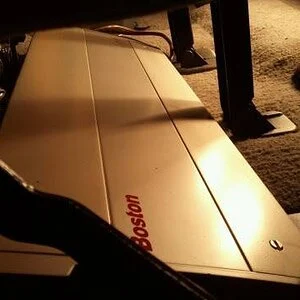
In the high-fidelity world of car audio, the quest for the "perfect" bass response is often a battle between the laws of physics and the limitations of automotive cabin acoustics. Recently, a debate ignited within the enthusiast community regarding the optimal enclosure configuration for a specific Sound Quality (SQ) build centered around the Hertz MP 300 D4.3 subwoofer.
The installation, located within a Toyota Auris Touring Sports—a wagon body style known for its distinct cabin gain—presents unique challenges for achieving a tight, authoritative 45Hz "kick" while maintaining subterranean extension down to 35Hz. As audiophiles weigh the merits of sealed versus ported designs, the discourse provides a masterclass in acoustic theory and system integration.
Main Facts: The Components of a High-Fidelity Build
The system under scrutiny features a well-regarded list of components that prioritize sonic accuracy over raw output:
- Subwoofer: Hertz MP 300 D4.3 (12-inch, dual voice coil)
- Amplifier: Ground Zero GZCS A-1.650D
- Front Stage: Morel Maximo Ultra 602 HE MKII (powered at 90W)
- Head Unit: Kenwood DPX-M3300BT
- Vehicle Platform: Toyota Auris Touring Sports (Station Wagon)
The central challenge identified by the owner is the vehicle’s inherent 55Hz cabin bump. Cabin gain in smaller, hatchback-adjacent vehicles like the Auris can significantly amplify specific frequencies, often resulting in a "boomy" or muddy sound if the enclosure tuning is not precisely managed. The user’s goal is to achieve a precise, punchy transient response at 45Hz—essential for rock and percussion-heavy tracks—without sacrificing the low-end authority at 35Hz.
Chronology of the Expert Debate
The discussion began when the owner, "Karcsika," sought advice on whether to proceed with a large sealed enclosure (48L–55L) or a ported design tuned to 35Hz. The community response, spanning several days of technical deliberation, highlighted the divergent philosophies between "traditional" SQ design and "modern" high-output accuracy.
Initial feedback from user "RobGMN" suggested that for pure sound quality, the sealed enclosure remains the gold standard, noting that "giving it plenty of power" would compensate for the efficiency losses inherent in a sealed design.
However, the conversation shifted when "ThxOne" challenged the premise that an enclosure choice alone could solve the user’s specific acoustic requirements. The subsequent intervention by "nauc" regarding impedance matching and the eventual synthesis by "Old_Slapper" provided a roadmap for a hybrid approach to the tuning.

Technical Analysis: Sealed vs. Ported for SQ
To understand the recommendations provided, one must first understand the fundamental differences in how these enclosures affect the Hertz MP 300 D4.3.
The Case for the Sealed Enclosure
A sealed enclosure acts as an acoustic suspension system. Because the air inside the box is trapped, it acts as a spring that controls the movement of the subwoofer cone. This design is widely favored in SQ builds because:
- Transient Response: The "tightness" of the bass—the ability to start and stop the note instantly—is superior in sealed designs.
- Predictability: The roll-off is much gentler (usually 12dB/octave), making the integration with the mid-bass drivers (the Morel 602s) significantly easier to manage through a crossover.
- Size Efficiency: While the user considered 48L–55L, a sealed box is generally more forgiving of volume fluctuations than a ported box.
The Ported Advantage
The argument for the ported box, as presented by the experts in the thread, centers on "efficiency and reach." A ported enclosure uses the resonance of the air within a vent (port) to reinforce the low-end output. By tuning the port to 35Hz or 40Hz, the system can achieve significantly higher output at those frequencies with the same amount of amplifier power.
For the Toyota Auris, the experts argued that a ported box—if built with sufficient rigidity—could offer the necessary "kick" by utilizing the cabin gain at 55Hz while allowing the port resonance to handle the sub-40Hz frequencies.
Supporting Data: Tuning for the 45Hz Kick
The consensus among contributors like ThxOne and Old_Slapper was that relying solely on a sealed design might require more power than the Ground Zero amplifier can efficiently provide to achieve the desired impact.
Frequency Mapping and the "Kick"
The "kick" in music, particularly rock, resides in the 50Hz to 80Hz range. With the Auris’s cabin bump at 55Hz, the car is naturally assisting the driver in this region. The experts suggested that a ported enclosure tuned to 40Hz creates a "sweet spot":
- The 45Hz Kick: By tuning the box to 40Hz, the user ensures the port output is peaking near the kick drum’s fundamental frequency.
- The 35Hz Extension: A 40Hz tuning does not cut off at 40Hz; it provides a gradual decline, ensuring that 35Hz remains audible and impactful, especially in the enclosed cabin of a wagon.
Specific Enclosure Recommendations
The experts provided concrete targets for the Hertz 12-inch sub:

- JL Audio 12w3v3 logic: Using a 49L–50L (roughly 1.75–1.8 cu. ft.) volume is considered the "sweet spot" for this class of high-quality 12-inch drivers.
- Rigidity: A recurring theme was the need for a "rigidly built" enclosure. Any flex in the box walls absorbs energy, turning a tight, accurate kick into a "boomy" or smeared sound.
Official Technical Perspectives and System Synergy
The interaction between the Hertz subwoofer and the Ground Zero amplifier was a point of contention. "nauc" noted that the specific dual-voice-coil (DVC) configuration of the Hertz MP 300 D4.3 might not be the most efficient match for the Ground Zero GZCS A-1.650D if the impedance is not optimized.
Impedance Matching
In car audio, the goal is to extract the maximum stable power from the amplifier. The Ground Zero amplifier is designed to handle specific loads. If the DVC sub is wired in series versus parallel, the amplifier may see a 1-ohm, 2-ohm, or 4-ohm load.
- The Verdict: While "nauc" questioned the setup, "ThxOne" ultimately encouraged the user to move forward with the Hertz driver, suggesting that the quality of the driver outweighs the theoretical perfect match, provided the wiring configuration is correct to prevent clipping.
The Role of the Front Stage
The Morel Maximo Ultra 602 HE MKII speakers are highly regarded for their mid-bass performance. In a wagon, these speakers are often fighting against the sub for dominance. The experts advised that the sub-enclosure must be tuned to avoid "muddying" the mid-bass response of the Morels. By keeping the sub crossover low—likely around 60Hz to 80Hz—the system can avoid the "bloat" caused by the 55Hz cabin gain.
Implications for the DIY Audiophile
The resolution of this debate offers several key takeaways for any car audio enthusiast attempting to optimize an SQ build:
- Cabin Gain is a Tool, Not a Hindrance: Rather than fighting the 55Hz bump in the Toyota Auris, the builder should embrace it as a natural bass booster, allowing the subwoofer to focus its energy on the lower frequencies (35Hz–40Hz).
- Enclosure Quality Over Volume: The material and bracing of the box are as important as the air volume. A 50L box built with 1-inch MDF and internal cross-bracing will sound significantly "tighter" than a 50L box made of thin, vibrating material.
- Port Tuning: A port tuned to 40Hz is a versatile compromise for a 12-inch sub, providing the desired "kick" for rock music without sacrificing the deep-bass extension necessary for modern production.
- System Balance: The final advice highlights that high-end components like Hertz and Morel require meticulous installation. Simply dropping a subwoofer into a generic "off-the-shelf" box is insufficient for the SQ results the owner desires.
Final Recommendation Summary
For the user in the Toyota Auris, the community experts ultimately converged on a ported enclosure of approximately 50 liters, tuned to 40Hz. This configuration honors the Hertz driver’s design parameters while addressing the acoustic environment of the wagon. By pairing this with a clean, high-power signal from the Ground Zero amplifier and ensuring the box is structurally sound, the owner can achieve the precise, non-boomy, yet authoritative bass response they seek.
The project remains a testament to the fact that while technology provides the tools, it is the integration of acoustic science and meticulous craftsmanship that defines the true high-fidelity experience.