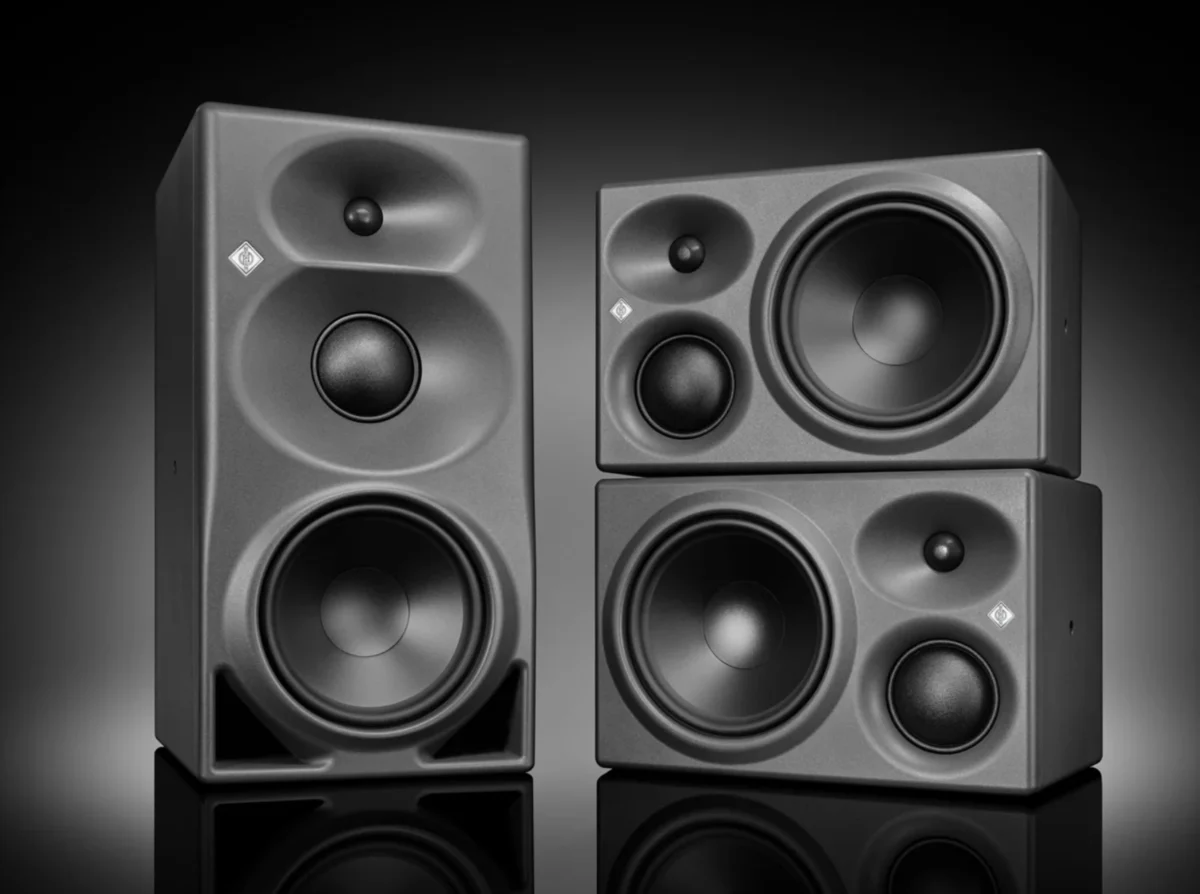
September 11, 2026 — In a major development for the professional audio industry, Neumann has announced the official release of two advanced 3-way studio monitors: the KH 310 II and the KH 350. Built around an entirely new, highly sophisticated Digital Signal Processing (DSP) platform, both models are engineered to deliver uncompromising monitoring accuracy, lower distortion, and seamless workflow integration for modern recording, mixing, and mastering studios.
By combining cutting-edge in-house driver designs, robust amplification, and advanced 32-bit DSP processing, Neumann aims to bridge the gap between traditional analog-era acoustic fidelity and the demands of modern multi-channel, immersive, and spatial audio production environments.
Main Facts at a Glance
- The Models: Neumann KH 310 II (an evolution of the legendary KH 310) and the brand-new KH 350 (a full-range powerhouse designed for larger spaces and immersive rooms).
- Acoustic Configuration: Both models share a 3-way design featuring a 1-inch tweeter, a 3-inch soft-dome midrange driver, and an 8.25-inch woofer.
- The Engine: Powered by an advanced new DSP platform utilizing 32-bit processing for tighter production tolerances, precise phase linearity, and minimized distortion.
- Integration: Full compatibility with Neumann’s proprietary MA 1 Automatic Monitor Alignment room correction system.
- Connectivity: Flexible input options supporting both traditional analog and AES3 (coaxial) digital standards.
- Power and Performance: Virtually double the amplifier power of previous iterations, ensuring exceptional headroom and dynamic range across stereo, surround, and spatial formats.
The Evolution of Precision: A Chronology of Neumann Monitoring
To understand the significance of the KH 310 II and KH 350 release, it is helpful to look at the trajectory of Neumann’s monitoring division. Over the past two decades, the company—historically renowned worldwide for its legendary studio microphones—has successfully carved out a dominant position in the professional loudspeaker market.
The Foundation (The Klein + Hummel Heritage)
Neumann’s loudspeaker lineage traces back to its acquisition and integration of Klein + Hummel, a legendary German brand respected for uncompromising acoustic engineering. When Neumann officially branded its monitor line, models like the KH 120 and the original KH 310 quickly became industry standards. The original KH 310, in particular, earned a fiercely loyal global following among mixing and mastering engineers who relied on its sealed-cabinet design for tight, incredibly accurate low-end translation and a remarkably revealing midrange.
The Shift to DSP and Smart Alignment
As modern music production moved out of heavily treated, multi-million-dollar studios and into project studios, bedroom setups, and complex multi-channel immersive rooms, acoustic challenges multiplied. In response, Neumann introduced networked DSP capabilities and the MA 1 Automatic Monitor Alignment system. This allowed users to calibrate their monitors precisely to their physical rooms, mitigating destructive reflections and modal issues.
The 2026 Breakthrough: The KH 310 II and KH 350
Culminating years of research and development in transducer technology and digital signal processing, the announcement of the KH 310 II and KH 350 represents the next major milestone. Rather than merely tweaking the older analog-centric designs, Neumann redesigned the core architecture around a high-resolution 32-bit DSP engine, creating a unified acoustic platform that scales across different room sizes and monitoring topologies.
Supporting Data and Technical Architecture
At the heart of both the KH 310 II and the KH 350 lies a shared acoustic philosophy, though each is optimized for distinct spatial demands.

Shared Transducer Design
Both monitors utilize a carefully engineered 3-way complement:
- The Tweeter (1-inch): Designed for ultra-low distortion, wide dispersion, and high-frequency extension without harshness or fatigue during long mixing sessions.
- The Midrange Driver (3-inch soft dome): This is the crown jewel of Neumann’s 3-way systems. The proprietary soft-dome midrange isolates the critical vocal and instrumental fundamental ranges from intermodulation distortion, providing the pinpoint imaging and vocal clarity that made the original KH 310 famous.
- The Woofer (8.25-inch): Built to handle massive transient peaks while maintaining linear cone excursion, the redesigned woofer delivers punchy, articulate bass response down to deep sub-frequencies.
Power and Amplification Redefined
A standout engineering achievement in the new generation is the massive leap in amplification capability. The KH 310 II delivers nearly twice the amplifier power of its predecessor. This headroom is not merely about playing louder; it ensures that complex transients—such as a fast snare hit or sudden orchestral dynamics—are reproduced without compression or thermal power-soaking.
The DSP Advantage
The integration of a robust 32-bit DSP platform brings several critical benefits to the engineer:
- Phase Linearity: Advanced digital filters allow for linear phase response, resulting in superior stereo imaging and depth perception.
- Tighter Component Tolerances: Digital calibration eliminates the slight variances inherent in analog components, ensuring that any two KH 310 II or KH 350 monitors match each other with microscopic precision—a vital requirement for immersive audio setups where dozens of speakers must work in absolute harmony.
- MA 1 Integration: Both models interface effortlessly with the Neumann MA 1 system, allowing users to measure their acoustic environment via a calibrated measurement microphone and automatically optimize amplitude and phase response.
Official Perspectives from Neumann Leadership
The engineering and product management teams at Neumann emphasized that these new releases are designed to respect the past while embracing the rigorous demands of modern workflows.
Roman Kramer, Product Manager at Neumann, highlighted the careful balance between honoring a classic and pushing boundaries:
"The KH 310 has earned an exceptional reputation among recording, mixing, and mastering engineers worldwide. With the KH 310 II, we worked long and hard to retain everything users love about the original while elevating performance in virtually every area. At the same time, the KH 350 opens new possibilities for engineers who need greater low-frequency authority and the flexibility to work confidently across both nearfield and midfield environments."
Stephan Mauer, Director of Product Management at Neumann, expanded on the broader philosophy driving the dual release:

"The KH 310 II and KH 350 share the same acoustic DNA and commitment to truthful sound reproduction. Today’s engineers work across a wide range of rooms, formats, and production styles. Our goal was to provide two solutions that deliver the same trusted reference standard while allowing users to choose the monitoring concept that best supports their workflow."
Industry Implications: What This Means for Producers and Engineers
The introduction of the KH 310 II and KH 350 is expected to send ripples through the professional audio market, particularly in three key areas:
1. The Rise of Immersive Audio (Dolby Atmos)
With Dolby Atmos and spatial audio formats becoming a baseline requirement for major record labels, film studios, and streaming services, monitoring consistency is more critical than ever. Immersive rooms often require 7.1.4 configurations or larger, demanding up to a dozen identical-sounding speakers. The tight production tolerances afforded by Neumann’s new DSP platform ensure that spatial soundstages remain stable and cohesive, regardless of where a listener or engineer sits.
2. Bridging Nearfield and Midfield Boundaries
Traditionally, engineers had to compromise when shifting from tight nearfield setups to larger midfield mains, often dealing with translation issues as the acoustic environment changed. By introducing the KH 350 as a full-range monitor alongside the studio-staple KH 310 II footprint, Neumann gives professionals the ability to scale their monitoring power up without sacrificing the familiar, honest voicing they rely on.
3. Workflow Streamlining via Software Integration
As digital audio workstations (DAWs) and hardware controllers become more deeply integrated, studio monitors are evolving from "dumb" speakers into intelligent nodes within a networked studio ecosystem. Through MA 1 alignment and digital connectivity (AES3), Neumann is cutting down setup times, making room calibration accessible even in less-than-ideal acoustic spaces.
Conclusion
The release of the Neumann KH 310 II and KH 350 marks a significant evolution in studio monitoring technology. By taking the revered acoustic blueprint of the KH series and supercharging it with a state-of-the-art 32-bit DSP platform, increased amplification, and rigorous manufacturing tolerances, Neumann has delivered tools that cater to both traditional stereo purists and next-generation spatial audio innovators.
As studios around the world begin integrating these new monitors into their workflows, the KH 310 II and KH 350 are poised to set a new benchmark for translation, accuracy, and reliability in professional audio production.