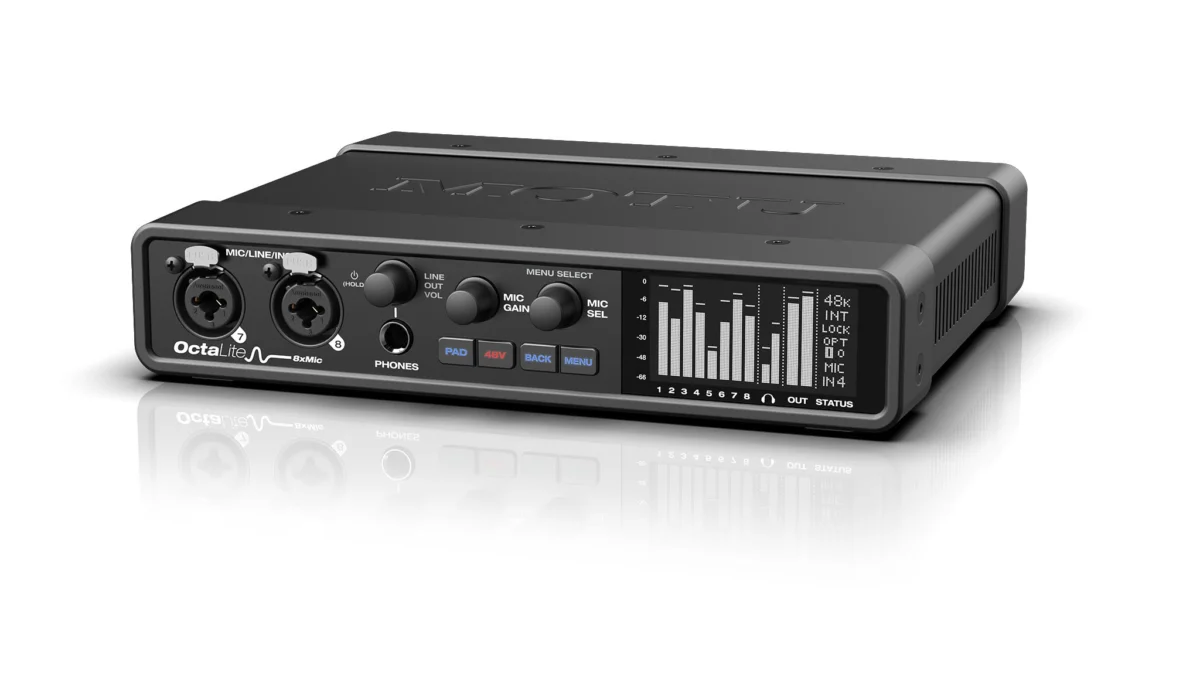
CAMBRIDGE, MA — Mark of the Unicorn (MOTU), a stalwart in the evolution of digital audio workstations and hardware interfaces, has officially announced that its latest hardware innovation, the OctaLite, is now shipping worldwide. Designed to bridge the gap between ultra-portability and professional-grade studio capabilities, the OctaLite is a 16-input, 12-output half-rack USB audio interface compatible with macOS, Windows, and iOS platforms.
With a retail price point of $849.95, the OctaLite arrives in a market increasingly hungry for compact solutions that do not compromise on I/O count, conversion quality, or DSP performance. Featuring eight discrete microphone preamplifiers, high-end ESS Sabre conversion, onboard mixing with effects, and ADAT optical expansion capabilities, the OctaLite is positioned as a uniquely versatile tool for mobile recordists, project studio owners, and live sound engineers alike.
Main Facts and Core Specifications
At its core, the MOTU OctaLite packs a staggering amount of hardware into a rugged, portable metal chassis designed to occupy just half of a standard 19-inch rack space.
Key Feature Breakdown:
- Analog Inputs: Eight combo XLR/TRS inputs supporting microphone, line-level, and high-impedance (Hi-Z) instrument signals. Two inputs are conveniently placed on the front panel, while the remaining six reside on the rear.
- Analog Outputs: Two balanced 1/4-inch main analog outputs for studio monitors, alongside a dedicated front-panel low-impedance headphone output.
- Digital I/O: Optical TOSLINK ports supporting ADAT digital I/O, allowing the unit to function either as a traditional interface or as a standalone optical expander.
- Conversion Technology: Powered by 32-bit ESS PRO SABRE DAC technology, delivering an impressive 125 dB of dynamic range.
- Preamplification: Burr-Brown engineered Texas Instruments preamps and op-amps, offering up to +74 dB of clean, transparent gain with an equivalent input noise (EIN) of -129 dB.
- Connectivity: High-speed USB-C 2.0 interface (fully compatible with USB 3/4 and iOS devices), boasting ultra-low round-trip latency (RTL) down to 2 milliseconds.
- DSP Processing: Onboard hardware mixing powered by a dedicated DSP engine, running a 4-band parametric equalizer, compression, gating, and professional reverb without taxing the host computer’s CPU.
- Control Software: Managed via the cross-platform CueMix 5 application, available for macOS, Windows, iPadOS, and iOS.
Chronology of Development and Market Introduction
The release of the OctaLite follows years of steady refinement in MOTU’s hardware engineering pipeline, particularly following the successful launch and widespread adoption of the UltraLite-mk5. While previous generations of mobile interfaces often forced engineers to choose between physical preamp counts and physical footprint, recent advancements in surface-mount component technology and thermal management have allowed manufacturers to shrink large-format analog circuits.
MOTU’s engineering team identified a distinct void in the market: producers and tracking engineers frequently required a multi-mic setup for drum recording, mobile location tracking, or ensemble sessions, yet portable rigs were largely limited to two or four preamps unless users stepped up to bulky, full-width rack units.
The development of the OctaLite focused intensely on packing eight true preamps into the half-rack paradigm while maintaining thermal stability and pristine signal-to-noise ratios. By integrating high-performance Texas Instruments components and ESS conversion architectures—proven reliable in MOTU’s flagship product lines—the company streamlined the production timeline. Following initial preview announcements earlier in the season, MOTU confirmed that the manufacturing run was complete and that units are actively shipping to authorized dealers globally as of October 2026.
Supporting Technical Data and Architectural Deep Dive
To understand where the OctaLite sits in the modern audio landscape, it is helpful to examine its underlying hardware architecture and data routing capabilities.
Preamplification and Conversion
The analog front end is anchored by Burr-Brown designed circuitry. In professional audio, Burr-Brown topologies are revered for their ultra-low distortion characteristics and musicality. Delivering +74 dB of gain, the OctaLite’s preamps can easily drive notoriously gain-hungry passive ribbons and dynamic microphones (such as the Shure SM7B or Electro-Voice RE20) without the need for external inline boosters like Cloudlifters. Furthermore, an EIN rating of -129 dB ensures that acoustic details remain pristine and free of self-noise.
The conversion stage utilizes 32-bit ESS PRO SABRE DAC technology. This yields a dynamic range of 125 dB on the outputs, ensuring that monitoring environments reveal minute shifts in transient response, stereo imaging, and dynamic compression.
Channel Architecture and Routing
As a 16-input, 12-output device, the channel count goes beyond the physical analog connections thanks to digital integration.
- Inputs (16 total): 8 analog mic/line/instrument inputs + 8 channels of ADAT optical digital input.
- Outputs (12 total): 2 main monitor outputs + 1 stereo headphone output + 8 channels of ADAT optical digital output.
This expansive routing flexibility allows the OctaLite to shine as an optical expander. By routing "Analog In 1-8" to the optical output bank—a configuration easily accessible via the front-panel menu or the CueMix 5 software—users can transform the OctaLite into an eight-channel standalone preamp bank that feeds ADAT-equipped audio interfaces, digital mixing consoles, or hardware recorders. At higher sample rates (88.2 kHz and 96 kHz), the unit supports 4-channel SMUX operations through its secondary optical port.
Latency and Driver Performance
Operating over a high-speed USB-C protocol, the OctaLite features custom-written drivers that achieve round-trip latencies as low as 2 ms at high sample rates (e.g., 96 kHz with a 32-sample buffer). For iOS users or environments where driver installation is prohibited, the unit supports full USB audio class-compliant operation, ensuring plug-and-play functionality across mobile operating systems.
Official Responses and Industry Perspectives
The announcement has generated significant buzz within the professional audio community, with executives and engineers highlighting the unique engineering hurdles overcome during the design phase.
“The OctaLite is truly unique because it’s the only audio interface on the market that offers eight mic preamps in a super-portable half-rack unit,” stated Jim Cooper, Director of Marketing at MOTU.
Cooper’s sentiment underscores a core design philosophy: zero compromise on physical features despite the miniature footprint. In professional reviews and early user feedback panels, engineers have lauded the inclusion of individual hardware switches for 48V phantom power, -20 dB input pads, and phase inversion on every single channel. These features are frequently omitted from mobile-class interfaces to save internal board space, yet they remain indispensable for professional tracking applications.
Industry analysts note that MOTU has cleverly targeted a specific demographic of hybrid creators—those who record mobile podcast panels, live acoustic sessions, or on-location indie film audio, but who also demand studio-grade routing flexibility when they return to their primary workstations.
Implications for Studios, Live Sound, and Mobile Producers
The introduction of the MOTU OctaLite carries several broader implications for the pro-audio ecosystem, particularly regarding modular studio design and mobile workflow efficiency.
1. The Rise of the Modular Half-Rack Rig
Historically, expanding a studio setup meant purchasing bulky 1U or 2U interfaces. With the OctaLite, MOTU has leaned heavily into modular physical integration. Utilizing optional half-rack mounting kits or coupler kits, users can join two OctaLites side-by-side in a single 19-inch rack space. This configuration yields a staggering 16 pristine microphone preamplifiers in just 1U of rack space—a feat previously achievable only by combining multiple separate preamp units and conversion boxes.
Alternatively, users can couple an OctaLite with MOTU’s popular UltraLite-mk5 to create hybrid rigs tailored to specific tracking needs. For mobile engineers, both units fit comfortably inside half-rack road cases, such as the Odyssey FZHR02 2U Half Rack Flight Case, establishing a virtually indestructible, self-contained recording rig that can be transported in a backpack or checked as airline luggage.
2. Standalone Flexibility and DSP Mixing
Because the OctaLite features a robust internal DSP mixing matrix controlled by the cross-platform CueMix 5 app, it is not strictly tethered to a traditional computer-based DAW during operation. Producers can configure monitor mixes, apply zero-latency hardware compression and EQ, and route signals completely independently. This makes the OctaLite a capable standalone digital mixer for small ensemble rehearsals, live streaming setups, or field recording, where a laptop or iPad acts purely as a remote-control surface rather than a heavy computational bottleneck.
3. Economic Impact on Project Studios
At $849.95, the OctaLite hits a sweet spot in the mid-tier market. It undercuts many enterprise-level modular systems while vastly outperforming entry-level mobile interfaces that rely on stripped-down preamps and external wall-wart power supplies. For independent artists and project studio owners working within strict budget constraints, the ability to track a full acoustic drum kit or a small chamber ensemble with eight matching, high-end Burr-Brown preamps—without investing in separate ADAT expansion units—represents a major cost-to-performance victory.
Availability
The MOTU OctaLite is shipping immediately and is available through authorized musical instrument and pro-audio retailers worldwide at a manufacturer’s suggested retail price of $849.95 USD. Optional accessories, including the single-unit half-rack mounting kit and the dual-unit rack coupler kit, are sold separately. For deeper technical specifications, driver downloads, and dealer locations, prospective buyers can visit the official MOTU website.