Main Facts
At the 53rd edition of the renowned Telluride Film Festival in Colorado, long-standing audio partner Meyer Sound executed a major technological leap for the event’s largest temporary venue. Transforming the 650-seat Werner Herzog Theater—annually erected inside the Hanley Ice Rink at Telluride’s Town Park Pavilion—the audio engineering team successfully deployed a state-of-the-art Dolby Atmos immersive sound system.
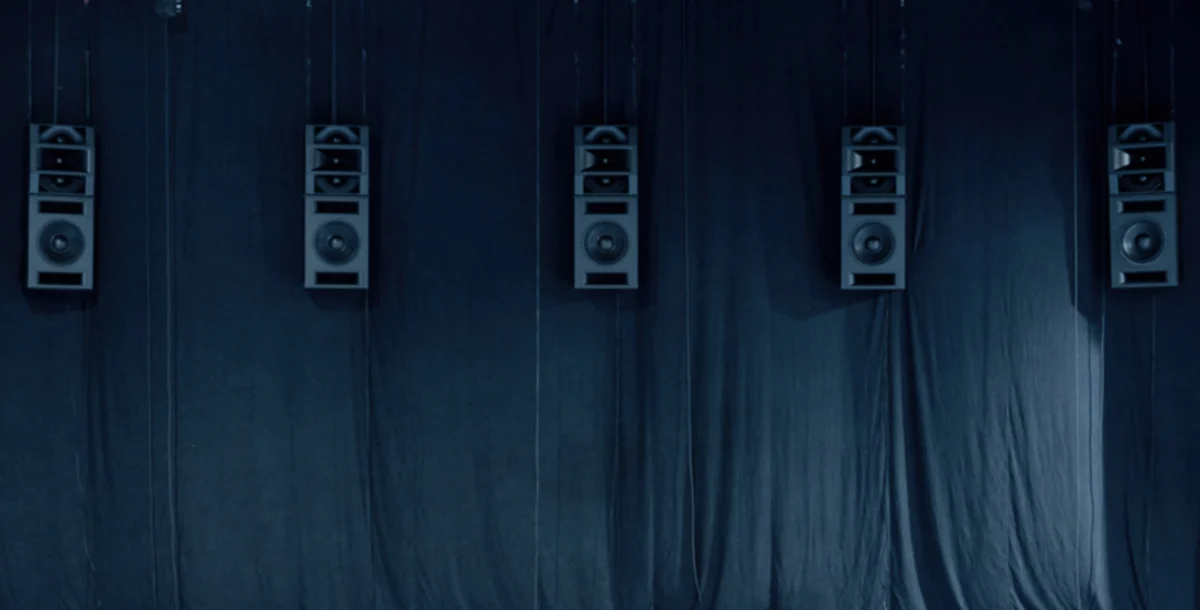
The crowning achievement of this year’s installation was the Telluride debut of Meyer Sound’s brand-new ASTRYA-140 screen-channel loudspeakers. Five of these advanced, flown loudspeakers served as the front channels for the massive 46-foot projection screen. Marking Meyer Sound’s 26th consecutive year of supporting the festival, the company also provided top-tier cinema sound systems for the event’s Galaxy and Palm theaters. However, it was the conversion of the acoustic challenge that is the Herzog Theater—shifting from a legacy 7.1 surround sound layout to a complex 59-loudspeaker Dolby Atmos architecture—that defined the audio narrative of the festival.
The logistical and engineering feat required collaborative coordination among lighting, staging, and audio production crews, completing a massive acoustic overhaul in a compressed three-day window. By leveraging modern networked audio distribution and purpose-built flyable hardware, the Meyer Sound team turned a challenging, acoustically unforgiving hockey arena into a world-class reference playback environment, bridging the gap between professional film dub stages and a temporary high-altitude festival venue.
Chronology of the Transformation: From Ice Rink to Reference Cinema
The Legacy of the 7.1 System (2013–2024)
Since its inception in 2013, the Werner Herzog Theater has operated using a traditional 7.1 cinema sound configuration. While this legacy system served audiences and visiting filmmakers well for over a decade, it relied on a lower channel count—delivering eight distinct channels across 37 loudspeakers. As cinematic mixing techniques evolved to embrace object-based audio formats like Dolby Atmos, filmmakers presenting projects at Telluride increasingly voiced a desire for more immersive, multidimensional soundstages.
Pre-Festival Planning and Engineering Decisions
Recognizing the shifting demands of modern cinema production, Meyer Sound program manager for cinema and residential Jay Wyatt, who spearheaded system design and onsite deployment, determined that the 53rd festival was the ideal time to upgrade. The decision was further catalyzed by the development of the ASTRYA-140, a screen channel designed specifically to bridge the acoustic gap between high-end dub stages and commercial cinemas. During the loudspeaker’s R&D phase, Wyatt had specifically requested that Meyer Sound’s engineering team incorporate integrated rigging points to make ASTRYA flyable—a feature tailored precisely for unique deployment scenarios like film festivals.
The Three-Day Installation Sprint
Deployment inside the Town Park Pavilion began days before the festival’s opening red carpet. Operating alongside concurrent lighting and stage production crews, Wyatt’s team faced a tight, high-pressure timeline. Because the venue doubles as a functional hockey arena during the off-season, all acoustic treatments, structural rigging, cabling paths, and speaker arrays had to be built from scratch.
The installation process required meticulous coordination:
- Day 1: Structural truss reinforcement, motorized rigging deployment, and the flying of the main ASTRYA-140 screen channel array.
- Day 2: Deployment of surround-sound arrays, overhead height speakers, and the complex cardioid end-fire subwoofer array beneath the screen.
- Day 3: System calibration, network routing via Cat cable, alignment, room EQ tuning, and comprehensive telemetry testing via the booth dashboard.
Supporting Data and Technical Specifications
The architectural shift from a 7.1 setup to a fully realized Dolby Atmos environment significantly scaled up the technical complexity of the temporary venue.
| Metric / Specification | Legacy 7.1 System (Past Years) | New Dolby Atmos System (53rd Festival) |
|---|---|---|
| Total Processed Outputs | 8 Channels | 50 Discrete Processor Outputs |
| Total Loudspeaker Count | 37 Units | 59 Units |
| Screen Channels | Standard Configuration | 5x ASTRYA-140 (Left, Left Center, Center, Right Center, Right) |
| Surround Configuration | Standard Surround Layout | 22x HMS-12 Cinema Surrounds + 2x ULTRA-X40 Wide Surrounds |
| Overhead Height Channels | None / Not Applicable | 4x ULTRA-X40 + 12x ULTRA-X23 Point Source Loudspeakers |
| Subwoofer Array | Traditional Configuration | 10x X-800C (Cardioid End-Fire) + 4x 900-LFC (Fitted Bass Management) |
| Cabling Strategy | Analog Snakes and Breakouts | Single-Run Networked Audio (Cat Cable) |
Networked Audio and Cable Management
The explosion from 8 channels to 50 discrete processor outputs forced the engineering team to completely re-evaluate their cabling infrastructure. Running dozens of long analog multi-core snakes through a temporary arena was impractical and prone to signal loss or interference.
Instead, the team embraced networked audio distribution. Because the ASTRYA-140 loudspeakers are natively network audio-capable, the entire complex signal routing was achieved using single runs of high-reliability Cat cable. This drastically reduced setup time, minimized potential failure points, and simplified troubleshooting. Furthermore, the screen channels continuously fed real-time health and telemetry data back to a centralized booth dashboard, granting operators remote visibility over the system’s operational status throughout the festival screenings.
Acoustic Control and Low-Frequency Management
Ice rinks and sports pavilions are notoriously difficult environments for audio reproduction due to hard, reflective boundaries, large open volumes, and persistent slap-echoes. To combat high-frequency reflections, the seating area of the Werner Herzog Theater was completely enclosed within a double layer of heavy drapes.
Addressing low frequencies presented an even greater challenge. The 46-foot screen opened up to a massive, empty storage area behind it. Uncontrolled bass frequencies escaping into this cavernous backspace would bounce around uncontrollably and smear the audio clarity for the audience.
To solve this, the engineering team deployed ten X-800C cinema subwoofers arranged in two rows of five as a cardioid end-fire array. This specific configuration physically steered low-frequency energy directly toward the seated audience while aggressively canceling out backward radiation toward the open arena space. Additionally, four flown 900-LFC low-frequency control elements were utilized to establish four distinct zones of bass management, ensuring uniform low-frequency response as sound objects dynamically panned across the room.
Official Responses and Industry Perspectives
The successful deployment of a high-end, festival-scale Dolby Atmos system inside a temporary live venue drew praise from festival leadership and audio engineering experts alike.
Julie Huntsinger, Director of the Telluride Film Festival, shared her enthusiasm for the collaboration:
"I could not be more proud of our 26-year partnership with Meyer Sound. By working in tandem with Meyer Sound experts, along with our skilled festival production and technical teams who took engineering to a new level, Telluride Town Park’s Hanley Ice Rink—the festival’s Werner Herzog Theater—was transformed into a stunning 21st-century movie palace with ASTRYA-140 screen channel loudspeakers and Dolby Atmos immersive sound. Once again the show demonstrates the technological magic that can be achieved at high altitude in a temporary installation with the wizardry of excellence, mastery, and determination… what a thrilling show we had!"
Jay Wyatt, Meyer Sound Program Manager for Cinema & Residential, reflected on the operational hurdles:
"Most film festivals don’t do Dolby Atmos, or if they do, it’s usually in a venue that already has it permanently installed. To be able to pull off an Atmos system of this complexity in a temporary live venue was a rewarding challenge. We felt like this was a good year to do it because there was more and more demand from filmmakers, and we finally had a new screen channel that was really well suited to the task."
Mark Mayfield, Meyer Sound Director of Cinema Marketing, emphasized the sonic lineage of the new technology:
"ASTRYA was designed to bridge the dub stage and the cinema with exceptional linearity and dynamic range. At Herzog, those qualities supported the festival’s transformation of an acoustically unforgiving arena into an extraordinary playback environment where each soundtrack could be presented as its creators intended."
Implications for Future Film Festivals and Cinema Audio
The successful deployment at the 53rd Telluride Film Festival establishes a new benchmark for temporary cinema sound design. Historically, filmmakers premiering high-budget, immersive audio-mixed projects at film festivals have had to compromise on monitoring quality when their films were screened in converted gymnasiums, hockey rinks, or civic auditoriums.
By demonstrating that a complex, 50-output, networked Dolby Atmos system can be rapidly installed, calibrated, and operated flawlessly in a temporary high-altitude venue, Meyer Sound and the Telluride technical staff have effectively shattered technical limitations.
Key takeaways and long-term implications include:
- Elevating Temporary Venues to Dub-Stage Standards: The linearity and dynamic range of the ASTRYA-140 prove that portable screen channel loudspeakers can match the sonic fidelity of permanent commercial multiplexes or mixing stages.
- The Shift Toward Networked Infrastructure: The successful reliance on Cat-cable networking over traditional analog multi-core snakes highlights the future of mobile event audio. High channel counts are no longer hindered by logistical nightmares of heavy copper cabling.
- Increased Filmmaker Confidence: As word spreads about the acoustic integrity of the Werner Herzog Theater’s new Atmos configuration, directors, sound designers, and mixers can submit their immersive audio projects to Telluride with the absolute confidence that their artistic intent will be faithfully reproduced, regardless of the venue’s non-traditional origins.
As the film industry continues to push the boundaries of spatial and object-based sound design, technical showcases like the one witnessed at Telluride’s 53rd edition prove that world-class acoustic experiences are no longer bound by permanent architectural walls.