October 2026 — In the rapidly evolving landscape of live entertainment, touring productions, and mobile broadcast environments, the convergence of audio, video, lighting, and data onto a shared network infrastructure has become the industry standard. Advanced protocols like Dante, NDI, Art-Net, sACN, and SMPTE ST 2110 now routinely share the same physical cables, core switches, and fiber-optic backbones.
However, this technological leap forward has created a silent operational bottleneck: a lack of standardized addressing. Because every production company, rental house, and system designer historically developed custom configurations for Virtual Local Area Networks (VLANs) and Internet Protocol (IP) ranges, touring crews and freelance engineers have long faced a steep learning curve. Walking onto a new job often means deciphering a completely arbitrary network layout from scratch.
To solve this persistent industry-wide headache, veteran IT trainer and AV consultant Bodo Felusch has officially introduced BF-C.O.R.E. (Base Framework for Converged Operations & Reliable Event-IT). Designed as a free, open-source, vendor-neutral framework, BF-C.O.R.E. establishes a unified approach to VLAN IDs, IP addressing, and switch configuration for mobile event production networks. By streamlining these foundational parameters, the framework aims to reduce setup times, minimize human error during hectic load-ins, and foster a truly interoperable global standard for live event technology.
Main Facts: What is BF-C.O.R.E.?
At its core, BF-C.O.R.E. is a meticulously engineered specification document rather than proprietary software or hardware. It provides a standardized structural blueprint for how network resources are organized across temporary and mobile event setups.
The framework is built around several foundational pillars:
- Departmental VLAN Blocks: VLAN IDs are systematically segregated by production departments (e.g., audio, video, lighting, communications, inter-departmental control), ensuring predictable traffic isolation and security.
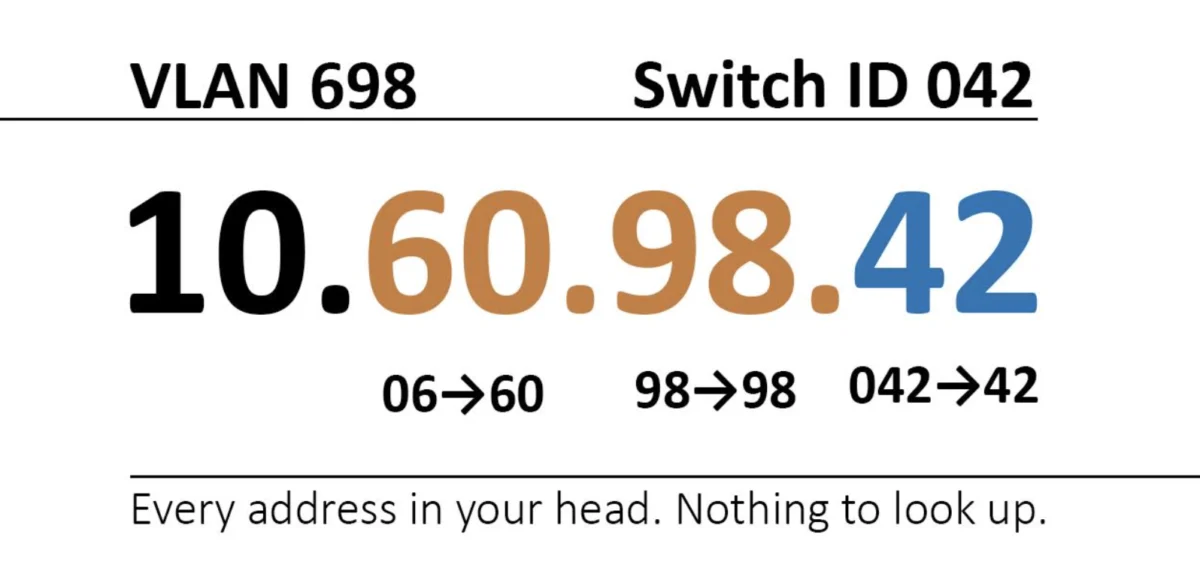
- Algorithmic Subnetting & Switch Addressing: Subnets and core switch management addresses are not chosen at random; they are logically derived straight from the assigned VLAN IDs and specific switch identifiers.
- Predictable End-Device Ranges: Fixed, standardized address ranges are designated for end-node clients, making device discovery and troubleshooting significantly faster for technicians on site.
- Scalability: The architecture is flexible enough to accommodate lean corporate events utilizing just three switches, yet robust enough to scale up to massive multi-stage festival setups managing up to 100 switches—with an ultimate theoretical asset pool capacity of 9,999 switches and 510 dedicated client addresses per department.
- Vendor Neutrality: BF-C.O.R.E. steers clear of dictating specific network topologies, Quality of Service (QoS) rule sets, routing protocols, or manufacturer-specific settings (such as Cisco-specific or Juniper-specific CLI commands). It leaves high-level network engineering decisions squarely in the hands of the local systems designer.
Crucially, the specification is distributed completely free of charge under an open community-development model, inviting feedback and contributions from AV and IT professionals worldwide.
Chronology of an Industry Challenge: The Road to Convergence
To understand why BF-C.O.R.E. is arriving now, it is vital to trace the historical timeline of networking within live production.
The Analog and Dedicated Era (Pre-2010s)
For decades, live event production departments operated in strict isolation. Audio relied on analog snakes or dedicated proprietary digital protocols (like early Yamaha MY-card formats or point-to-point MADI lines). Lighting used dedicated DMX512 copper chains run daisy-chain style. Video ran over discrete SDI and HDMI cables. Because these signals did not share a common medium, network planning was largely non-existent for the average touring technician; configuration was physical rather than logical.

The Converged IT Revolution (2010–2020)
As the live events industry marched through the 2010s, the technological ground shifted beneath its feet. The transition to IT-based protocols accelerated rapidly:
- Audio over IP (AoIP): Technologies like Audinate’s Dante became ubiquitous, moving multi-channel uncompressed audio over standard Ethernet networks.
- Lighting Control: The adoption of Art-Net and sACN transitioned lighting consoles from legacy DMX hubs to heavy consumers of local area network bandwidth.
- Video over IP: Network Device Interface (NDI) revolutionized video production workflows, while high-end broadcast installations began transitioning toward SMPTE ST 2110 for uncompressed studio video transport.
During this period, IT trainer Bodo Felusch launched his specialized education platform, IT For AVs, in 2009. Recognizing early on that live event technicians needed formal training in traditional computer networking principles, Felusch spent over a decade teaching crews how to subnet, configure managed switches, and troubleshoot multicast traffic.
However, as Felusch observed classroom after classroom of technicians learning the ropes, a recurring paradox became glaringly obvious. Every company was teaching—and deploying—its own proprietary version of network architecture.
The Proliferation of Custom Silos (2020–2025)
By the mid-2020s, major rental houses, production design firms, and system integrators had all crafted their own internal "house standards" for IP schemes. Company A might place lighting on VLAN 10 and Dante on VLAN 100, while Company B put lighting on VLAN 500 and Dante on VLAN 10.
While these custom methodologies worked fine within the closed ecosystem of a single company’s inventory, they created friction on multi-vendor co-productions, festival stages, and touring circuits. Freelance audio engineers, lighting directors, and video technical directors were forced to constantly recalibrate their mental maps every time they stepped onto a new tour or into a different corporate venue.
The Birth of BF-C.O.R.E. (Late 2026)
Recognizing that the industry was wasting countless hours reinventing the wheel—with hundreds of independent engineers arriving at similar, yet subtly incompatible, conclusions—Felusch synthesized years of training feedback into a unified document. Released in October 2026, BF-C.O.R.E. represents the culmination of this evolution: a collective attempt to codify an industry-wide "common tongue" for live event network addressing.
Supporting Data and Technical Architecture
While full implementation details are outlined in the free download available at itforavs.com, the architectural philosophy of BF-C.O.R.E. rests on eliminating cognitive friction.
When analyzing the technical realities of modern event networks, data reveals several key operational bottlenecks that the framework addresses:
- Setup Speed and Load-In Windows: On a typical arena tour or corporate mega-conference, the network load-in window is measured in hours, not days. Technicians juggling multiple control systems often spend 20 to 30 percent of their network provisioning time verifying IP conflicts, correcting subnet mismatches, or deciphering confusing switch port profiles left behind by previous productions. Standardized address blocks cut this troubleshooting overhead down drastically.
- Rental Cross-Hiring: Modern production companies frequently cross-rent gear to meet peak seasonal demands. When an audio console from Vendor X is integrated into a network managed by Vendor Y, IP gateway mismatches can instantly break control surfaces or stage boxes. A universal addressing framework ensures "plug-and-play" compatibility for cross-rented inventory.
- Multi-Departmental Safety: By enforcing strict department-based VLAN partitioning, BF-C.O.R.E. prevents high-bandwidth, latency-sensitive traffic (such as uncompressed ST 2110 video streams or high-channel-count Dante networks) from colliding with or being disrupted by administrative guest Wi-Fi traffic or lighting control broadcast storms.
Official Perspectives and Industry Quotes
Reflecting on the motivations behind the framework, Bodo Felusch emphasizes that the technical mechanics of networking are rarely the true challenge—rather, it is the lack of human consensus that creates obstacles.
"The remarkable part is that all of these systems work," notes Felusch, looking back at nearly two decades of training event professionals through IT For AVs.
"Whether lighting sits on VLAN 500 or VLAN 141 is technically almost always equivalent. It’s a convention, not a law of nature. The thinking has been done a hundred times over, in parallel. We could have agreed on one answer. We just never did."
Felusch points out that for a standard to be successfully adopted by a fragmented industry, it cannot rely on corporate mandates or heavy-handed enforcement. Instead, it must offer undeniable practical utility.
"A shared standard has to be good enough that working it out yourself becomes pointless," Felusch asserts. "Not by talking anyone into it, but because everything has been thought through. That is what BF-C.O.R.E. should be judged on."
Early reception from the live production community has been overwhelmingly positive. System integrators, touring network engineers, and AV educators have praised the framework for providing a neutral pedagogical baseline that can be taught in technical schools and applied immediately in the field.
Implications for the Future of Live Production
The launch of BF-C.O.R.E. arrives at a critical juncture for live entertainment technology. As shows grow larger, more immersive, and increasingly reliant on complex IP ecosystems—incorporating everything from immersive spatial audio to real-time LED volume tracking for virtual production—the margin for network error is shrinking to zero.
1. Education and Workforce Readiness
For educational institutions and training providers, BF-C.O.R.E. offers an invaluable teaching tool. Instead of students learning abstract, company-specific networking rules that may not apply to their next job, they can master a widely recognized standard that prepares them for real-world touring environments immediately upon graduation.

2. Streamlining Freelance Workforces
The live event industry relies heavily on freelance talent. By normalizing VLAN layouts and IP addressing conventions, BF-C.O.R.E. allows traveling technicians to troubleshoot and configure networks with intuitive familiarity, regardless of whose production truck they walk into.
3. Fostering Open Community Growth
By releasing the framework openly and inviting collaborative development via its official web portal, Felusch ensures that BF-C.O.R.E. will not remain a static document. As new protocols emerge and network demands shift (such as the inevitable mainstream adoption of higher-bandwidth video standards and advanced security overlays like 802.1X authentication in live spaces), the community can iteratively update the framework to keep pace.
Conclusion
The introduction of BF-C.O.R.E. marks a mature step forward for an industry that has spent the last fifteen years rapidly digitizing its infrastructure. By addressing the invisible yet crucial human element of network configuration—standardizing how we talk to our switches, subnets, and devices—Bodo Felusch has provided live production professionals with a powerful tool to eliminate redundant labor.
As the specification continues to be adopted by touring crews, system integrators, and rental houses worldwide, it promises to make mobile event networks faster to deploy, easier to maintain, and universally understandable.
The complete BF-C.O.R.E. specification is available as a free download, and community development is actively underway at itforavs.com.