Main Facts
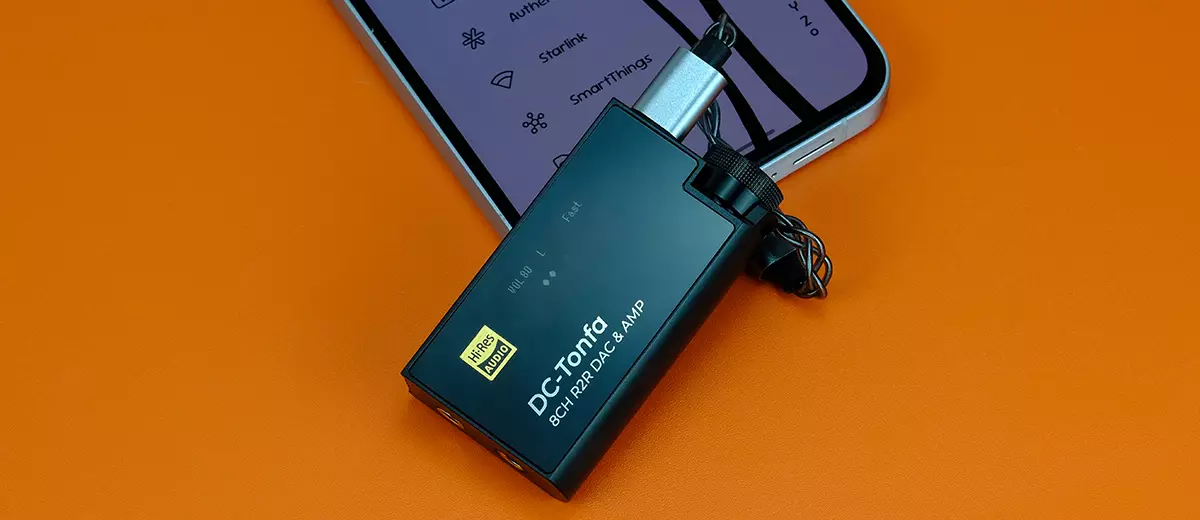
The portable audiophile market has a compelling new contender with the launch of the iBasso DC-Tonfa, a discrete R2R dongle DAC priced at $359.00. Co-developed alongside renowned Japanese retail giant e-earphone, this device represents a strategic shift for iBasso. Rather than chasing clinical neutrality or ultra-precise analytical measurements—hallmarks of the brand’s previous DC series—the DC-Tonfa is deliberately engineered to deliver a robust, analog-leaning sound signature optimized for high emotional engagement and musicality.
Operating as an 8-channel, fully differential R2R DAC, the unit leverages a sophisticated architecture. It incorporates dual Texas Instruments op-amps, four BUF634A buffers, and 312 ultra-low-temperature-drift Viking metal film resistors—including 60 dedicated entirely to a hardware resistor compensation network.

Despite its compact dongle form factor, the DC-Tonfa punches well above its weight class, pushing up to 800mW of balanced output power into a 32-ohm load. This high output capability allows it to effortlessly drive modern planar magnetic headphones, while its dedicated Linear LT3042 ultra-low-noise LDO (delivering 0.8 µV output noise and 100 dB PSRR) ensures a dead-silent background for ultra-sensitive in-ear monitors (IEMs).
Chronology and Development
The genesis of the DC-Tonfa stems from a collaborative desire to bridge the gap between portable convenience and desktop-tier analog warmth.

- Early Concept Phase: iBasso partnered with e-earphone to capture specific consumer demands from the Japanese retail market. Customer feedback pointed toward an overwhelming preference for two main traits: heightened driving power and a more emotionally connected, engaging sonic presentation.
- Engineering and Prototyping: Utilizing R2R topology previously explored in higher-end components like the iBasso DX270 digital audio player, engineers adapted the architecture down to a portable dongle chassis. They integrated dual Accusilicon femtosecond crystal oscillators and iBasso’s proprietary FPGA-Master system for advanced digital signal management and jitter reduction.
- Release and Commercial Launch: Priced competitively at $359.00, the DC-Tonfa launched to the global audiophile community, quickly drawing comparisons to established heavyweights like the Cayin RU7 and iBasso’s own DC-Elite.
Supporting Data and Technical Architecture
A breakdown of the DC-Tonfa’s internal components and specifications highlights its technical ambition:
| Specification / Feature | Detail |
|---|---|
| Price | $359.00 USD |
| DAC Architecture | Discrete 8-channel, fully differential R2R |
| Resistors | 312x Viking metal film resistors (60 for hardware compensation) |
| Max Output Power | 800mW (Balanced, 32Ω load) |
| Supported Formats | Up to 32-bit/768kHz PCM, Native DSD512 |
| Analog Components | 2x Dual TI Op-Amps, 4x BUF634A Buffers |
| Power Regulation | Linear LT3042 ultra-low-noise LDO (0.8 µV noise, 100 dB PSRR) |
| Clocking | Dual Accusilicon femtosecond crystal oscillators + FPGA-Master |
| Display & Interface | 0.96-inch OLED screen with a multi-function rotary dial |
| Outputs | 4.4mm Balanced, 3.5mm Single-Ended (Doubles as S/PDIF Coaxial out) |
Design, Build Quality, and Controls
Sharing a similar physical footprint with the iBasso Nunchaku and DC-Elite, the DC-Tonfa leans toward the bulkier side for a dongle DAC. However, this extra footprint houses a durable aluminum housing capped with tempered glass front and rear panels, ensuring zero plastic construction.

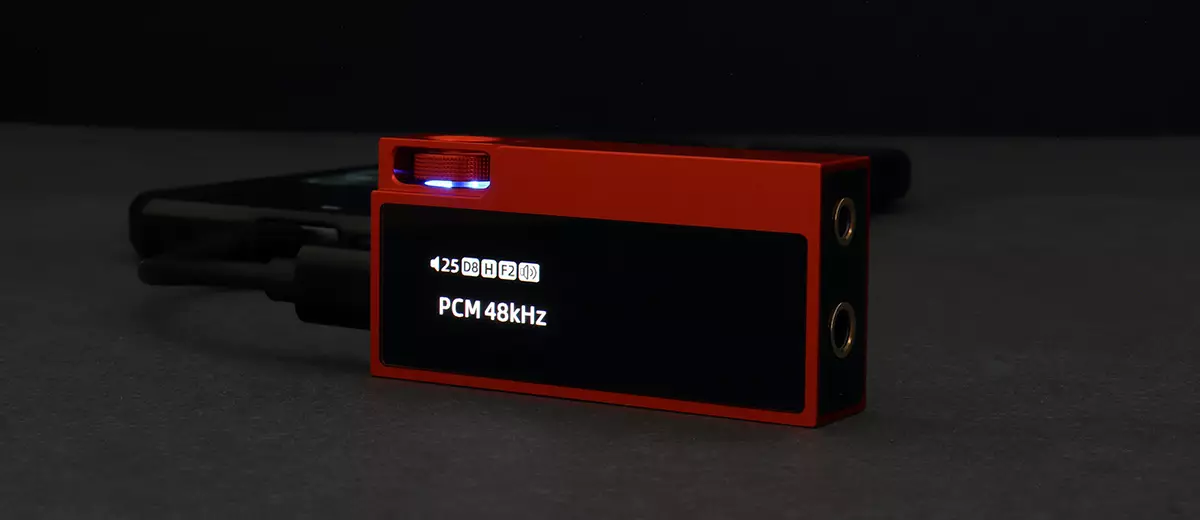
The unit features a 0.96-inch OLED display that clearly presents real-time operational data, including volume levels, active gain states, and digital filter selections. Navigation is managed via a guarded multi-function rotary dial. Pressing the dial for one second summons the on-screen menu, where users can seamlessly cycle through settings.
For connectivity, the top panel hosts a USB-C port supporting UAC 2.0 and UAC 1.0 protocols. The base houses both 3.5mm and 4.4mm headphone jacks. Notably, the 3.5mm port doubles as an S/PDIF coaxial output, transforming the DC-Tonfa into a pure transportable source component when paired with external DACs or amplifiers.

Accessories and Ecosystem
Out of the box, the DC-Tonfa includes a comprehensive accessory suite:
- A color-matched, grain-finished leather protective case featuring an integrated MagSafe magnetic ring on the rear for secure smartphone mounting.
- Two short, premium braided 4-core USB-C to USB-C and Lightning cables.
- A USB-C to USB-A adapter for legacy computer connections.
Official Responses and Collaborative Vision
The partnership between iBasso and e-earphone was pivotal in shaping the product’s identity. Representatives from e-earphone noted that modern portable audio consumers are increasingly fatigued by overly clinical, sterile measurements that sacrifice musical enjoyment for technical precision.

In response, iBasso’s engineering team focused heavily on tuning the R2R ladder network to emphasize harmonic richness and spatial depth. By incorporating a dedicated Non-Oversampling (NOS) mode alongside standard oversampling (OS) filter profiles, the developers gave users direct control over the reconstruction filtering, allowing them to alternate between a clean, sedate presentation and an aggressive, punchy analog delivery.
Implications for the Portable Audio Market
The release of the iBasso DC-Tonfa carries several important implications for the personal audio industry:

- Mainstreaming R2R in Micro-Form-Factors: Historically, discrete R2R ladder DACs were restricted to bulky desktop units or expensive portable digital audio players due to space and power constraints. The DC-Tonfa proves that high-performance R2R processing can be successfully miniaturized into a dongle form factor without catastrophic compromises to power delivery or thermal management.
- The Shift Toward "Musicality" Over Pure Measurement: As the portable DAC market reaches a saturation point of ultra-clean sigma-delta chipsets, consumer demand is clearly pivoting toward gear with character. By leaning into an analog-like sound signature with deep bass texture and forward vocal imaging, iBasso provides a distinct alternative for listeners who prioritize emotional engagement over flat frequency response graphs.
- Redefining Value at the $350 Price Point: At $359.00, the DC-Tonfa undercuts ultra-premium flagship dongles while offering desktop-grade driving power (800mW). This challenges manufacturers to rethink feature parity, proving that consumers expect advanced hardware compensations, physical OLED displays, and robust planar-driving capabilities even in mid-tier portable products.
Ultimately, the iBasso DC-Tonfa stands out not merely as an incremental upgrade to the brand’s catalog, but as a deliberate artistic statement—one that successfully merges old-school R2R warmth with modern smartphone-era convenience.