By Tech & Home Cinema Editorial Desk
Published: September 2024
Artificial intelligence has officially infiltrated virtually every corner of the consumer electronics landscape, and the home entertainment sector is no exception. From smartphones to refrigerators, the omnipresent influence of machine learning algorithms now promises to optimize our daily interactions with technology. The latest industry heavyweight to join the AI bandwagon is projector stalwart Epson, which has just pulled back the curtain on an ambitious new range of 4K home cinema projectors.
Headlined by a sophisticated, AI-driven image-processing engine, this new four-model lineup aims to redefine what home viewers can expect from digital projection. By dynamically adapting picture settings to the specific content on screen, boosting lower-resolution upscaling efficiency, and refining both contrast and motion handling, Epson is signaling a massive leap forward in projector intelligence.
Positioned comfortably below the award-winning, high-end EH-LS9000, the new series is split squarely down the middle: two entry-to-mid-range offerings (the EH-LS5000 and EH-LS6000) and two performance-tier heavyweights (the EH-LS7000 and EH-LS7500). With European rollouts slated imminently, home theater enthusiasts have plenty to get excited about as autumn sets in.
Main Facts
At the core of Epson’s fresh projection hardware strategy is the integration of MediaTek’s robust MT9681 chipset. This powerful silicon not only acts as the central nerve system for the newly minted AI image-processing suite, but it also provides native support for high-bandwidth 4K video playback at up to 120Hz via HDMI 2.1. This makes the new range exceptionally appealing to next-generation console gamers looking for buttery-smooth frame rates on massive screens.
The four-model lineup breaks down as follows:
- EH-LS5000: The entry-tier model utilizing Epson’s proprietary 3LCD technology, offering a peak brightness of 2,500 lumens.
- EH-LS6000: A step up in the accessible bracket, pushing brightness capabilities up to 3,400 lumens.
- EH-LS7000: A premium-tier option aimed at dedicated media rooms, hitting a formidable 3,600 lumens.
- EH-LS7500: Epson’s flagship professional short-throw offering in this batch, combining a compact footprint with 3,500 lumens of brightness.
Crucially, all four projectors boast native 4K capabilities, HDR10 and HLG support, and integrated Matter smart home connectivity, allowing seamless incorporation into automated home ecosystems alongside voice assistants.
Chronology: The Evolution of Epson’s Smart Projection Journey
To understand the significance of Epson’s latest announcement, it helps to examine the timeline of how the company has iterated on its home cinema technologies over recent years.
- Pre-2023: The Foundation of 3LCD and Laser Light Sources
For years, Epson built its formidable reputation on proprietary 3LCD technology, utilizing three distinct liquid-crystal chips to split white light into red, green, and blue beams. This design philosophy focused heavily on eliminating the "rainbow effect" often found in single-chip DLP projectors while maintaining high color brightness. - Late 2023 – Early 2024: Premium Flagship Launches
Epson introduced critical benchmarks in the high-end sector, notably releasing acclaimed units like the EH-LS9000 and the EH-QB1000. These models established Epson as a dominant force in high-end, dedicated home theater installations, racking up industry awards along the way. - Mid-2024: The Hardware Bottleneck & The Gaming Push
As next-generation gaming consoles (PS5 and Xbox Series X) pushed standards toward 4K/120Hz, home cinema projectors lagged behind televisions in offering multiple HDMI 2.1 ports with ultra-low input lag. Epson recognized the need for a chipset capable of handling heavy computational video pipelines without compromising gaming performance. - September 2024: The AI-Powered Announcement
Epson officially unveiled the EH-LS5000, 6000, 7000, and 7500. By partnering with MediaTek to integrate the MT9681 chipset, Epson bridged the gap between traditional home theater projection and modern, AI-enhanced video processing. The company announced an immediate European retail rollout targeting late September.
Supporting Data & Technical Specifications
A closer examination of the engineering behind Epson’s newest machines reveals several key proprietary advancements designed to solve common projection pain points, such as thermal management, color fidelity, and spatial constraints.
1. The Power of MediaTek MT9681 and AI Image Processing
The integration of MediaTek’s MT9681 chipset cannot be understated. Historically, projectors relied on simpler scaling engines that often introduced artifacts when blowing up 1080p or lower-resolution content to massive screen sizes. The AI engine baked into the MT9681 analyzes incoming scenes in real-time. It differentiates between skin tones, background foliage, and fast-moving action sequences, applying localized optimizations for contrast enhancement and noise reduction. Furthermore, full HDMI 2.1 bandwidth unlocks 4K/120Hz compatibility, positioning these units for high-end PC and console gaming.
2. 3LCD Technology and LD Boost Innovations
Epson continues to champion its 3LCD architecture across the line. By ensuring that white and color brightness are equal, the projectors avoid the washed-out colors common in some rival technologies.
To combat thermal and acoustic issues—since pushing lamps or laser diodes harder usually results in deafening fan noise—Epson has introduced LD Boost Technology. According to company specifications, LD Boost can dynamically increase peak brightness by up to 12 percent without forcing the internal cooling fans to spin faster or louder. This preserves the quiet acoustic environment necessary for immersive movie watching.
3. Brightness and Throw Metrics
- EH-LS5000 (2,500 lumens): Tailored for dark, controlled home theater environments where absolute black levels and color accuracy take precedence over ambient light rejection.
- EH-LS6000 (3,400 lumens): Offers more flexibility for multi-purpose living rooms where total darkness isn’t always guaranteed.
- EH-LS7000 (3,600 lumens): Built specifically for premium media rooms, capable of punching through moderate ambient light while retaining punchy HDR highlights.
- EH-LS7500 (3,500 lumens): A landmark release as Epson’s first short-throw professional home 4K projector to reach this brightness milestone. Designed for compact spaces, it can project a massive image from mere inches away from the wall—opening doors for unconventional setups such as dedicated media nooks or even indoor golf simulators.
Across the board, these projectors are capable of scaling up to an astonishing 500 inches, transforming virtually any blank wall into a cinematic canvas.
Official Responses and Industry Context
While consumer-facing press releases emphasize the flashy inclusion of artificial intelligence and gaming-friendly frame rates, industry analysts and early briefings have pointed out certain strategic choices made by Epson.
Notably, the inclusion of HDR10 and HLG (Hybrid Log-Gamma) covers the foundational bases for high dynamic range content. However, industry observers have quickly noted the conspicuous absence of advanced dynamic metadata formats such as Dolby Vision or HDR10+. Epson has historically been conservative regarding dynamic tone-mapping licenses, often opting for proprietary internal tone-mapping algorithms. With the inclusion of the new AI processing engine, Epson seemingly believes its hardware can dynamically evaluate and optimize HDR content frame-by-frame on its own terms, potentially bypassing the need for third-party dynamic metadata formats.
Additionally, Epson has leaned heavily into modern smart home integration by adopting the Matter standard. By supporting Matter, Epson ensures that its new projectors are future-proofed, allowing users to integrate the hardware smoothly into Apple Home, Google Home, Amazon Alexa, or Samsung SmartThings ecosystems without proprietary app friction.
Implications: What This Means for the Home Cinema Market
Epson’s latest product drop carries several profound implications for the consumer projection market as we head toward the holiday shopping season.
1. The Democratization of High-Refresh Gaming on Big Screens
For years, serious gamers had to choose between high refresh rates (120Hz+) on small television sets or cinematic immersion on sluggish, high-latency projectors. By introducing HDMI 2.1 support and low-latency processing via the MediaTek chipset, Epson is actively courting the demographic that views a 100-inch-plus display as the ultimate gaming monitor.
2. AI as a Standard Feature, Not a Gimmick
As machine learning chips become cheaper and more efficient, consumer tech buyers are growing weary of "AI washing"—the practice of slapping the "AI" label on basic algorithms. Epson’s implementation, however, addresses concrete projector limitations: upscaling legacy content cleanly, managing dynamic contrast in real-time, and maximizing brightness via LD Boost without sacrificing acoustic tranquility. If these algorithms perform as advertised, AI processing will quickly transition from a luxury marketing bullet point to a baseline consumer expectation in the projection space.
3. Versatility Over Dedicated Darkness
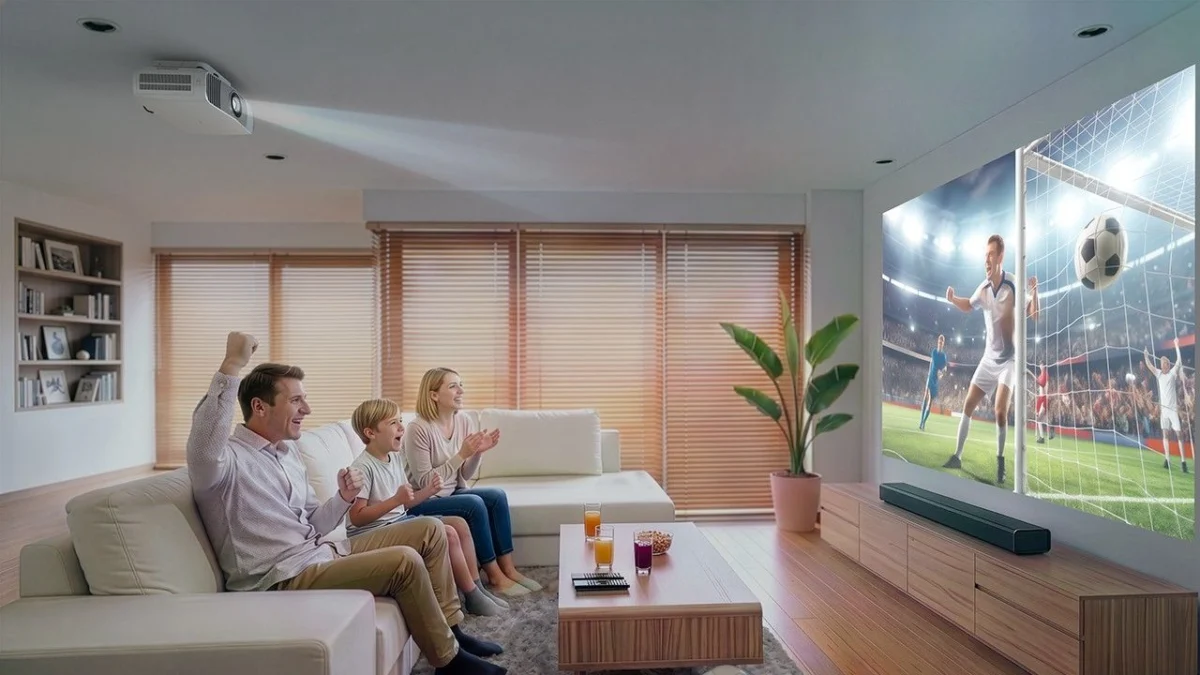
The inclusion of the EH-LS7500 short-throw projector highlights a shifting consumer paradigm. Modern buyers increasingly demand home entertainment technology that adapts to multi-functional living spaces rather than requiring a dedicated, light-controlled basement bunker. By packing 3,500 lumens into a short-throw form factor suitable for media rooms, apartments, and even indoor entertainment spaces like golf simulators, Epson is expanding the total addressable market for high-end projection.
Conclusion
Epson’s new quartet of 4K projectors proves that even legacy hardware categories must adapt to the modern computational era. By marrying time-tested 3LCD imaging with cutting-edge MediaTek silicon, AI-driven video processing, robust smart home integration, and gamer-friendly HDMI 2.1 specs, Epson has delivered a comprehensive lineup that bridges the gap between traditional home cinema purity and modern lifestyle versatility. As these units hit European shelves this month, all eyes will be on how well the AI engine performs in real-world testing—and whether competitors will be forced to rush their own machine-learning projection suites to market.