Main Facts
When hip-hop innovator and creative visionary A$AP Rocky finalized the North American leg of his highly anticipated Don’t Be Dumb tour, the production team faced a unique acoustic and spatial challenge. Known for pushing the boundaries of stage design and immersive concert production, the artist’s vision centered on placing himself—and the audience’s primary focus—at a B-stage positioned on a thrust near the center of the arena, right underneath the scoreboard.
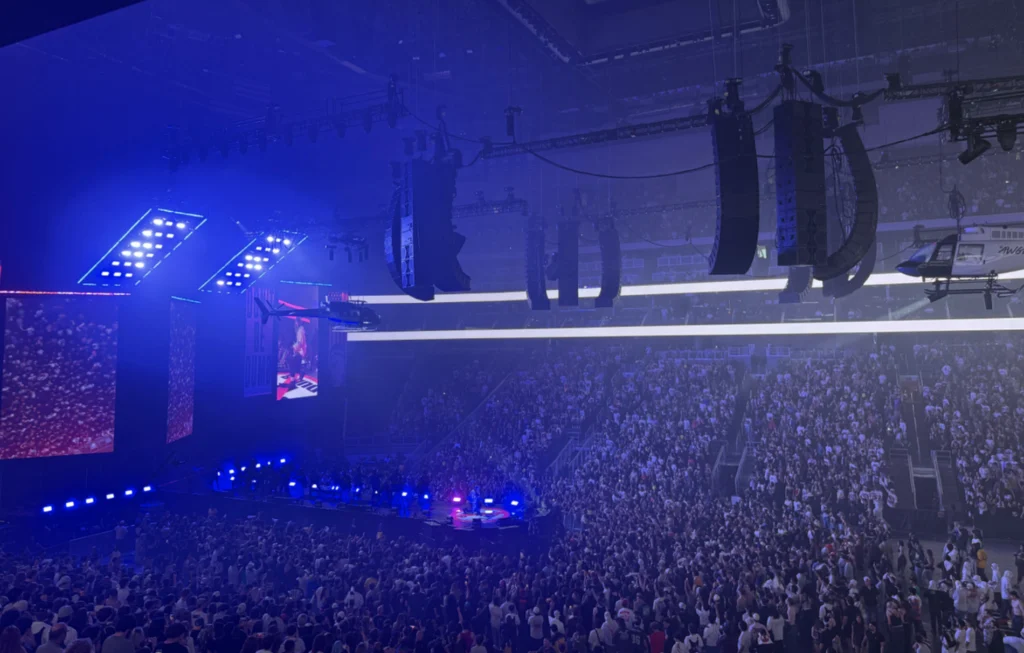
To bring this ambitious concept to life, the final 10 shows of the tour relied on a cutting-edge, 360-degree in-the-round sound reinforcement system powered entirely by Cohesion loudspeakers and supporting audio hardware. Headlined by the robust CO12 line array elements and the hard-hitting CP218 II+ subwoofers, the deployment was engineered to deliver direct, punchy, and crystal-clear audio to every single seat in the house.
The massive audio configuration was divided into four distinct quadrants. Each quadrant featured two formidable arrays comprising 16 CO12 loudspeakers and eight flown CP218 II+ subwoofers arranged in a cardioid configuration. This brought the total flown inventory to 128 CO12 enclosures and 32 CP218 II+ subwoofers. Additionally, eight flown CO10 loudspeakers were deployed as pit fills to ensure seamless coverage directly below and around the central stage elements.
On the arena floor, the low-frequency impact was further amplified by 21 additional CP218 II+ subwoofers arranged in horizontal cardioid carts surrounding the B-stage, each topped with a pair of CO10 loudspeakers. Deployment across the final stretch of the tour was executed seamlessly by veteran crews from industry heavyweights Sound Image, Eighth Day Sound, and Clair Global.
Chronology of the Tour’s Acoustic Evolution
The integration of the 360-degree Cohesion system did not happen overnight; it was the result of a calculated evolution in response to A$AP Rocky’s dynamic stage requirements.
The Mid-Tour Handover
Front-of-house (FOH) engineer Zach Stansberry joined the tour in Texas, taking over mixing duties for the second half of the U.S. run. Around the same time, monitor engineer Ishti Szilagyi joined the trek in Florida, overseeing the final 15 shows. Stepping into an already rolling production meant adapting quickly to A$AP Rocky’s relentless energy and unpredictable staging.
Conceptualizing the 360-Degree Design
The conversation regarding a shift from a standard end-stage deployment to an in-the-round setup was sparked by the artist himself. A$AP Rocky spends the vast majority of his performances stationed at the B-stage at the end of the central thrust. He explicitly requested that the auditory experience feel as though it were emanating directly from that central focal point—hitting the audience “in the face” with immediate, visceral impact.
System engineer and crew chief Andy Bongardt accepted the challenge, designing a symmetrical, four-quadrant PA layout. This configuration successfully decentralized the audio, wrapping the entire arena in a nearfield-style sonic blanket.
The Live Show Arc
Each performance followed a thrilling, high-octane narrative arc. The show opened with A$AP Rocky immersed directly in a mosh pit on the floor right in front of the FOH mixing position. For the second act, the artist ascended into the arena’s air space inside a fully realized helicopter set piece—one of three helicopter props utilized during the high-energy performances. Finally, he descended back to the thrust to command the stage for the explosive finale. Throughout these dramatic transitions, the audio crew had to dynamically track the artist’s movements across the stage and through the air, ensuring that vocals and sound effects remained pristine and tightly integrated with the visual spectacle.
Supporting Data and Technical Specifications
The success of the Don’t Be Dumb tour’s final run was underpinned by impressive metrics, showcasing the efficiency, headroom, and sonic capabilities of the Cohesion ecosystem.
Audio Performance and SPL Metrics
- Total Flown CO12 Cabinets: 128 units (configured in four quadrants of two arrays of 16).
- Total Flown CP218 II+ Subwoofers: 32 units (flown cardioid configuration).
- Total Ground CP218 II+ Subwoofers: 21 units (horizontal cardioid carts around the B-stage).
- Fill Speakers: 8 flown CO10 pit fills, plus pairs of CO10s atop the ground sub carts.
- Sound Pressure Levels (SPL): The shows consistently operated at a comfortable yet powerful 105–108 dB A-weighted and 128–130 C-weighted.
- Amplification Efficiency: Despite the massive sonic output, the system never touched its protection limiters. The entire arena audio setup was successfully powered off a single 400A 3-phase disconnect, highlighting the remarkable electrical efficiency of the modern amplification technology.
Spatial and Logistical Advantages
By utilizing aerial amplifier racks, the production significantly reduced the amount of ground space required for amplification gear. Furthermore, the 360-degree configuration optimized truck-pack space and reduced the overall weight of the touring system compared to traditional, sprawling distributed systems.
Because modern Cohesion enclosures throw farther with higher impact, the engineering team was able to achieve superior results with fewer physical enclosures overall. This was particularly crucial given that some venue visual elements—specifically the hovering helicopter props—required the PA system to be trimmed significantly higher than usual.
Official Responses and Engineering Insights
The crew members responsible for delivering the tour’s sound praised the gear and the collaborative effort required to pull off such a complex technical feat.
"A$AP Rocky is really creative — you have to be on your A-game working with him since he has a ton of visions of stage designs and ideas for how the show needs to look and sound," noted FOH engineer Zach Stansberry.
Stansberry emphasized the transparency and headroom of the Cohesion boxes:
"This was a different approach to mixing than a typical left-right, which is a longer throw. I’m closer to the PA on the 360 degrees. It sounded like everybody was in the nearfield. I didn’t have to push as much with Cohesion to get what I needed. I wasn’t even close to maxing out the headroom. That’s the great thing about Cohesion. It sounds big and powerful without hitting any gain reduction with the way I mix."
System engineer and crew chief Andy Bongardt highlighted the dual challenges of massive arena scoreboards and the artist’s specific sonic demands:
"[A$AP Rocky] wanted the auditory experience for the audience to come from that center focal point, hitting the audience ‘in the face.’ […] In some of these arenas, with ever-growing massive scoreboard setups, the roof structure where we can rig can get pushed out 40 or 50 feet from the center of the floor. This makes even coverage a challenge on the floor area behind the main arrays; luckily, I had the CO10 pit fills as my ‘secret weapon.’"
Bongardt also pointed out the physical advantages of the system:
"We needed to trim the system high due to some of the visual elements of the show […] Cohesion throws farther at higher impact, and we could do more with fewer physical enclosures. The new amplification technology is a noticeable advancement in sonic quality, and we’re able to get a very smooth high-frequency response, even at much higher SPL that doesn’t feel painful."
Monitor engineer Ishti Szilagyi shared his astonishment at the raw power of the sub-low deployment:
"I walked each arena multiple times, and the coverage was insane—there was low end on top of the bleachers! The subs were so powerful, they were literally shaking the stage. I’ve never had a situation like that. It was mesmerizing."
Szilagyi added praise for the logistical turnaround:
"With that number of speakers and that truck space? Good luck beating this system. It was insane to see, with the right preparation and people behind it, how fast the PA could go up and come down—really smooth sailing."
Finally, Stansberry reflected on the artistry of mixing a live hip-hop performance on such a sophisticated rig:
"I tried to follow him on stage as much as I could, whether mixing sound effects or vocals—I was mixing a live show. I wasn’t just letting my snapshots fire. I mixed every element so the audience could relate to what he relayed to them. You have to get the details relayed, no matter if it’s rap, R&B, anything else. I love that Cohesion is transparent. They put that engine in the car and let you drive it."
Implications for Future Arena Tours
The successful deployment of the Cohesion 360-degree PA system on the final North American stretch of A$AP Rocky’s Don’t Be Dumb tour establishes a compelling new benchmark for modern arena concert production.
As hip-hop and contemporary urban artists continue to demand theatrical, multi-dimensional stage designs—incorporating central thrusts, suspended props, and immersive audience interactions—traditional end-stage sound reinforcement models often fall short. By pivoting to a four-quadrant, in-the-round Cohesion configuration, the production team proved that artists no longer have to compromise sonic weight or vocal clarity for the sake of immersive spatial design.
The implications for touring audio engineers and production managers are clear:
- Decentralized Coverage Solves Arena Obstacles: With modern scoreboards and rigging limitations pushing main hang points further away from the floor center, targeted fill systems (such as the CO10) and carefully time-aligned cardioid sub-arrays (like the CP218 II+) are essential for eliminating dead zones.
- High Output Meets Efficiency: The ability to run a massive arena show at high, distortion-free SPLs (105–108 dB A-weighted) off a single 400A 3-phase disconnect demonstrates that future tours can achieve monumental sonic impact while minimizing power consumption and venue infrastructure demands.
- Logistical Streamlining: Reducing the physical number of enclosures required to achieve superior throw and high-frequency smoothness translates directly to reduced truck-pack footprints, faster load-ins and load-outs by collaborative crew networks (Sound Image, Eighth Day Sound, Clair Global), and lower operational overhead.
Ultimately, the collaboration between A$AP Rocky’s creative team and Cohesion Audio demonstrates that technical innovation and artistic vision can move in lockstep, offering audiences a visceral, crystal-clear concert experience regardless of where they sit in the arena.