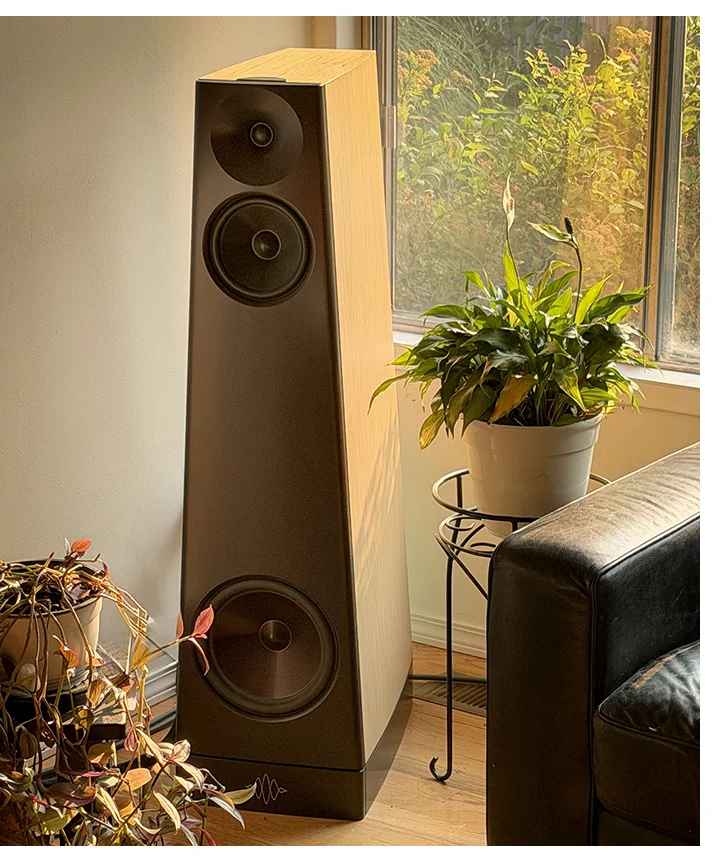
For audiophiles who have long admired the uncompromising engineering and precision-milled aluminum enclosures of YG Acoustics loudspeakers, a common refrain has persisted over the years: “I would buy a pair of those in a heartbeat if only they came in a more traditional wood cabinet.”
For decades, the Colorado-based high-end audio manufacturer has carved out a distinct identity in the ultra-luxury audio sector, relying on aerospace-grade aluminum, complex internal baffling, and computer-numerical-control (CNC) machining to construct cabinets that look as much like modern sculptures as they do audio transducers. While this aesthetic has won over critics and consumers seeking a sleek, industrial look, it has occasionally posed a challenge for interior designers and listeners whose domestic spaces call for the warmth of natural wood finishes.
With the launch and maturation of the Peaks series—culminating in the flagship Summit loudspeaker—YG Acoustics has officially answered that call. By blending their signature metalwork philosophy with advanced resin-and-wood-veneer hybrid enclosures, the company has created a product that preserves its legendary sonic DNA while offering a gentler, more traditional visual footprint. Priced at approximately $30,000 per pair, the Summit sits at the very pinnacle of the Peaks lineup, offering performance that rivals the brand’s renowned Reference series while inviting a broader audience into the fold.
1. Main Facts
The YG Acoustics Summit is a high-performance, three-way floorstanding loudspeaker designed to bridge the gap between industrial-grade aluminum engineering and traditional domestic aesthetics.
- Enclosure Architecture: The Summit utilizes a thick, CNC-machined aluminum front baffle—finished in a striking matte black anodization—which is securely bonded to a specialized high-density resin cabinet wrapped in a fine wood veneer. This hybrid construction softens the visual impact of the speaker without sacrificing structural rigidity.
- Driver and Crossover Technology: Borrowing directly from YG Acoustics’ pedigree, the Summit incorporates the identical proprietary driver and crossover topologies found across the company’s elite speaker offerings, ensuring no compromise in fidelity.
- Acoustic Performance and Pricing: Retailing for roughly $30,000 per pair, the Summit occupies the same price tier as YG’s entry-level Reference series offering, the Carmel 3. However, as a true three-way design, the Summit delivers deeper, more authoritative bass extension and a slightly warmer overall sonic presentation.
- Amplification Flexibility: Boasting a high sensitivity rating of 90 dB (at 1 watt/1 meter), the Summit is remarkably cooperative with a wide range of amplification. It can be driven effortlessly by moderate tube amplifiers starting around 30 watts per channel, yet it scales gracefully when paired with high-end, high-current solid-state monoblocks.
2. Chronology of Development: From All-Aluminum to the Peaks Series
To understand the significance of the Summit, one must trace the evolution of YG Acoustics’ design ethos and the strategic roadmap that led to the introduction of the Peaks series.
The Pure-Metal Era
Founded on principles of extreme mathematical precision, computer modeling, and advanced metallurgical science, YG Acoustics built its stellar reputation on the back of all-aluminum cabinets. Speakers like the Anat, Hailey, and Sonja series utilized thick slabs of aircraft-grade aluminum, carved meticulously to eliminate internal standing waves, resonances, and cabinet coloration. While acoustically peerless, these speakers projected a cold, high-tech aesthetic. For many consumers, finding a place for massive silver or black monoliths in a cozy living room proved to be an insurmountable hurdle, regardless of how breathtaking they sounded.
Recognizing the Market Shift
Recognizing that a significant segment of the audiophile market valued traditional home aesthetics just as much as ultra-low distortion metrics, YG Acoustics initiated development on a more accessible, domestic-friendly line. The result was the Peaks series. The engineering team faced a formidable challenge: how to introduce wood enclosures without compromising the extreme rigidity and acoustic deadness that aluminum provided.
The Birth of the Hybrid Cabinet
The breakthrough came in the form of a hybrid architecture. YG retained their signature machined aluminum front baffle—crucial for anchoring the drivers on an absolutely inert, non-flexible platform—and married it to a newly developed composite resin cabinet exterior clad in genuine wood veneer. This allowed the company to retain the tight mechanical tolerances and diffraction control of their metal baffles while introducing the warm, organic textures of wood.
Arrival of the Summit Flagship
As the Peaks series matured, the lineup expanded to include monitors and smaller floorstanders. However, listeners demanded a flagship model that could compete directly with the lower tiers of the Reference series in terms of scale and full-range authority. Enter the Summit: a true three-way floorstander designed to sit comfortably at the top of the Peaks pyramid, priced identically to the Carmel 3 ($30,000/pair) and offering a compelling alternative for those weighing the merits of pure aluminum versus wood-clad hybrid design.
3. Supporting Data and Technical Specifications
When evaluating a loudspeaker in the $30,000 price bracket, prospective buyers demand rigorous engineering transparency. The Summit does not disappoint, leaning heavily on YG Acoustics’ proprietary research and development.
Acoustic Architecture and Frequency Response
Because the Summit is engineered as a dedicated three-way system, its internal acoustic volume and driver allocation allow it to reach significantly deeper into the sub-bass frequencies compared to two-way or two-and-a-half-way designs of a similar footprint. In typical domestic listening spaces, the Summit extends far enough down the frequency spectrum that an auxiliary subwoofer is largely unnecessary for music reproduction. However, for home theater applications or bass-heavy genres, YG Acoustics offers the matching Descent subwoofer, specifically voiced to integrate seamlessly with the Summit.
Sensitivity and Impedance
One of the most striking technical attributes of the Summit is its favorable 90 dB sensitivity rating. In the world of high-end loudspeakers—which often sacrifice efficiency in favor of flat frequency response and deep bass—a 90 dB sensitivity figure is a welcome luxury.
- Low-Power Compatibility: During testing phases, reviewers successfully drove the Summits with boutique tube-based integrated amplifiers, such as the PrimaLuna EVO 100, which outputs a modest 40 watts per channel.
- High-Power Scaling: Conversely, the speakers proved equally accommodating to brute-force electronics, seamlessly handling heavy-duty Class-A solid-state monoblocks like the Pass Labs XS 300 (delivering 300 watts per channel). This wide dynamic headroom ensures that the speakers can effortlessly track the sudden transients of a full orchestra or an aggressive rock track without running out of breath.
Comparative Metrics: Summit vs. Carmel 3
| Feature | YG Acoustics Carmel 3 | YG Acoustics Summit |
|---|---|---|
| Series | Reference Series (Entry-Level) | Peaks Series (Flagship) |
| Retail Price | ~$30,000 / pair | ~$30,000 / pair |
| Enclosure Material | All-Machined Aluminum | Machined Aluminum Baffle + Resin/Wood Veneer Cabinet |
| Speaker Type | 2-way Floorstander | 3-way Floorstander |
| Sonic Signature | Ultra-transparent, analytical, precise | Warm, full-range, engaging, dynamic |
| Bass Extension | Excellent for size; benefits from sub in large rooms | Deep, authoritative; rarely requires a subwoofer |
| Sensitivity | Moderate | 90 dB / 1-watt |
4. Official Responses and Industry Reception
Early responses from audio critics, industry insiders, and YG Acoustics’ internal teams point toward a resounding success for the Summit.
Industry reviewers who have spent extended periods evaluating the speaker note that the transition to a resin-and-wood enclosure has introduced a subtle, highly desirable sonic character. While the Carmel 3 (from the Reference line) is celebrated for its razor-sharp, hyper-detailed analytical presentation, the Summit leans toward a slightly warmer, more forgiving presentation. It captures every micro-detail of a recording without ever tipping over into clinical fatigue.
According to long-term listening logs from industry publications—whose publishers have anchored their living room reference systems around the Summits paired with various integrated amplifiers—the speakers have proven remarkably versatile. Reviewers have described themselves as "smitten" by the speaker’s ability to disappear into the room musically while anchoring the aesthetic space gracefully.
YG Acoustics representatives have emphasized that the Peaks series was never intended to be a "budget" or "lesser" line. Rather, it represents an alternative path to the same sonic destination. By democratizing their core technologies and housing them in a more living-room-friendly chassis, YG has effectively dismantled the primary barrier to entry that kept traditionalists from experiencing their brand.
5. Implications for the High-End Audio Market
The introduction and success of the YG Acoustics Summit carry several broader implications for the ultra-luxury audio sector:
1. The Convergence of Form and Domestic Harmony
For decades, high-end audio has battled the "Wife Acceptance Factor" (WAF)—a colloquial and somewhat dated term for domestic decor compatibility. By merging cold, precise aluminum engineering with the warm, tactile elegance of wood veneers, YG Acoustics has bridged a psychological gap. The Summit proves that consumers no longer have to choose between cutting-edge industrial design and cozy interior aesthetics.
2. Pricing Parity and Consumer Choice
Pricing the flagship Peaks model at the exact same level as the entry-level Reference model ($30,000) is a brilliant strategic move. It reframes the buying decision. Instead of viewing the Peaks series as a step down in quality, buyers now view it as a lateral move dictated entirely by aesthetic preference and room-matching acoustics: do you want the clinical, all-aluminum look of the Carmel 3, or the warmer, three-way authority and wood-veneer finish of the Summit?
3. Engineering Trickle-Down
The Summit validates the efficacy of hybrid cabinet construction. By demonstrating that resin composites clad in wood can successfully anchor a high-machined aluminum baffle without compromising acoustic integrity, YG Acoustics has opened the door for future innovations across the industry. Other manufacturers may look to this hybrid model as a blueprint for balancing structural rigidity with traditional aesthetics.
Conclusion
The YG Acoustics Summit is more than just another high-end loudspeaker hitting the market; it is a tactical evolution that listens directly to the consumer base. By taking the world-class drivers and crossover technologies from their high-end lineage and housing them in a gorgeous, wood-clad resin cabinet anchored by a precision-milled aluminum baffle, YG has solved a decades-old dilemma.
Offering deep, room-filling three-way performance, effortless 90 dB sensitivity, and a price tag that positions it directly alongside its aluminum stablemates, the Summit ensures that audiophiles no longer have to compromise between the sound they crave and the decor they love. As full, long-term reviews prepare to hit the public sphere, one thing is already abundantly clear: the peak of the Peaks series is a very sweet place to be.