By the Headfonics Review Team
In the fast-paced ecosystem of portable audio, true innovation is a rarity. The in-ear monitor (IEM) market is frequently saturated with iterative updates—products relying on familiar cookie-cutter templates, incremental driver counts, and standard closed-shell designs.
Enter Davies and Naomi at Flare Audio, a company long known for charting its own course in acoustic engineering. Following a legacy of idiosyncratic releases ranging from the classic R2A and R2Pro models to the recent Flares Pro 2 and Jet, the British brand has returned with its new flagship offering: the Flare Audio Flare Zero.

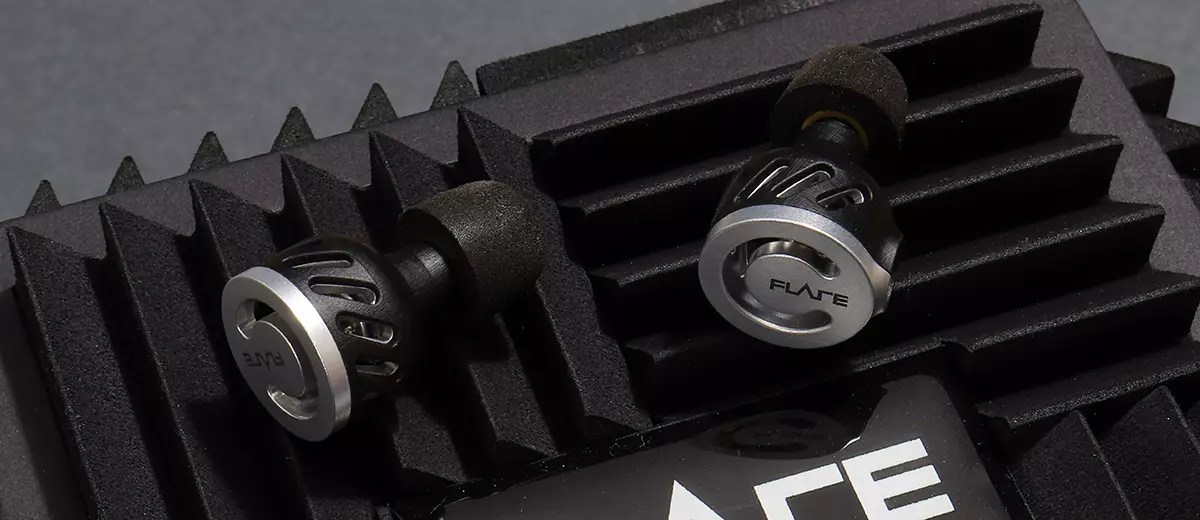
Priced at $595.00, the Flare Zero is not merely another high-end dynamic driver IEM. It represents a fundamental reimagining of how air, pressure, and resonance interact inside a compact shell. Built around a uniquely designed open-back architecture and a single beryllium-coated dynamic driver, the Zero aims to bring the expansive, natural acoustic philosophy of open-back full-sized headphones down to the ear canal.
Main Facts: Architecture and Specifications
At its core, the Flare Audio Flare Zero is an open-back, single-dynamic-driver in-ear monitor featuring a suite of exclusive, patented acoustic technologies.
- Driver Unit: A single high-specification 10mm beryllium-coated dynamic driver.
- Acoustic Design: Fully open-back shell architecture with an inverted horn output nozzle and a turbine-type "spiraled exhaust" back-pressure diffuser.
- Shell Construction: A laminated body combining satin-finished aluminum and poly resin materials to neutralize internal resonances.
- Cable: A 16-core braided silver-coated OFC (Oxygen-Free Copper) cable terminating in standard MMCX connectors and a 3.5mm single-ended plug.
- Price: $595.00 USD.
- Included Accessories: Three distinct tip variants (including comfort and audiophile configurations) in S/M/L sizes, and a custom embossed Flare Audio carrying case.
Chronology: The Evolution of Flare Audio’s Open-Back Philosophy
To understand the significance of the Flare Zero, one must examine the trajectory of Flare Audio’s design philosophy over the past decade.

The Early Years and Closed Designs
Back in 2015, models like the R2A and R2Pro established Flare Audio as a brand willing to experiment with tiny metal enclosures to achieve direct sound delivery. Subsequent iterations, including the Flare Studio, Studio Master, and Flares Pro, continued to tinker with ear-insert dynamics, often flying under the mainstream radar while cultivating a dedicated following among purists.
The Shift Toward Open-Air Acoustics
While the audio industry at large transitioned its full-sized over-ear headphones from closed-back to open-back designs to unlock superior soundstages and natural airiness (culminating recently in radical designs like HIFIMAN’s HE1000 Unveiled and Arya Unveiled), IEMs stubbornly remained closed-back. Simple venting was typically the extent of pressure management.
Flare Audio challenged this paradigm by conceptualizing a true open-back IEM environment. While they also developed a sister closed-back model, the Flare Ultra, the Flare Zero became the primary vehicle for their "zero-refraction" acoustic concept—a milestone chronology for a company that has spent years eliminating internal acoustic reflections piece by piece.

Supporting Data & Engineering: Unpacking the Technology
The engineering choices behind the Flare Zero are extensive, tackling complex acoustic hurdles through remarkably direct mechanical solutions.
1. The Single Driver Advantage
By choosing a single 10mm beryllium-coated dynamic driver, Flare Audio bypassed the need for complex crossover networks. Without passive components sitting between the amplifier and the driver, the system operates on a "source point" principle. The driver connects directly to the audio source, preserving phase coherence and timing accuracy.
2. The Inverted Horn and Spiraled Exhaust
Mounted directly on the inner output nozzle facing the ear canal, the driver sits in front of an inverted horn output nozzle. This geometry aims to project sound cleanly into the ear canal while minimizing unwanted wave reflections.

Behind the driver lies an open-chamber environment backed by a turbine-like surface dubbed the spiraled exhaust. While companies like FiiO utilize internal turbo designs (such as S-Turbo) to control cone motion and back pressure, Flare’s spiraled exhaust is specifically engineered to diffuse driver back-refractions, preventing internal standing waves from muddying the output.
3. The Laminated Shell Body
One of the most fascinating engineering triumphs of the Flare Zero is its composite shell. Through years of material testing, Flare Audio discovered that individual materials possess distinct resonant frequencies that color sound.
Their solution was a laminated body combining satin-finished aluminum with a poly resin material. By pairing these two distinct media, the shells effectively cancel out each other’s resonant frequencies, creating an acoustically dead enclosure. This ensures that the listener hears only the driver—free from second harmonics, shell-induced coloration, or internal reflections.

Ergonomics, Design, and Accessories
Comfort, Fit, and Isolation
Despite the complex internal engineering, the Flare Zero boasts an exceptionally lightweight form factor, tipping the scales at an estimated 6 to 7 grams per earbud. The output stems are notably elongated, allowing the nozzle to sit deep and close to the ear canal for unhindered sound delivery.
Because the shell features an open-back design, passive noise isolation is only average—outside ambient noise will bleed in. Interestingly, sound leakage to the outside world is remarkably well-controlled, maintaining a polite profile for public listening.
Tip Rolling and Customization
The Flare Zero ships with three distinct sets of ear tips: standard silicone, comfort-oriented tips, and audiophile-focused variants.

- Audiophile Tips: Deliver the widest frequency range, deepest extension, and the most impactful dynamic slam by positioning the nozzle closest to the inner ear.
- Alternative Tips (e.g., TRI Clarion): Open up the soundstage significantly and enhance airiness, though with a slight trade-off in bass wallop and low-end focus.
Stock Cable and Packaging
The stock cable is a flexible 16-core braid of silver-coated OFC strands with minimal microphonics. While the hardware relies on standard, durable components—including metal-housed 3.5mm plugs and color-coded MMCX connectors (red and white for channel identification)—it opts for a simple clear polystyrene bead as a chin slider.
The unboxing experience matches the acoustic theme: the packaging folds open like an inverted anechoic chamber, revealing the mirrored, ambidextrous IEM shells, the three tiers of tips, and a premium embossed carrying case.
Sound Impressions: Performance Analysis
Tested across high-end desktop and portable chains—including the Questyle SIGMA/SIGMA Pro, iFi audio iDSD Diablo 2, and FiiO M11 Pro—the Flare Zero reveals a distinctly transparent, reference-grade sonic signature with a surprising undercurrent of musicality.

Bass Performance
Capable of digging down to a subterranean 16Hz, the 10mm beryllium driver prioritizes texture, speed, and resolution over bloated, sub-bass dominance. The low-end response features rapid attack and decay times. Rather than a party-level wall of bass, listeners are treated to the subtle nuances of string vibrations, room resonances, and natural afternotes.
Midrange Clarity
The midrange is where the Zero truly shines. Void of artificial coloration, vocals and instruments are presented with breathtaking transparency and a strong physical presence. A pair of minor peaks at 5kHz and 7kHz are deftly tamed by the inverted horn nozzle, ensuring that vocals remain smooth, balmy, and free of stridency while retaining intimate details like performer breathing and fret friction.
Treble and Highs
High frequencies exhibit effortless extension and airiness. At moderate listening volumes, the treble sparkles with crisp detail. When driven harder, the high frequencies deliberately pull back slightly to prevent fatigue—a hallmark of a well-controlled dynamic driver that refuses to lose composure under stress.

Soundstage and Dynamics
Thanks to the open-back architecture, the soundstage feels remarkably organic, emphasizing width and depth to place the listener roughly seven rows back in a live concert venue. Macro-dynamic shifts—from whisper-quiet micro-details to explosive, sudden crescendos—are handled with an unrestrained transient response made possible by free-air driver movement.
Implications: A New Benchmark for Open IEMs?
The introduction of the Flare Audio Flare Zero at $595.00 marks a significant inflection point for the portable audio community. For years, true open-back in-ear monitors have been exceedingly rare, often confined to niche, high-priced eccentricities like the Audeze iSINE/LCDi4 series or heavily vented hybrids.
By successfully translating the acoustic advantages of open-back full-sized headphones into a lightweight, dual-material laminated IEM shell, Flare Audio has bypassed the conventional limitations of closed-in-ear acoustics.

For the audiophile and studio professional alike, the Flare Zero offers a compelling proposition: a window into recordings that strips away artificial coloration and cabinet resonances. It challenges the market to rethink how IEMs handle air pressure and cabinet design, proving that true innovation still has a home in portable audio.