Audio Engineering & Hardware Analysis — Topping, a brand historically synonymous with high-end desktop digital-to-analog converters (DACs) and headphone amplifiers ranging from the ultra-affordable DX1 II to the flagship DX9 Discrete, has officially expanded its horizon. With the launch of the Topping MA4, priced competitively at $319.00 per set, the company has broken into the powered loudspeaker market under its new sub-brand, Topping Professional.
Aimed squarely at audio engineers, producers, and nearfield audiophiles, the MA4 represents a calculated gamble for a company best known for micro-electronics. Reviewers and industry insiders have expressed both curiosity and caution regarding this pivot. However, an extensive evaluation reveals that Topping’s maiden voyage into studio monitors is a remarkably mature release, balancing analytical precision with musical engagement.

Main Facts & Overview
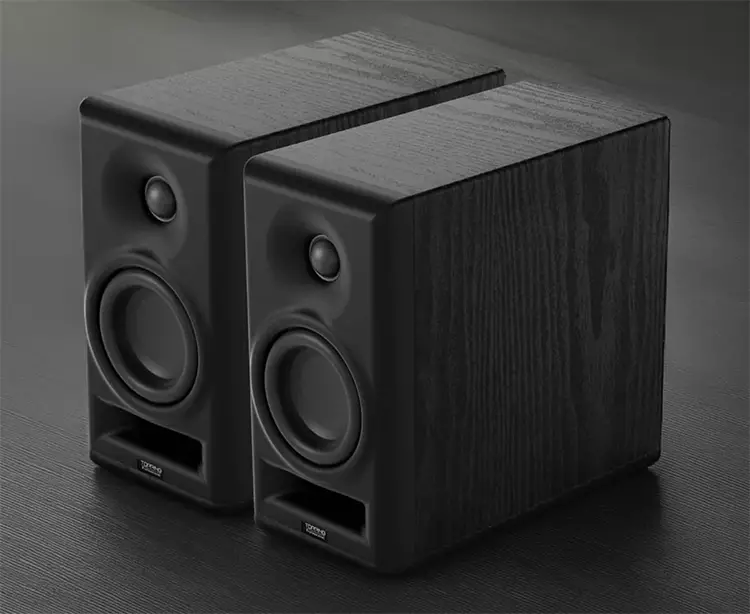
The Topping MA4 is a compact, bi-amplified active desktop speaker system built around a 4-inch paper woofer cone, a 1-inch domed tweeter, and an integrated Opti-Wave waveguide.
- Price Point: $319.00 USD (per set)
- Amplification: Bi-amplified architecture featuring a 50W woofer amplifier and a 25W tweeter amplifier.
- Acoustic Standards: Adheres to the stringent CTA-2034 loudspeaker measurement standard for frequency response, directivity, and maximum output capability.
- Connectivity: Dedicated, fully balanced analog XLR inputs.
- Dimensions & Weight: 14.0 cm x 25.5 cm x 28.8 cm; weighs 3.78 kg per speaker.
- Colorways: Available in matte black/black and clean white/white configurations.
Chronology of Development and Market Entry
Topping’s transition from desktop DACs and amplifiers to fully realized active studio monitors did not happen overnight. For years, the company established an enviable reputation in the personal audio community for engineering-heavy, ultra-low-distortion components.

As the brand saturated the headphone amplification and digital decoding markets with units like the DX9 and various DAC stacks, engineers at Topping began conceptualizing a hardware ecosystem that could bridge the gap between pure digital source conversion and physical air translation.
The Pre-Release Buzz
Months prior to its official commercial shipping date, early prototypes and industry whispers hinted that Topping was developing an active monitor. Early skepticism was palpable: the pro-audio loudspeaker market is fiercely competitive, dominated by legacy giants like Genelec, Yamaha, and KRK, alongside modern desktop challengers like Edifier and FiiO.

However, upon arrival at review benches worldwide—including extensive hands-on testing by independent audio publications—the MA4 quickly dispelled doubts. By leaning into its core philosophy of low distortion, transparent engineering, and strictly balanced analog signal paths, Topping transformed skepticism into genuine industry interest.
Supporting Data & Engineering Specifications
To understand how the Topping MA4 performs in real-world environments, one must look closely at its acoustic and electronic architecture. Unlike many consumer desktop speakers that rely heavily on digital signal processing (DSP) and subsequent AD/DA conversions to sculpt sound signatures, the MA4 takes a purist approach.

The Fully Balanced Analog Crossover
The MA4 utilizes a fully balanced analog crossover set at 1.4kHz. By avoiding DSP-based correction loops, the signal path remains entirely analog from the balanced XLR input straight to the amplification stages. This eliminates conversion latency and minimizes digital jitter or quantization distortion, preserving the inherent transient speed of the source gear.
Acoustic Dispersion and Cabinet Design
The integration of a 50W amplifier for the woofer and a 25W amplifier for the tweeter ensures ample headroom for nearfield monitoring.

- Forward-Facing Bass Reflex Port: Engineered to mitigate unwanted internal standing waves and attenuate resonances hovering around the 1kHz mark. This prevents muddy midrange interference—a common pitfall in compact desktop monitors.
- The Opti-Wave Waveguide: Surrounding the 1-inch domed tweeter, this custom waveguide optimizes off-axis response. Even in untreated or semi-treated rooms, the sweet spot remains remarkably broad, allowing for accurate horizontal and vertical dispersion.
- CTA-2034 Compliance: Meeting the CTA-2034 standard guarantees that the speaker has undergone rigorous testing regarding its directivity index, listening window response, and sound power levels.
Rear-Panel Controls and I/O
The rear control array is straightforward, featuring a master power toggle, a sensitivity switch, and a high-frequency trim switch.
- Sensitivity Switch: Offers three settings—+4dBu, +14dBu, and +24dBu—allowing users to match the speaker’s input gain structure seamlessly with high-output pro-audio interfaces or external DACs. (Most desktop setups comfortably utilize the +4dBu setting).
- High Trim Switch: Provides adjustments at +2dB, 0dB, and -2dB in the treble region, enabling users to compensate for overly reflective studio spaces or personal hearing preferences.
Sound Impressions & Performance Analysis
After a mandatory 75-hour burn-in period, critical listening sessions were conducted using high-end source gear, including the JC Acoustics UDP-5 and YULONG DA-ART Aquila III, connected via balanced XLR cables. Additional testing sources included coaxial feeds from an Oppo BDP-83 and optical inputs from a Fosi Merak setup.

1. Bass Performance
The low-end response of the MA4 is defined by control rather than chest-thumping bravado. Driven by the 4-inch paper cone and assisted by the front-firing reflex port, the bass is taut, highly articulate, and surprisingly extended for a footprint of this size.
- It is unmistakably a studio monitor low end: it refuses to bleed into the midrange, avoiding the bloated, exaggerated warmth found in consumer multimedia speakers.
- While bassheads seeking sub-bass subversion might crave a dedicated subwoofer, producers will appreciate the honest, fast transient decay that exposes lower-mid congestion immediately.
2. Midrange Clarity
The midrange is arguably the crown jewel of the MA4. Thanks to the carefully calculated 1.4kHz crossover point, vocals and lead instruments occupy a vivid, three-dimensional space without feeling overly forward or recessed.

- The balance between attack and decay is exceptionally tuned. Attack transients carry enough weight to sound realistic and organic, while a slightly shortened decay ensures the presentation never turns sluggish or muddy.
- Acoustic guitars, pianos, and male/female vocal tracks are rendered with surgical precision, making the MA4 an exceptional tool for editing, mixing, or simply evaluating the micro-details of a complex mix.
3. Treble and Spatial Staging
The high frequencies avoid the piercing harshness that plagues many budget active monitors. The 1-inch dome tweeter, backed by the Opti-Wave waveguide, projects a smooth, holographic treble extension.
- The soundstage projects an impressive sense of cubic proportion—stretching wide, tall, and notably deep.
- Instrument separation is remarkably distinct. Even when fed older, compressed compact disc recordings, the MA4 retains its composure, translating spatial cues accurately without artificially boosting high-frequency sheen.
Official Responses and Industry Context
While consumer feedback has been overwhelmingly positive regarding the MA4’s sonic capabilities, early production batches faced minor points of critique within online audiophile communities.

- Physical Depth Limitations: Some users noted that the cabinet depth (roughly 28.8 cm) can make placement on shallow computer desks or tight bookshelves challenging. Topping Professional recommends utilizing dedicated desktop stands or monitor isolation pads to optimize the listening angle and clear up desk space.
- Finish and Dust Accumulation: The wood-patterned plastic finish, while sturdy and well-assembled, tends to attract fingerprints and airborne dust more readily than matte-textured aluminum chassis.
- Accessory Sparsism: Reviewers pointed out that the packaging is exceptionally minimalist—shipped in individual foam-lined boxes with power cables and basic instruction sheets, omitting protective cloth sleeves for transit. However, Topping’s robust structural foam ensures units arrive undamaged even across international shipping lanes.
Implications for the Desktop Audio Market
The release of the Topping MA4 carries significant implications for both the brand and the wider desktop audio ecosystem.
- A New Era for Topping Professional: By successfully executing a dedicated active studio monitor at a sub-$350 price point, Topping has signaled that its engineering prowess is not confined to micro-components. The MA4 proves the brand can scale its philosophy of transparent, low-distortion audio reproduction into electro-acoustic transducers.
- Pressure on Competitors: Rival brands like FiiO (with products like the SP5) and Edifier now face a serious challenger in the entry-to-mid-tier studio monitor category. The strict adherence to balanced-only XLR architecture places the MA4 firmly in the crosshairs of semi-professional creators who demand true studio-grade connectivity rather than consumer-centric Bluetooth or RCA inputs.
- The Audiophile-Pro Convergence: The MA4 bridges a vital gap. It serves as an uncompromising, neutral tool for mixing engineers by day, while doubling as an engaging, holographic nearfield listening station for audiophiles by night.
Final Verdict
At $319.00, the Topping MA4 is a triumph of design discipline. It avoids the temptation to artificially sweeten the sound, offering instead an honest, cohesive, and deeply spatial audio presentation. For desktop users willing to accommodate its depth and commit to a balanced XLR source chain, the MA4 punches well above its weight class, establishing Topping Professional as a force to be reckoned with in the loudspeaker market.