Main Facts
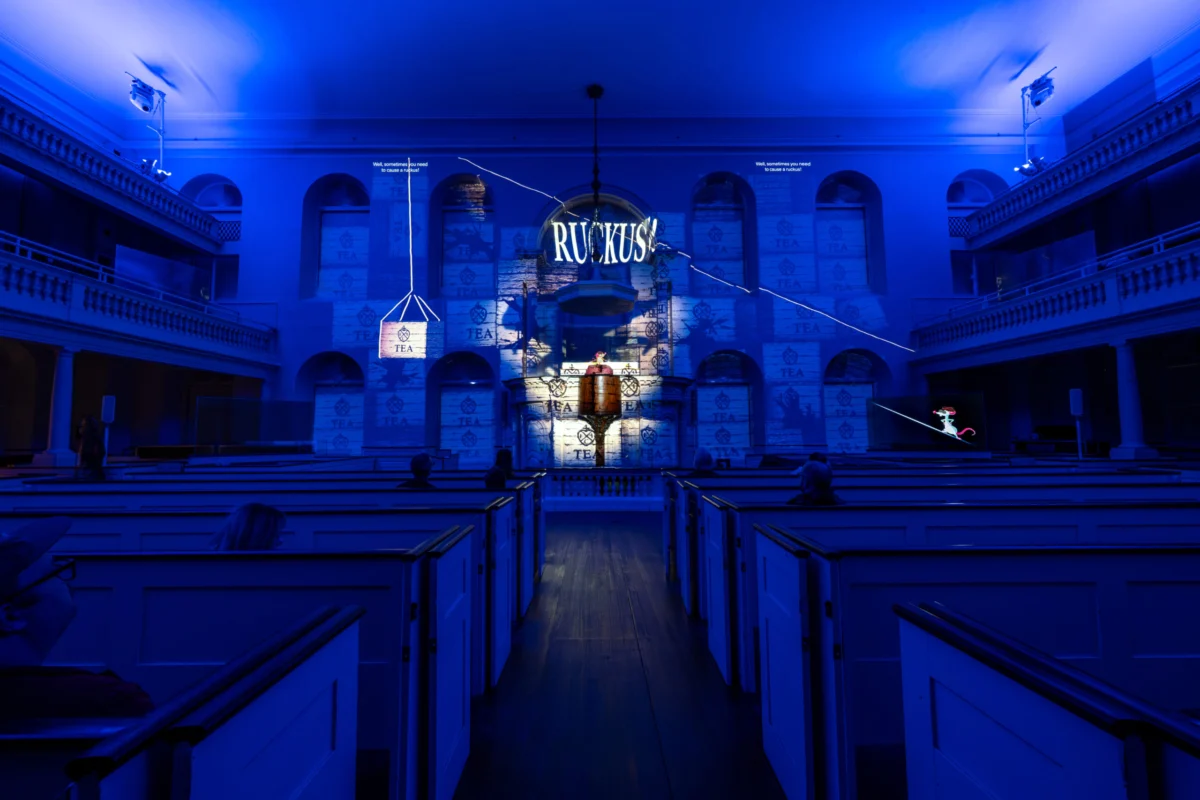
At the crossroads of American history stands the Old South Meeting House in Boston, Massachusetts—a revered landmark where colonists once gathered to debate the oppressive policies of the British Crown, setting the stage for the Boston Tea Party and the American Revolution. Today, this hallowed sanctuary is bridging centuries past with modern multimedia storytelling through Ruckus!, an ambitious experiential exhibit produced by Revolutionary Spaces.
However, bringing high-tech, multi-channel sound into a historic structure not built for modern audio presented a formidable engineering challenge. To solve this, systems integrator Electrosonic deployed a state-of-the-art professional audio network anchored by high-performance loudspeakers from 1 SOUND.
The installation relies on a sophisticated array of customized audio hardware designed to deliver pristine intelligibility, robust low-end support, and immersive spatial sound without disturbing the delicate architectural integrity of the 18th-century landmark. Central to the setup are:
- Tower LCC84 loudspeakers acting as the primary mains.
- Tower LCC44 loudspeakers serving as side fills.
- Level L35 loudspeakers flush-mounted to provide seamless surround coverage toward the rear of the hall.
- C4 loudspeakers dedicated to covering the historic balcony.
- SUB28 subwoofers positioned at the front left and right to deliver deep low-frequency reinforcement for musical scores, dramatic sound effects, and recorded narration.
Through close collaboration between Electrosonic, Revolutionary Spaces, and 1 SOUND’s specialized Custom Shop, the loudspeakers were color-matched and structurally integrated to vanish into the venue’s interior palette. The result is an invisible acoustic transformation that elevates everything from immersive historical exhibits to live concerts, public forums, and theatrical productions.
Chronology of the Project
The realization of the Ruckus! exhibit and its accompanying soundscape was not an overnight endeavor. It represents a meticulous multi-year timeline of historic preservation, technological planning, and acoustic engineering.
Phase 1: Conceptualization and Heritage Constraints (Pre-2025)
Revolutionary Spaces began conceptualizing Ruckus! as a way to thrust modern museum-goers directly into the turbulent, high-stakes atmosphere of pre-Revolutionary Boston. The exhibit was designed to utilize projected animations, dynamic lighting, recorded dialogue, and spatialized audio to bring historical figures to life.
However, planners faced an immediate hurdle: the Old South Meeting House’s cavernous, highly reflective interior. The venue’s hard plaster surfaces, timber framing, and historic pews generated severe reverberation and acoustic reflections. Previous attempts to host spoken-word events or amplified performances often resulted in muddy, unintelligible sound. Venue leadership recognized that any permanent multimedia installation would require a radical acoustic overhaul that respected the building’s national landmark status.

Phase 2: System Design and Integration Engineering (2025–Early 2026)
Electrosonic was brought on board to design a technological backbone capable of handling complex multi-channel audio without compromising the venue’s visual aesthetic. The team needed loudspeakers that could maintain tight pattern control, project sound evenly across tiered seating and balconies, and fit into tight physical constraints.
After evaluating various professional audio manufacturers, Electrosonic selected 1 SOUND for its innovative cardioid column array technology and its agility in custom manufacturing. Engineers mapped out speaker placements that would maximize direct sound transmission to the audience while minimizing energy bleeding onto the reflective historic walls.
Phase 3: Custom Fabrication and Acoustic Tuning (Mid 2026)
Because off-the-shelf industrial loudspeakers would instantly clash with the colonial-era interior, the project utilized 1 SOUND’s Custom Shop. Electrosonic and Revolutionary Spaces worked alongside 1 SOUND technicians to develop specialized custom finishes. Every cabinet, bracket, and mounting plate was meticulously color-matched to the interior walls and trim of the Meeting House.
Installation took place under strict historic preservation guidelines. Once the physical hardware—including the Tower LCC84 mains, LCC44 side fills, L35 surrounds, C4 balcony speakers, and SUB28 subwoofers—was successfully mounted, acoustic engineers executed a rigorous calibration process. Using advanced digital signal processing (DSP), the team dialed in time-alignment, equalization, and spatial panning to ensure that every seat in the house received uniform, crystal-clear audio.
Phase 4: Public Debut and Launch (September 2026)
The completed system debuted alongside the public opening of Ruckus!. The synergy between the visual projections and the newly minted spatial audio system instantly won critical acclaim from museum docents, historians, and visitors alike, marking a new chapter in how historic museums can engage modern audiences.
Supporting Data and Technical Architecture
The acoustic demands of the Old South Meeting House required a targeted engineering approach. Historic buildings generally present a worst-case scenario for modern sound reinforcement: massive open volumes, parallel reflective surfaces, and a complete absence of acoustic treatment.
To combat these challenges, the audio design leveraged directional dispersion control and multi-channel processing:

- Cardioid Technology: The selection of 1 SOUND’s Tower series (specifically the LCC84 and LCC44 models) was critical. Cardioid column arrays naturally reject sound from the rear and sides, focusing acoustic energy directly onto the audience plane. This drastically reduces the amount of high-frequency and mid-range energy bouncing off the historic walls and ceiling, curbing reverberation before it can muddy the soundstage.
- Distributed Multichannel Layout: Rather than relying on a traditional left-right stereo PA system—which often overpowers the front rows while starving the rear—Electrosonic designed a distributed surround layout. The L35 flush-mounted surrounds envelop the listeners, anchoring narrative elements to the visual animations projected across the room.
- Low-Frequency Management: Traditional large subwoofers often produce boomy, uncontrolled bass that rattles historic timber and plaster. The deployment of dual SUB28 subwoofers at the proscenium stage area provided tight, articulate low-frequency reproduction, ensuring that cinematic sound effects (such as mob unrest, marching feet, and dramatic musical stings) retained physical impact without inducing structural resonance.
- Balcony Coverage: The historic balcony presented an acoustic shadow zone. By integrating compact C4 loudspeakers specifically tuned for balcony throw, the system ensured that patrons seated upstairs experienced the exact same fidelity and intelligibility as those on the main floor.
Official Responses and Stakeholder Perspectives
The successful deployment of the audio system drew praise from both the cultural stewards of the venue and the engineering teams behind the installation.
Matthew Wilding, Senior Director of Interpretation & Future Projects at Revolutionary Spaces, emphasized the dramatic transformation the venue experienced:
"Solving sound for a space like ours, a space that needs to maintain its architectural and historical integrity, and that is not designed for modern sound, is a tall order. 1 SOUND worked with us to craft a state-of-the-art, multi-channel system that sounds absolutely incredible and is practically invisible. With our old system, there were parts of the building where you’d struggle to hear someone speaking clearly because of the reverberation. Now, every seat is a good seat, whether it’s for our new immersive show, a forum, a theater production, or a concert. 1 SOUND completely transformed the audio experience in our historic site."
Industry observers and audio professionals have similarly highlighted the project as a masterclass in blending modern experiential technology with historic preservation. By refusing to compromise on either sonic performance or aesthetic discretion, the project team proved that museums do not have to industrialize their interiors to offer cutting-edge visitor experiences.
Broader Implications for Historic Preservation and Museum Tech
The successful audio upgrade at the Old South Meeting House serves as a case study for cultural institutions worldwide. For decades, museums, historic churches, and heritage sites have struggled with a difficult compromise: either alienate tech-savvy modern visitors by retaining inadequate, muffled legacy sound systems, or install obtrusive modern audio gear that damages the visual authenticity of the space.
The collaboration between Revolutionary Spaces, Electrosonic, and 1 SOUND demonstrates a third path: Customized, high-performance architectural audio integration.
- The Rise of the Invisible PA: As speaker manufacturers increasingly invest in custom finishing, specialized form factors, and directivity control (such as advanced cardioid columns), historic venues no longer have to treat sound systems as visual eyesores. High-end audio can now be rendered virtually invisible.
- Elevating Immersive Storytelling: Museums are shifting away from static artifact displays toward experiential, narrative-driven exhibits like Ruckus!. These installations rely heavily on spatial audio to suspend disbelief and transport visitors into the past. Without a reliable, high-intelligibility sound system, the emotional impact of multi-media storytelling is lost.
- Multi-Use Viability: Beyond museum exhibits, historic spaces like the Old South Meeting House often rely on rental income from public forums, live concerts, weddings, and theater productions to remain financially self-sufficient. By installing a professional-grade multi-channel system that caters equally to spoken word and dynamic music, the venue has significantly expanded its commercial and cultural programming capabilities.
Ultimately, the Old South Meeting House stands not only as a monument to the birth of American democracy, but also as a forward-thinking blueprint for how historic architecture can successfully harness modern technology to tell timeless stories.