In the high-stakes world of live event production, wireless microphone reliability is the ultimate ghost in the machine. When an RF (radio frequency) system operates flawlessly, the audience remains blissfully unaware of the complex invisible architecture working behind the scenes. But when a wireless signal drops out, introduces static interference, or suffers from limited range, it immediately commands the attention of every technician and audience member in the room.
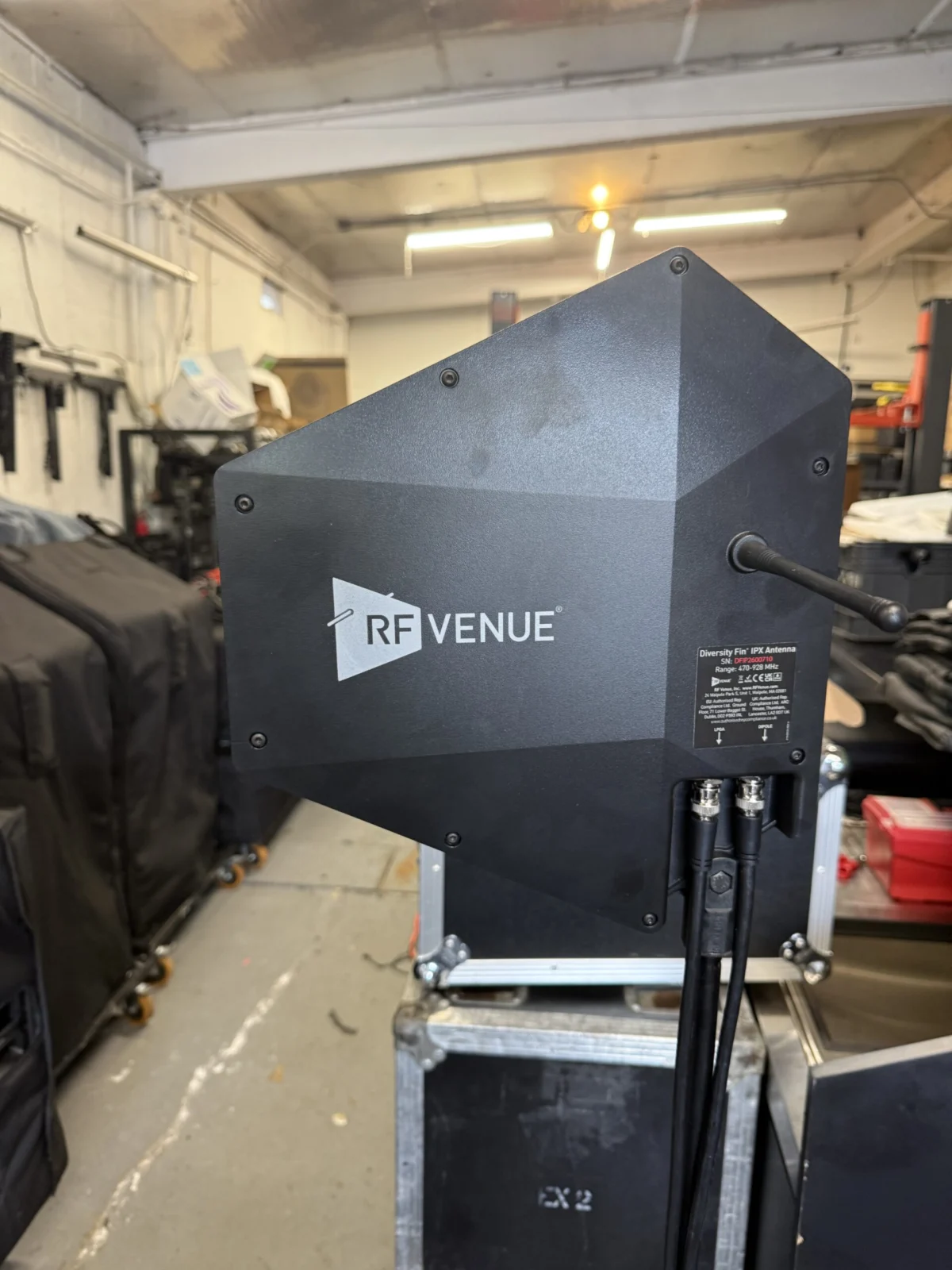
For audio professionals, choosing the right microphone capsule or transmitter is only half the battle. Antenna selection, placement, and engineering are equally vital to maintaining a pristine signal chain. Enter the newly released RF Venue Diversity Fin IPX Antenna, a purpose-built solution designed to combat the unpredictable nature of live sound.
After putting the Diversity Fin IPX through a rigorous evaluation across three vastly different real-world settings—a controlled laboratory shop test, a massive comedy arena, and an intimate performing arts theater—the conclusion is clear: RF Venue has once again engineered a tool that directly solves practical headaches for working audio engineers.
Main Facts: Engineering the Next Evolution in RF Reliability
The Diversity Fin IPX represents the latest evolution of RF Venue’s flagship Diversity Fin antenna technology. However, this iteration is specifically tailored for demanding touring circuits, large-scale outdoor festivals, sports stadiums, performing arts centers, and permanent outdoor installations.
At the core of the IPX designation is an IP44 weather-resistant rating, providing vital protection against solid objects larger than one millimeter and splashing water from any direction. This environmental fortification makes the hardware uniquely suited for the bruising realities of truck packs, load-ins, and changing weather conditions.
What Lies Beneath the Enclosure
Technically speaking, the Diversity Fin IPX cleverly merges two distinct antenna types into a single physical housing:

- A Log-Periodic Dipole Array (LPDA): Designed for directional focus and signal gain.
- A Dipole Antenna: Working in tandem to capture alternative angles.
Rather than relying on a single plane of orientation, the system utilizes cross-linear polarization, combining vertical and horizontal elements. During a live performance, a talent rarely holds a wireless microphone at a uniform angle; performers turn, tilt, rotate, and traverse the stage. Cross-linear polarization ensures the receiving system remains far less sensitive to these constant orientation shifts.
Furthermore, the antenna combats multipath interference—a phenomenon where RF signals reflect off walls, ceilings, metal trusses, video walls, and stage rigging, reaching the receiver at slightly different times. These phase differences can cause signal cancellation or "dropouts." By leveraging advanced diversity design in a single housing, the IPX mitigates these risks without requiring complex multi-paddle setups.
Chronology: A Three-Phase Real-World Evaluation
To thoroughly test the capabilities of the Diversity Fin IPX, the evaluation moved progressively from a controlled environment to high-pressure live production scenarios.
Phase 1: Establishing a Baseline in the Shop
Every piece of professional RF gear should undergo baseline testing before hitting the road. In the controlled environment of the audio shop, the Diversity Fin IPX was connected to a standard antenna distribution system alongside four wireless handheld units.
The primary objective was to observe baseline functionality, test transmitter mobility, and monitor for native interference before introducing the chaotic variables of a live venue. The setup proved remarkably straightforward. Within minutes, all four handheld units operated seamlessly, yielding zero noticeable RF interference and impressive baseline range both inside and outside the facility.
Phase 2: The Arena Test with Tig Notaro
The second phase shifted to a massive, acoustically and structurally challenging environment: an arena comedy performance headlined by Tig Notaro. Arenas present severe obstacles for wireless systems due to vast physical distances, complex steel-and-concrete architecture, and dense electronic noise floors.

For this production, the Diversity Fin IPX was rigged stage-left, approximately 75 feet away from the performer. In practical touring scenarios, technicians rarely enjoy ideal, unobstructed line-of-sight mounting positions. Sightlines, scenic elements, cable paths, and lighting rigs frequently dictate compromise. Despite being positioned 75 feet away at a stage-left offset, the IPX maintained a rock-solid wireless signal, delivering absolute confidence throughout the entire performance.
Phase 3: The Performing Arts Theater Test with Natalie Merchant
The third and final test took place in a starkly different acoustic and spatial environment: a concert featuring singer-songwriter Natalie Merchant at a mid-sized performing arts theater.
Characterized by a more intimate footprint, this venue required a modified deployment strategy. The Diversity Fin IPX was positioned stage-right, roughly 40 feet from the performing artist. Traversing these three distinct footprints—shop, arena, and theater—provided invaluable insight into the antenna’s adaptability across varying distances and spatial geometries. In every instance, the IPX delivered uncompromised, dependable RF performance.
Supporting Data and Technical Specifications
A closer examination of the hardware specifications reveals a thoughtful engineering approach aimed directly at live production workflows:
- Frequency Range: Broad operating range of 470–928 MHz, ensuring widespread compatibility with modern wireless microphone systems (subject to local spectrum regulations).
- Impedance & Connectors: Standard 50-ohm impedance utilizing downward-facing female BNC connectors. This downward orientation is a brilliant touring-friendly feature, shielding cable connections from rain, dust, and physical strain.
- Passive Operation: The antenna is entirely passive, meaning it requires no external power supplies or internal active gain stages. This eliminates a common point of failure and removes the hassle of routing power to remote antenna positions.
- Coverage & Range: Features a 120-degree horizontal coverage pattern with a typical operational range exceeding 300 feet (though actual performance varies based on local RF noise floors, transmitter power, cable loss, and venue architecture).
- Physical Mounting: Employs an industry-standard 5/8"-27 threaded microphone-stand mount (complete with an EU adapter), allowing for effortless integration into existing mic-stand inventory without bespoke hardware. For permanent builds, RF Venue also offers a universal wall-mount bracket.
- Serviceability: Housed in a ruggedized shell utilizing watertight threaded connections, the package includes two primary dipole antennas plus two spare dipoles and a storage pouch—a thoughtful touch that prevents minor touring mishaps from turning into show-stopping emergencies.
Official Responses and Industry Perspectives
Industry professionals have long sought ways to streamline RF distribution without sacrificing signal integrity. Traditional multi-antenna setups (such as dual "shark fin" configurations) require multiple stands, extra coaxial runs, and increased setup times—each element doubling as a potential point of failure.
According to RF Venue representatives, the integration of dual complementary antenna elements into a single physical housing was specifically engineered to address these workflow bottlenecks. By consolidating diversity reception into one mount, technicians save valuable minutes during festival changeovers while drastically reducing setup errors.

Touring audio engineers have increasingly echoed these sentiments, noting that the greatest compliment a piece of live infrastructure can receive is total invisibility—meaning it simply works without demanding troubleshooting, recalibration, or active babysitting during a show.
Implications for the Live Sound Industry
The success of the Diversity Fin IPX underscores a broader realization within professional audio: antennas deserve as much respect as the microphones and receivers they tether.
Even the most advanced, high-end wireless microphone system cannot compensate for poor antenna positioning or substandard RF design. By bridging the gap between transmitter and receiver with cross-linear polarization, passive reliability, and weather-resistant durability, products like the IPX redefine what touring teams should expect from their infrastructure.
Summary of Key Benefits for Production Companies:
- Reduced Complexity: Eliminates the need for dual paddle antennas on separate mounts for diversity reception.
- Tour-Grade Durability: IP44 weather-resistance and rugged construction safeguard against the elements and rough handling.
- Instant Deployment: Out-of-the-box readiness with standard microphone-stand compatibility minimizes pre-show stress.
- Disaster Prevention: Inclusion of spare dipoles in the kit shows a genuine understanding of road life.
Final Thoughts
When the curtain rises, production crews need tools that operate reliably in the background, allowing them to focus on mixing the show rather than hunting down RF dropouts.
RF Venue’s Diversity Fin IPX successfully bridges technical sophistication with the rugged demands of the road. Whether deployed in a controlled shop environment, a sprawling 75-foot arena throw, or a refined performing arts theater, this antenna proves that reliable RF doesn’t have to be complicated. For rental houses, touring acts, production companies, and houses of worship looking to bulletproof their wireless packages, the Diversity Fin IPX stands out as an indispensable asset for any modern live sound deployment.