In the complex, shifting landscape of the Russo-Ukrainian War, a new, often overlooked demographic has emerged among the ranks of foreign combatants: thousands of Latin American volunteers. Drawn from nations as diverse as Colombia, Venezuela, and beyond, these men and women have traveled thousands of miles to trade the familiarity of their homelands for the mud, frost, and artillery fire of the Eastern European front.
Their presence is the subject of a compelling new four-part documentary podcast, Call Sign Condor (Alias Cóndor in Spanish). Produced through a collaboration between DW, LA Times Studios, and Futuro Studios, and hosted by journalist Carolina Chimoy, the series offers an intimate look at the motivations, fears, and internal conflicts of these soldiers who have chosen to fight for a country that is not their own.

Main Facts: Who are the Volunteers?
The phenomenon of foreign volunteers in Ukraine is not new; since the onset of the full-scale invasion in February 2022, the International Legion for the Territorial Defense of Ukraine has attracted fighters from across the globe. However, the surge in Latin American participants has been notable for its scale and the specific backgrounds of the individuals involved.
Many of these volunteers are veterans of their home countries’ own internal conflicts. In Colombia, specifically, decades of counter-insurgency operations against groups like the FARC and the ELN have produced a generation of combat-hardened soldiers. For many, the transition to the Ukrainian front is not just an ideological stand against an aggressor, but a professional path that offers both a sense of purpose and, in many cases, a salary that far exceeds what is available in their local economies.
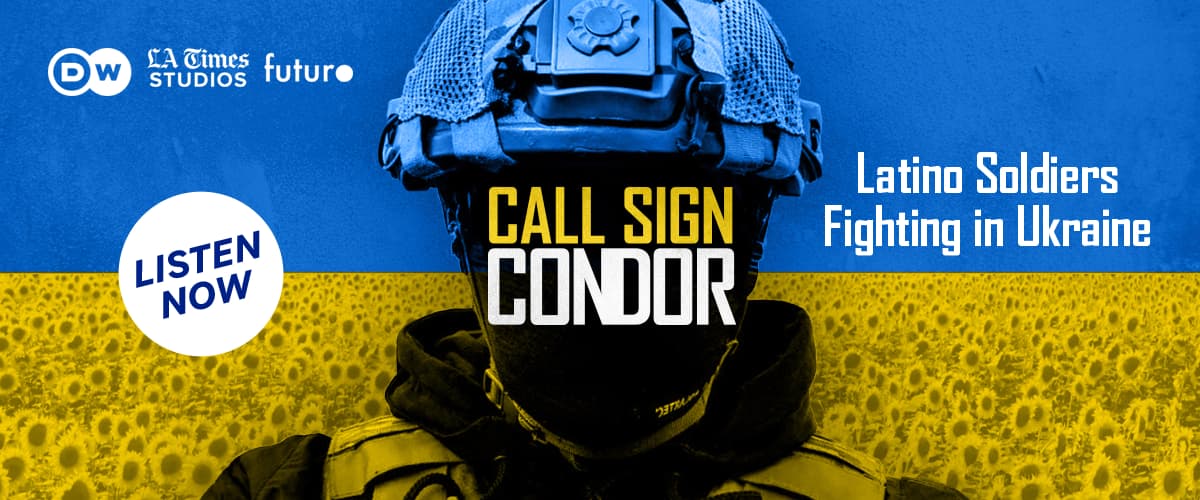
Call Sign Condor tracks the journey of one such individual, whose call sign provides the title for the series. Through his eyes, the listener is taken behind the scenes of the grueling training camps, the long stretches of boredom in defensive positions, and the sudden, chaotic intensity of trench warfare.
A Chronology of Engagement
To understand why thousands of Latin Americans have gravitated toward this specific conflict, one must look at the timeline of the war through the lens of international recruitment.

- February 2022: The immediate aftermath of the Russian invasion triggers a global call for volunteers. Ukraine establishes the International Legion, simplifying visa requirements and recruitment processes to facilitate the arrival of foreign specialists.
- Late 2022: The initial wave of idealist volunteers—mostly from Western nations—begins to wane. Simultaneously, reports emerge of professional soldiers from South America arriving in Eastern Europe. This shift marks a move from "ideological" volunteers to "professional" volunteers.
- 2023: Recruitment networks become more sophisticated. Social media platforms, particularly Telegram and WhatsApp, become hubs for informal networking where veterans share logistics on how to reach Poland and eventually the Ukrainian border.
- 2024–2025: The war settles into a grinding war of attrition. The role of Latin American fighters becomes critical as the Ukrainian Armed Forces face significant personnel shortages. These volunteers are integrated into various brigades, often tasked with holding the most volatile sectors of the front.
- October 2026: The release of Call Sign Condor brings these individual stories to a global audience, shedding light on the personal costs of this multi-year commitment.
Supporting Data: The Economics of War
While the Ukrainian government does not release exact figures on the number of foreign nationals serving in its ranks, independent estimates and journalistic investigations suggest that the Latin American contingent now numbers in the thousands.
The primary drivers for this migration are a combination of economic necessity and professional identity. In countries like Colombia, military pensions are often modest, and the job market for veterans is narrow. Conversely, the Ukrainian military offers contracts that, while not "mercenary-level" in the private security sense, provide a stable income that can support families back home in Latin America.

Moreover, the psychological aspect of "belonging" is a recurring theme in the podcast. Many of the soldiers interviewed by Carolina Chimoy express a deep sense of disillusionment with their home governments or the lack of recognition for their past service. In Ukraine, they are treated as heroes, defenders of sovereignty, and vital assets in the fight against authoritarianism. This creates a powerful bond—a "found family" of brothers-in-arms—that makes the prospect of returning to civilian life in their home countries feel alienating.
Official Responses and Geopolitical Implications
The presence of Latin American nationals in the Ukrainian military has placed their home governments in a delicate diplomatic position.

The Diplomatic Tightrope
Most Latin American nations, including Colombia, have officially maintained a stance of neutrality or have expressed support for the sovereignty of Ukraine without directly intervening. However, the sight of their citizens dying on European soil has sparked internal political debates.
For the Kremlin, the presence of these fighters is a propaganda tool. Russian state media has frequently labeled these individuals as "mercenaries," using their presence to claim that NATO is employing "third-world" proxies to fight its war. This rhetoric is intended to delegitimize the Ukrainian defense and sow discord within the Global South.

The Humanitarian View
Human rights organizations and the families of the fallen often raise concerns about the lack of legal protections for these volunteers. Because they are not citizens of Ukraine, their status as prisoners of war (should they be captured) is often contested by Russian forces, leading to fears that they may not receive the protections guaranteed under the Geneva Conventions.
Implications: The Search for Purpose
The central question posed by Call Sign Condor is: "Why would someone risk their life for a country that is not their own?"

As the series unfolds, it becomes clear that the answer is rarely simple. For some, it is about the "adrenaline of the mission." For others, it is a search for justice after years of witnessing violence in their own neighborhoods. Some find a sense of normalcy in the regimented life of the military, even in the middle of an active war zone.
The Cost of Belonging
The podcast does not shy away from the darker side of this choice. It covers the profound loss, the trauma of witnessing the deaths of comrades, and the complexity of falling in love in a land where tomorrow is never guaranteed. The "Condor" of the title represents the immigrant experience turned on its head—the immigrant who arrives not for work or asylum, but for the most dangerous occupation on earth.

A Global Perspective
The collaboration between DW, the LA Times, and Futuro Studios is significant. By producing the podcast in both English and Spanish, the creators are ensuring that the story reaches both the international community and the very populations from which these soldiers are drawn. It serves as a bridge, humanizing a demographic that is often reduced to statistics or political talking points.
Conclusion: The Legacy of the Conflict
As the war in Ukraine enters its later stages, the story of the Latin American volunteers will remain a defining chapter of this era. They are a physical manifestation of the interconnectedness of modern conflicts. Their stories, as told in Call Sign Condor, remind us that the struggle for freedom and the search for a place to belong are universal drives that know no borders.

For those interested in the human side of geopolitics, Call Sign Condor offers more than just an account of battles won and lost. It is a profound meditation on what it means to give one’s life for a cause, and the enduring, sometimes tragic, quest for meaning in a chaotic world.
Call Sign Condor / Alias Cóndor is available now on all major podcast platforms. For more information, visit the production’s official pages in English and Spanish.

A Note on Additional Audio Content
While exploring the complexities of global conflicts, listeners may also be interested in other thought-provoking series such as "Dispatches from the Divide," which explores extreme conflict in relationships and communities, or "The Vardø Witch Trials," which documents historical instances of extreme social upheaval. For those seeking professional development, "Think Fast Talk Smart" provides essential communication techniques that remain relevant even in the most high-stakes environments.