LOS ANGELES — Antares Audio Technologies, the undisputed pioneer of pitch-correction software that forever altered the landscape of modern popular music, has officially announced its latest flagship release: Auto-Tune Advanced. Built upon a radically overhauled Auto-Tune algorithm and anchored by a groundbreaking, patent-pending technology known as the DVA (Dynamic Vibrato Analysis) engine, this real-time vocal tuning plugin is designed to solve a decades-old dilemma in audio engineering: how to achieve precise, reliable pitch correction without stripping away the human emotion, natural vibrato, and individual character of a vocalist’s performance.
The announcement positions Auto-Tune Advanced as a powerful new pillar in the comprehensive Auto-Tune product ecosystem. It joins industry staples such as Auto-Tune Pro 11—which caters to detailed, manual post-production via its signature Graph Mode—and streamlined versions built for everyday corrective tasks. However, Auto-Tune Advanced carves out its own distinct territory by pushing the boundaries of Auto-Mode capabilities, offering a reimagined workflow tailored to meet the rigorous demands of modern tracking, real-time monitoring, and professional mix sessions.
Main Facts: What is Auto-Tune Advanced?
At its core, Auto-Tune Advanced is a state-of-the-art, real-time vocal tuning plugin engineered from the ground up. Rather than relying solely on incremental updates to legacy code, Antares completely rebuilt its foundational pitch-correction architecture to improve processing efficiency, sonic transparency, and phase-coherency during long, complex sessions.
Key features and technical specifications of the new release include:
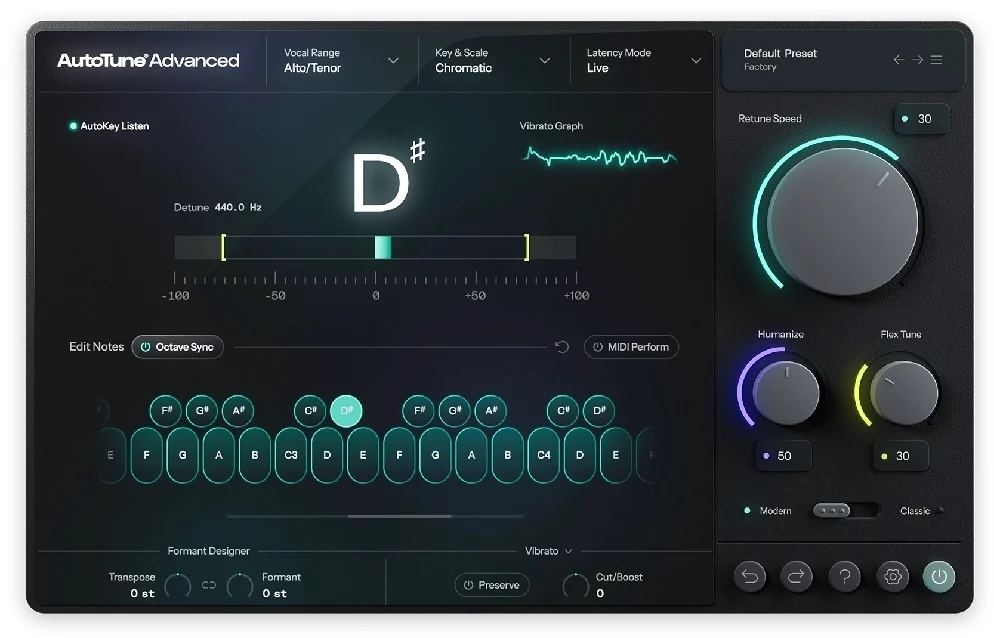
- The DVA Engine: A patent-pending, real-time vibrato engine that actively distinguishes between unintended pitch drift (errors) and intentional vocal expression (such as natural vibrato), preserving the latter during correction.
- Live Mode & Ultra-Low Latency: Engineered for real-time monitoring, boasting a remarkably low plugin latency of just 0.84 ms at 44.1 kHz (depending on buffer size and host system).
- Dual Processing Modes: Includes Low Latency Mode optimized for tracking performances live in the studio, and High Quality Mode built for heavy-duty mixing environments.
- Comprehensive Vibrato Tools: Features a real-time Vibrato Visualizer that displays detected vibrato on the fly. For raw, unadorned performances lacking natural oscillation, the built-in Vibrato FX section allows engineers to introduce synthetic vibrato shaped by sine, square, saw, or triangle waves, complete with precise rate and cut/boost controls.
- Classic vs. Modern Modes: Preserves the iconic, robotic, heavily tuned artifacting associated with early 1990s and 2000s records (Classic Mode) alongside an ultra-transparent algorithm designed to correct pitch invisibly (Modern Mode).
- Advanced Timbral Controls: Equipped with an updated Formant Designer for shifting vocal timbre, custom scale workflows, a 78-note Visual Keyboard for granular note behavior mapping, and MIDI Perform capabilities that allow hardware controllers to manipulate tuning parameters or write mix automation live. Staple controls like Flex Tune and Humanize also return.
- Artist-Curated Presets: Ships out of the box with custom presets engineered by industry heavyweights, including multi-Grammy-winning engineer Ann Mincieli, Billboard #1 producer Benjamin Thomas, Julian Marley, and Tom Norris.
Chronology: The Evolution of Pitch Correction
To understand the magnitude of the Auto-Tune Advanced release, it is necessary to examine the evolutionary timeline of pitch-correction technology over the last three decades:
- 1997 (The Genesis): Antares Audio Technologies introduces the original Auto-Tune. Initially developed by Dr. Andy Hildebrand—a geophysicist who used seismic data algorithms to discover subsurface oil—the technology was adapted to detect pitch in audio signals and instantly shift them to the nearest chromatic note. While initially intended as an invisible corrective tool for out-of-tune takes, producers and artists quickly realized that pushing the settings to their extremes created a distinct, robotic vocal effect that would come to define the sound of modern pop, hip-hop, and R&B.
- Late 1990s – 2000s (The Cher Effect and Mainstream Domination): Cher releases "Believe" in 1998, famously utilizing an extreme, stylized setting of Auto-Tune that sparked a global pop revolution. Over the next decade, pitch correction transitioned from an industry secret to a ubiquitous production standard, though it was frequently criticized by purists who argued it homogenized vocal performances.
- 2010s (Refinement and Real-Time Integration): Antares continually refines its algorithms, introducing features like Flex Tune (which leaves natural vocal glides untouched until the very end of a note) and Humanize (which prevents static, robotic-sounding sustained notes). Real-time processing capabilities improve exponentially, allowing artists to monitor through the effect live on stage and in the studio.
- Present Day (Auto-Tune Advanced and the DVA Era): After more than 30 years of development, Antares targets the fundamental limitation that has dogged pitch correction since its inception: the mechanical erasure of natural vocal micro-dynamics. With the introduction of the DVA engine in Auto-Tune Advanced, the company enters a new era focused on hyper-intelligent distinction between algorithmic correction and human artistry.
Supporting Data & Architectural Performance
Behind the user-facing interface lies a completely restructured plugin architecture designed to handle the taxing environments of modern digital audio workstations (DAWs). Modern mixing sessions often feature dozens of vocal tracks, stacked harmonies, and heavy native processing. Auto-Tune Advanced addresses CPU strain and session stability through optimized code that prevents crashes during prolonged tracking marathons.
Furthermore, the integration of the Vibrato Visualizer provides engineers with visual feedback that was previously guesswork. By painting a real-time picture of how the DVA engine interacts with a singer’s vocal cords, users can visually verify that natural expression is being protected.
The software’s flexibility is further underscored by its dual-mode framework:
- Low Latency Mode: Reduces buffering overhead, ensuring that vocalists tracking through headphones experience zero distracting delay or phase anomalies.
- High Quality Mode: Allocates maximum processing power during the mixdown phase, ensuring maximum fidelity when the track is subjected to heavy compression, saturation, and spatial effects.
Official Responses and Industry Reception
The industry response to Auto-Tune Advanced has been overwhelmingly positive, particularly from elite mix engineers and producers whose credits span the upper echelons of the Billboard charts.
Ann Mincieli, a five-time Grammy Award-winning engineer renowned for her work with Alicia Keys, Beyoncé, and Jay-Z, emphasized the plugin’s seamless integration into high-pressure professional environments:
"After more than 30 years of recording and mixing vocals, I know how important it is to have tools you can trust," Mincieli states. "Auto-Tune Advanced gives me the precision, speed, and flexibility I need while still allowing the emotion, individuality, and character of the performance to come through. It fits seamlessly into my workflow and lets me make creative decisions quickly without compromising the vocal."
Echoing this sentiment, Billboard #1 producer and mixer Benjamin Thomas—whose extensive credits include Pharrell Williams, Lil Uzi Vert, and Future—highlighted the creative freedom unlocked by the new DVA engine:
"The vibrato mode on Auto-Tune Advanced gives you the perfect opportunity to both push the AutoTune hard, but also keep that natural vibrato that is essential to a singer’s performance and realism!"
Jeff Wright, CEO of Antares Audio Technologies, pointed directly to the psychological barrier that has historically separated artists from pitch-correction software:
"Since 1997, the complaint about pitch correction has been the same: it takes the singer out of the singing," Wright concludes. "That’s the problem DVA was built to solve. It can tell the difference between a pitch error and a decision the vocalist made, and it leaves the decision alone."
Implications for the Future of Vocal Production
The release of Auto-Tune Advanced represents more than just a routine software update; it marks a philosophical shift in how audio technology interacts with human performance. For decades, the paradigm of vocal tuning has been binary: either you correct the pitch and risk flattening the human soul of the performance, or you leave it uncorrected and risk missing commercial tuning standards.
By introducing an intelligent, patent-pending engine capable of parsing intentional human inflection from accidental pitch drift, Antares has bridged the gap between technical perfection and organic expression. For up-and-coming bedroom producers and platinum-selling mix engineers alike, Auto-Tune Advanced removes the historical compromise of vocal production. Singers can now lean into raw, emotionally volatile performances in the tracking booth, secure in the knowledge that their natural vibrato, breath, and artistic individuality will be intelligently preserved by the technology rather than ironed away.
As Auto-Tune Advanced rolls out to studios worldwide, it sets a new benchmark for what audio software can achieve—proving that even after nearly three decades at the top of the industry, Antares is still finding revolutionary ways to keep the human voice at the center of modern music.