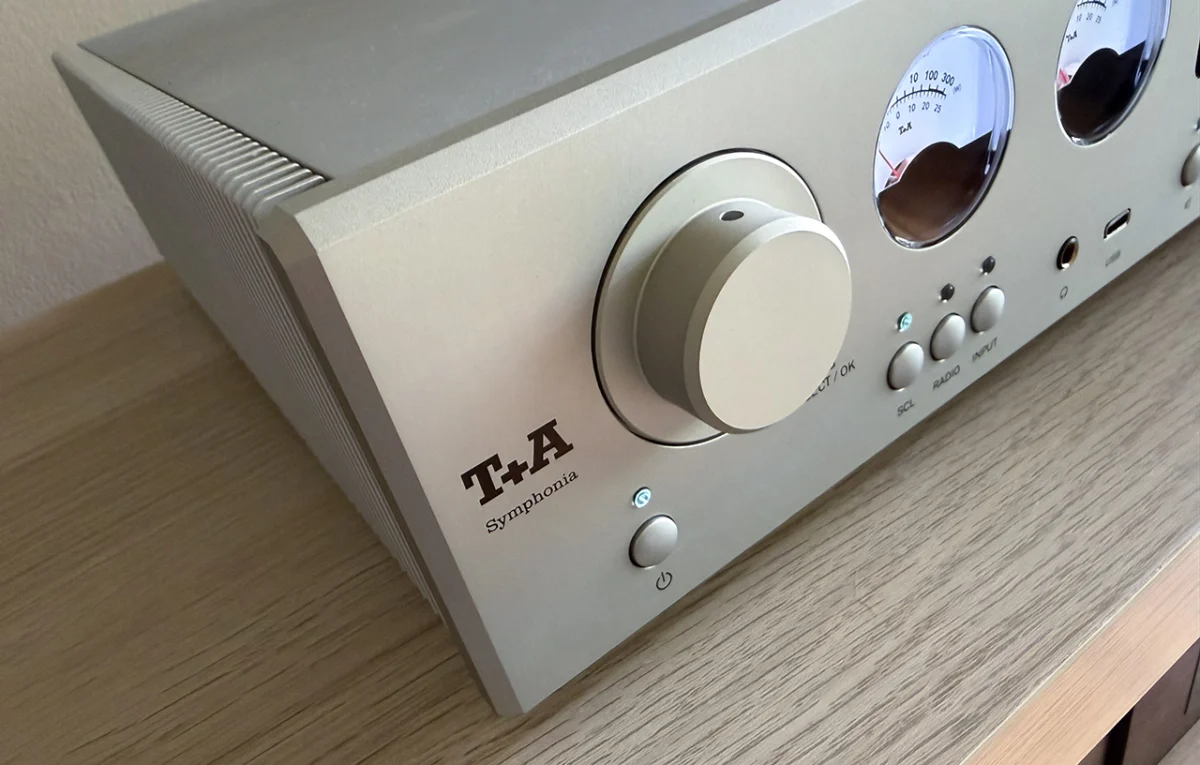
Main Facts
In the rapidly evolving landscape of high-end consumer audio, manufacturers are constantly challenged to balance two opposing philosophies: the traditional audiophile desire for dedicated, single-purpose chassis components—separate monoblocks, dedicated preamplifiers, standalone DACs, and outboard phono stages—and the modern lifestyle demand for minimalism, simplicity, and architectural discretion. Enter the T+A Symphonia, a meticulously engineered, beautifully compact single-chassis audio system that boldly attempts to bridge this divide.
Priced at $10,995, the Symphonia is squarely aimed at the discerning enthusiast who refuses to compromise on sonic fidelity while seeking to drastically reduce component clutter. Far from being a mere "lifestyle" product built for convenience at the expense of performance, the Symphonia is a tour de force of German engineering. At its core, the unit leverages the globally respected Eigentakt amplifier chipset, but with a quintessential T+A twist. Rather than dropping an off-the-shelf module into a generic box, T+A’s engineering team has designed a completely custom circuit board. This custom implementation allows the unit to harness T+A’s proprietary, high-voltage power supply technology and wide-bandwidth throughput, successfully marrying cutting-edge class-D efficiency with the brand’s legendary sonic signature.
The resulting amplifier stage delivers a robust 125 watts per channel into an 8-ohm load, a figure that neatly doubles to 250 watts per channel as the impedance halves to 4 ohms. This doubling of power signals exceptional current delivery and load stability, enabling the Symphonia to drive even demanding reference-grade loudspeakers with absolute authority.
Yet, raw amplification is only part of the story. The Symphonia functions as a comprehensive digital hub, integrating a high-performance USB DAC that is fully Roon Ready, alongside comprehensive streaming capabilities supporting Wi-Fi, Ethernet, and Bluetooth. For legacy digital sources, optical and RCA/SPDIF inputs are readily available. Physical media and analog purists are equally well accommodated, thanks to a dedicated moving magnet (MM) phono stage, a line-level RCA input (ideal for connecting a reel-to-reel tape deck or legacy source), and—in a nod to traditional broadcast media—both FM and DAB radio tuners.
Despite its remarkably modest footprint, the T+A Symphonia punches well above its weight class, seamlessly fusing convenience, aesthetic elegance, and uncompromising audiophile DNA.
Chronology
The genesis of the T+A Symphonia reflects a multi-year trajectory of technological refinement and shifting consumer demands within the high-end audio sector. While the official rollout of the Symphonia marks a major milestone for the Herford, Germany-based manufacturer, its underlying architecture has been years in the making.
Phase One: The Evolution of Eigentakt and High-Voltage Power Supplies
Long before the conceptualization of the Symphonia, T+A (Theory and Application) established a stellar reputation for its high-end separates, notably its HV (High Voltage) series. These products relied on elevated operational voltages within the amplification stages to achieve exceptionally low distortion, wide bandwidth, and an expansive soundstage. Meanwhile, the audio industry witnessed a paradigm shift with the introduction of Purifi’s Eigentakt class-D technology, celebrated for its astonishingly low intermodulation distortion and load-independent frequency response.
Recognizing the potential of pairing Eigentakt topology with their own proprietary power supply topologies, T+A’s engineering division initiated research into custom hybrid implementations. The goal was to harness the efficiency and linearity of modern switching amplifier modules while retaining the rich, harmonic saturation and dynamic headroom characteristic of traditional high-voltage analog designs.
Phase Two: Streamlining the Ecosystem and Lifestyle Integration
As high-resolution streaming cemented its dominance as the primary medium for music consumption, T+A developed sophisticated, proprietary streaming boards capable of handling high-res PCM, DSD, and seamless integration with ecosystem platforms like Roon. Concurrently, the brand recognized a growing market segment: affluent, design-conscious audiophiles who desired reference-grade sound quality in modern living spaces, but who balked at the visual and spatial footprint of traditional multi-box stacks.
The mandate was clear: consolidate a high-performance streamer, DAC, preamplifier, power amplifier, phono stage, and tuner into a single, cohesive chassis without introducing internal electrical interference, thermal bottlenecks, or sonic compromises.
Phase Three: Prototyping, Stress Testing, and Reference Auditions
In the months leading up to its market introduction, prototype units of the Symphonia underwent rigorous bench testing and critical listening evaluations. Engineers subjected the custom Eigentakt-based boards to extreme thermal and load stresses, ensuring that the unit could effortlessly double its output power into low-impedance loads without thermal throttling.
Simultaneously, acoustic panels and listening rooms hosted marathon evaluation sessions using demanding reference loudspeakers—such as YG Acoustics Summit systems. The positive results from these closed-door sessions cleared the path for full-scale production, culminating in the official commercial launch of the Symphonia at a retail price of $10,995.
Supporting Data and Technical Specifications
To truly understand the value proposition of the T+A Symphonia, one must examine the engineering metrics and connectivity options that define its specification sheet.
Power and Amplification Metrics
- Continuous Power Output (8 ohms): 125 Watts per channel
- Continuous Power Output (4 ohms): 250 Watts per channel (demonstrating true voltage-source behavior and exceptional current delivery)
- Amplification Topology: Custom-engineered board utilizing Eigentakt technology integrated with T+A proprietary high-voltage power supply architecture and wide-bandwidth throughput.
Digital Connectivity and Streaming
- USB DAC: High-resolution asynchronous USB input, fully compatible with modern computer audio and network streamers.
- Network Integration: Roon Ready certification, ensuring seamless multi-room and library management.
- Streaming Protocols: Wi-Fi, Ethernet (recommended for jitter-free, optimal high-res data transmission), and Bluetooth for quick mobile pairing.
- Digital Inputs: Optical (TOSLINK) and coaxial RCA/SPDIF inputs for digital transports, televisions, or game consoles.
Analog Connectivity and Tuner Options
- Phono Stage: Built-in Moving Magnet (MM) phono preamplifier, allowing direct connection of a turntable without external boxes.
- Line-Level Inputs: Analog RCA input, suitable for external analog sources such as legacy CD players, cassette decks, or reel-to-reel tape machines.
- Outputs: Dedicated subwoofer line-level output, facilitating easy integration into 2.1 channel or multi-channel crossover setups.
- Broadcast Tuner: Integrated FM and DAB (Digital Audio Broadcasting) terrestrial radio tuners.
Economic and Spatial Considerations
- Retail Price: $10,995 USD
- Footprint & Cabling Economy: Consolidating a streamer, DAC, preamplifier, power amp, phono stage, and tuner into a single chassis eliminates the need for multiple aftermarket AC mains cables, expensive interconnects, digital links, and massive equipment racks.
Official Responses and Expert Impressions
Initial industry reactions and early evaluations from prominent high-end audio publications highlight the profound impact the Symphonia is expected to make upon its wider release. While comprehensive, final review cycles are currently underway, preliminary critical consensus points toward a triumph of engineering execution.
Industry analysts and early listening panels have been particularly vocal about the unit’s sonic composure. Reviewers noting early listening sessions with reference-tier loudspeakers—specifically high-resolution systems like the YG Acoustics Summit—report that the Symphonia exhibits zero signs of strain, even when pushed to dynamic peaks.
"The audio performance is what we’ve come to expect from T+A," noted an early field report from reviewers tracking the component. "Dynamic, detailed, open, and musical. It drives our reference YG Acoustics Summit speakers flawlessly."
Furthermore, T+A’s engineering team emphasizes that the Symphonia was never intended to be a "watered-down" entry point, but rather a condensed masterclass in audio design. By refusing to compromise on the purity of the power supply or the sophistication of the streaming board, the company has positioned the Symphonia as a legitimate high-end contender that happens to occupy a fraction of the physical space typically required for such performance.
Critics and lifestyle interior designers alike have also lauded the chassis architecture. In high-end residential spaces where acoustic treatment and visual minimalism must coexist, the Symphonia offers an elegant, low-profile alternative to towering equipment racks laden with tangled cabling and blinking LEDs.
Implications for the High-End Audio Market
The introduction of the T+A Symphonia at the $10,995 price point carries significant implications for both manufacturers and consumers within the luxury audio ecosystem.
1. The Redefinition of "All-In-One" Performance
For decades, high-end audiophiles held a deeply ingrained bias against single-chassis "receiver" or "all-in-one" components, associating them with compromised power supplies, crosstalk between digital and analog stages, and inferior sonic purity. Products like the Symphonia systematically dismantle this prejudice. By utilizing advanced shielding, custom-tailored circuit topology, and ultra-quiet linear and switching power supplies, T+A proves that high-end performance and multi-function integration are no longer mutually exclusive.
2. Economic Efficiency in Cable and Rack Investments
When evaluating the $10,995 price tag, industry analysts urge consumers to look at the holistic cost of ownership in traditional audiophile systems. Building a comparable separates system requires purchasing a standalone streamer/DAC, a preamplifier, a power amplifier, and a phono stage. Crucially, each separate component demands its own high-grade power cord, high-end interconnects, and digital cables—an ancillary expenditure that can easily run into thousands of dollars. Furthermore, the space-saving nature of the Symphonia reduces furniture and rack expenditures. Viewed through this lens, the Symphonia represents a surprisingly cost-effective entry into state-of-the-art playback.
3. Catering to the Modern Lifestyle Audiophile
As younger generations of affluent consumers enter the high-end audio market, expectations regarding interior design and aesthetic integration have shifted. Bulky equipment stacks, sprawling cable management systems, and multi-component footprints are increasingly viewed as intrusive. The T+A Symphonia caters directly to this demographic, offering uncompromised sonic transparency, deep dynamic expression, and effortless streaming integration wrapped in a sophisticated, understated European chassis.
Looking Ahead
As full-length reviews and consumer impressions roll out over the coming months, the T+A Symphonia stands poised to challenge conventional wisdom regarding how high-end sound should be delivered. By merging uncompromising German engineering with modern multi-source versatility, T+A has not only built a component that "does it all"—they have elevated the standard for what an integrated high-end audio system can achieve.