In the fast-evolving landscape of personal audio, portable USB-DACs—commonly referred to as "dongle DACs"—have transitioned from simple headphone jack adapters into sophisticated, high-resolution audio powerhouses. Pushing the boundaries of what is technically achievable in a pocket-sized form factor, Shanling has introduced the UA6 II. Priced competitively at $209, this second-generation device breaks industry conventions by housing an unprecedented octal-DAC (8× CS43131) decoding array.
While multi-chip setups are becoming increasingly common in high-end desktop audio, translating a massive eight-chip layout into a bus-powered, portable chassis represents a major engineering feat. Designed primarily for discerning audiophiles and in-ear monitor (IEM) enthusiasts who prioritize sonic refinement over brute-force amplification, the UA6 II aims to redefine the performance ceiling of mobile audio.
Main Facts and Core Specifications
The Shanling UA6 II enters a crowded market of high-end portable sources, attempting to stand out through sheer conversion horsepower rather than sheer wattage.

- Model: Shanling UA6 II
- Price: $209
- Decoding Chipset: 8× Cirrus Logic CS43131 array
- Maximum Output Power: Up to 365mW into a 32Ω load (Balanced) / 107mW into 32Ω (Single-ended 3.5mm)
- Supported Formats: PCM up to 32-bit / 768 kHz, Native DSD up to DSD512
- Display & Control: 0.95-inch OLED screen paired with a multifunction rotary volume knob
- Connectivity: USB-C digital input (UAC1/UAC2 selectable), 3.5mm single-ended, and 4.4mm balanced headphone outputs
- Chassis Dimensions: 62 mm × 30 mm × 13.5 mm
- Color Options: Black, Silver, and Orange
Chronology and Product Positioning Within Shanling’s Lineup
Shanling’s "UA" series has long been a testing ground for portable innovations. The journey began with iteration-focused models like the UA4 and UA5, eventually leading to the original UA6, which utilized a four-DAC layout.
However, product segmentation within portable audio rarely follows a linear path. Shanling’s current flagship, the UA7, utilizes a rare hybrid architecture featuring JAN6418 vacuum tubes, OP+BUF circuitry, and an impressive output of 577mW per channel. Despite the UA7 holding the title of Top-of-The-Line (TOTL), Shanling took a different approach with the UA6 II. Rather than chasing higher voltage output or integrating vacuum tubes, engineers directed their focus entirely toward the digital-to-analog conversion stage.
By doubling the DAC count from four to eight, the UA6 II positions itself uniquely: it offers less raw driving power than the tube-based UA7 or competitors like the FiiO QX13 (605mW), but delivers a vastly superior, cleaner DAC section optimized heavily for multi-driver IEMs and sensitive headphones.

Supporting Data and Technical Architecture
The Octal-DAC Breakthrough
While quad-DAC configurations are frequently seen in mid-tier and flagship portable units, deploying eight DAC chips is typically reserved for expensive desktop components manufactured by boutique brands like Accuphase or Audio-GD. Implementing eight Cirrus Logic CS43131 chips into a compact, bus-powered enclosure required meticulous power management.
Shanling addressed potential power draw concerns by incorporating a menu option allowing users to toggle between a power-saving four-DAC mode and the full-performance eight-DAC mode. However, the sonic penalty of running four chips is notable enough that most audiophiles will likely leave the unit permanently locked in octal mode.
The CS43131 architecture is renowned for its clinical cleanliness, low distortion, and high Signal-to-Noise Ratio (SNR). The UA6 II capitalizes on these traits, supporting high-resolution audio streams up to 32-bit/768 kHz PCM and native DSD512, while deliberately omitting MQA support in favor of pure, unadulterated decoding paths. Five selectable digital filters (fast roll, slow roll, low latency fast, low latency slow, and NOS) allow listeners to fine-tune transient responses to their personal preference.

Amplification and Output Performance
The UA6 II delivers moderate output power compared to ultra-high-wattage contemporaries. Off the 4.4mm balanced output, it provides 365mW at 32Ω, dropping to 107mW via the 3.5mm single-ended port. Voltages are rated at 3.418V (balanced) and 1.85V (single-ended).
Crucially, utilizing the balanced output yields significant performance upgrades across technical metrics:
- Signal-to-Noise Ratio (SNR): Jumps from 128 dB (single-ended) to 133 dB (balanced).
- Channel Separation: Improves dramatically from 76 dB to 108 dB on the balanced tap.
This profile makes the UA6 II an ideal pairing for high-end IEMs and low-to-medium impedance headphones, though extremely demanding, high-impedance planar magnetic over-ears may require a more robust desktop setup.

Industrial Design and Controls
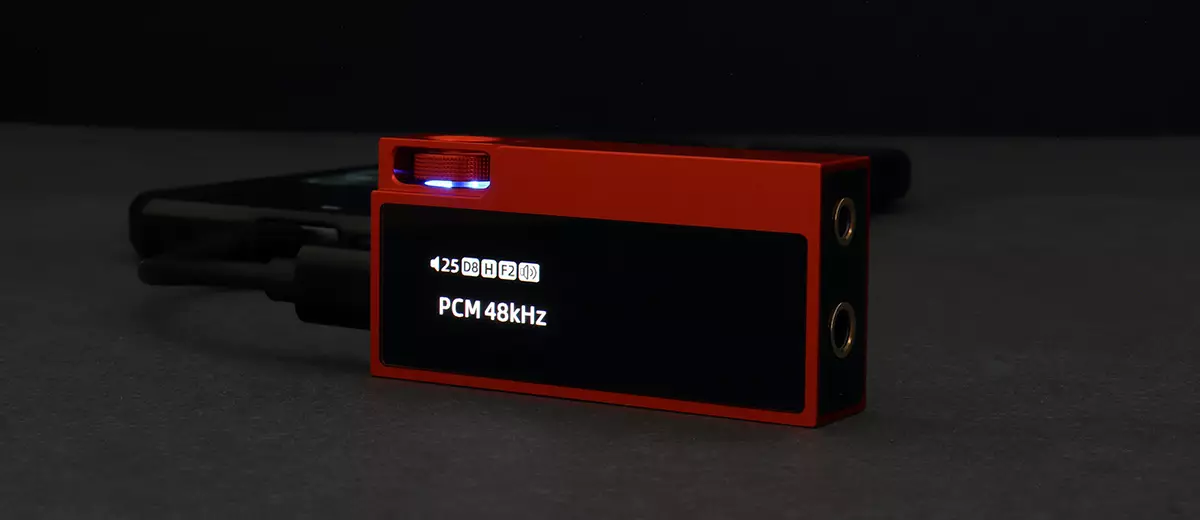
Measuring just 62 x 30 x 13.5mm, the UA6 II manages its internal complexity without ballooning in size. Borrowing its design language from the UA7, Shanling discarded the pushbuttons of the original UA6 in favor of a sleek 0.95-inch OLED screen and a top-mounted multifunction rotary volume wheel.
The wheel handles 100 precise volume steps and acts as a scroll controller for the onboard menu, while a separate top button handles selection duties. Available in black, silver, and orange, the chassis emphasizes structural ruggedness, though its blocky form factor and sharper corner edges contrast with softer, contoured alternatives on the market.
Official Responses and Software Integration
Shanling’s companion Eddict App offers deep software control over the UA6 II. Beyond basic playback features, the app grants access to digital filter switching, gain selection, balance tuning, and DAC-mode toggling (4-DAC vs. 8-DAC).

The onboard display also supports a variety of graphical UI themes that coordinate with an LED glow pulsing behind the volume knob. While functional, user feedback notes that some themes lean toward overly flamboyant seasonal designs, suggesting that future firmware updates might benefit from more minimalist, industrial aesthetics.
Note on Firmware Updates: Users should be aware that firmware updates for the UA6 II cannot be executed directly via mobile devices and require a Windows PC connection. Fortunately, out-of-the-box stability is robust enough that most users will have little need for immediate flashing.
Sound Impressions: Listening Evaluation
Tested across a diverse suite of gear—including the HIFIMAN Sundara, Sennheiser HD 490 PRO Plus, FiiO FX17, and Grand Oriveti Eminency—the UA6 II presents a distinctly refined sonic profile.

Overall Presentation and Timbre
The UA6 II leans toward neutrality with a touch of organic warmth. Unlike sterile, clinical processors of the past, it delivers an energetic presentation with an effortless sense of control.
Operating in eight-DAC mode unlocks maximum resolution, opening up the upper registers and enhancing micro-detail retrieval without sacrificing low-end impact. Bass notes are authoritative, punchy, and deeply extended, maintaining absolute composure without any trace of bloat.
Soundstage and Imaging
Perhaps the most striking attribute of the UA6 II is its expansive soundstage. The transition from four to eight DACs introduces a notable widening of the acoustic panorama.

Depth recreation is exceptional for a portable dongle, allowing complex multi-layered tracks to remain coherent. Even during heavy, dynamic musical crescendos, instrument separation and spatial imaging remain locked in place against a completely black, hiss-free background.
Implications for the Portable Audio Market
The release of the Shanling UA6 II at the $209 price point signals an important shift in the portable DAC segment. By democratizing octal-DAC technology—an implementation previously restricted to high-end home audio components—Shanling proves that extreme channel decoding density can be successfully miniaturized and powered via a smartphone connection.
For IEM enthusiasts, the UA6 II offers an enticing value proposition: desktop-grade conversion architecture wrapped in a pocket-sized footprint. While it may not satisfy those seeking raw, high-voltage desktop amplification for power-hungry headphones, its stellar signal-to-noise ratio, expansive soundstage, and immaculate background silence make it a formidable contender in the modern portable audiophile landscape.