The sub-$150 In-Ear Monitor (IEM) market is arguably one of the most fiercely contested battlegrounds in modern personal audio. Every month, manufacturers push the boundaries of price-to-performance ratios, introducing advanced acoustic technologies that were once reserved exclusively for flagship tier products costing thousands of dollars.
SIVGA, a brand widely recognized for its artful integration of natural woods, acoustic engineering, and accessible pricing, has officially expanded its aviary of portable audio solutions. Following the success of the Nightingale, the budget-darling Que, and their respective PRO iterations, the audio manufacturer introduced its latest creation at CanJam London before a wider global launch: the SIVGA Lyrebird.

Priced competitively at $149.00, the Lyrebird features an exotic quadbrid driver configuration housed within an aircraft-grade aluminum and stabilized wood chassis. Edrea of Headfonics has put the Lyrebird through its paces. This comprehensive feature article explores the genesis, technical architecture, sonic performance, and competitive standing of SIVGA’s latest auditory avian creation.
Main Facts: What is the SIVGA Lyrebird?
At its core, the SIVGA Lyrebird is a hybrid quad-driver universal IEM engineered to deliver a spacious, neutral-bright acoustic presentation with high-tier detail retrieval.

- Product Name: SIVGA Lyrebird
- Price: $149.00 USD
- Driver Configuration: Quadbrid setup comprising:
- 1 x Dynamic Driver (handling the low end)
- 1 x Balanced Armature (handling the midrange)
- 1 x Micro-planar Driver (assisting the upper frequencies)
- 1 x Multilayer Piezoelectric Ceramic Driver (handling ultra-high frequency extension)
- Impedance: 14Ω
- Sensitivity: 108 dB
- Cable: 1.2m round interlaced hybrid design (30-core Furukawa OFC, 10-core silver-plated copper, and 10-core enamel gold-plated silver-copper; total 50 cores) terminating in a 4.4mm balanced jack with 0.78mm 2-pin connectors.
- Accessories: Premium Crazy Horse leather storage case, 4x wide-bore silicone tips, and 3x liquid silicone tips.
Chronology: The Journey of SIVGA’s Audio Evolution
SIVGA’s path to the Lyrebird has been marked by steady, calculated growth in the portable audio sector. Understanding where the Lyrebird sits requires tracing the brand’s trajectory over recent years.
1. Establishing the Foundation
SIVGA first captured the attention of the global audiophile community with the launch of the SV021 Robin, an over-ear headphone that proved high-fidelity sound could be achieved on a strict budget. Translating that philosophy into IEMs, the company released subsequent models that experimented with planar and dynamic configurations.

2. The Flock Expands: Nightingale and Que
The company expanded into planar magnetic IEMs with the Nightingale (priced at $229), followed by the ultra-budget Que at roughly $69. The Que quickly cemented itself as a community favorite due to its organic tuning and value proposition, paving the way for PRO iterations across the lineup.
3. The Debut at CanJam London
The Lyrebird was first previewed in prototype and early-production forms at CanJam London, generating considerable buzz among attendees before officially launching to the broader market. It steps directly into an overcrowded mid-fi segment defined by heavyweights like the Hidizs MP145 PRO, the Juzear Fiesta, and the EarAcoustic SPA Hi-End.

Technical Architecture and Supporting Data
The Quadbrid Acoustic Engine
Designing a multi-driver earphone requires careful crossover implementation to ensure phase coherence across disparate driver technologies. SIVGA has integrated four distinct driver types into the Lyrebird’s compact metal shells, assigning each to a specific frequency band:
- Dynamic Driver (Bass): Dedicated to the low frequencies, this driver delivers an elevated low-end response with substantial physical impact, weight, and texture.
- Balanced Armature (Midrange): Responsible for the critical vocal and instrumental registers, providing density and a warm, engaging presentation.
- Micro-Planar & Piezoelectric Drivers (Treble): Working in tandem to manage the high frequencies, the micro-planar driver ensures smooth transient speed, while the multilayer piezoelectric ceramic driver injects upper-register air, sparkle, and macro-detail retrieval.
With a low impedance rating of 14Ω and a high sensitivity of 108 dB, the Lyrebird is exceptionally easy to drive. It requires very little amplification power to reach optimal listening volumes, making it an ideal companion for portable digital audio players (DAPs), smartphones paired with dongle DACs, and low-power portable amplifiers.

Design, Build Quality, and Ergonomics
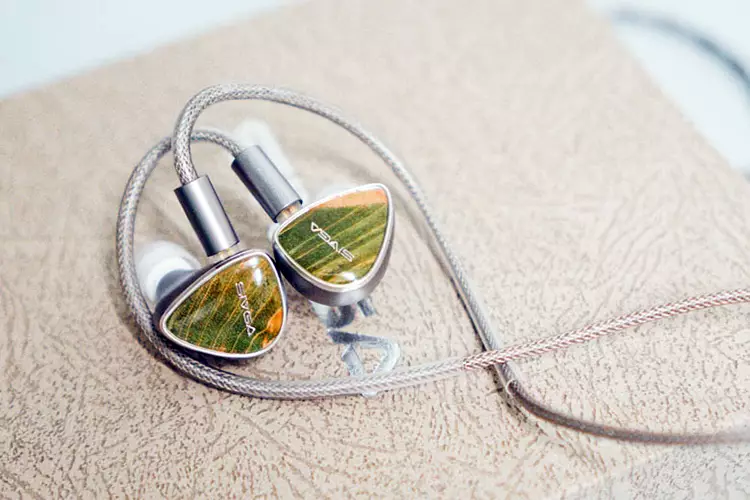
SIVGA’s signature aesthetic relies heavily on the use of stabilized wood. Each Lyrebird unit features a unique grain pattern. Review samples showcased a striking greenish hue that, combined with the matching cable and metal elements, evokes a natural "birch-in-the-forest" visual style.
The faceplates feature a layer of protective resin poured over the stabilized wood, topped with a discreet metallic SIVGA logo. The inner shell is machined from aircraft-grade aluminum, featuring strategic venting near the side and nozzle to alleviate pneumatic pressure build-up.

Despite utilizing a complex quad-driver setup and metal construction, SIVGA successfully kept the physical footprint compact. The nozzles are relatively wide, providing a secure, deep-insertion fit without inducing ear fatigue during marathon listening sessions.
Sound Impressions: Performance Analysis
Evaluated using high-end portable sources—including the FangSound NEREUS Mini, FiiO M21, and iBasso PB6 MACAW—the SIVGA Lyrebird demonstrates a distinct, highly engaging sonic identity.

1. Bass Response
The single dynamic driver delivers an authoritative, punchy low end. It offers a clear division of labor between the sub-bass and mid-bass:
- Sub-Bass: Features deep sustain, warmth, fullness, and heavy physical weight.
- Mid-Bass: Leaner and faster, focusing on rapid attack and tight thumps.
The bass remains well-controlled, avoiding unwanted bleeding into the lower midrange even on congested, bass-heavy tracks.
2. Midrange Performance
Handled by the balanced armature driver, the midrange exhibits a dense, warm presentation through the lower and center mids.

- Vocals: Both male and female vocals enjoy strong prominence and body. Duets are handled with admirable separation and physical presence.
- Density: As frequencies transition into the upper midrange, the density tapers slightly, giving the Lyrebird a vibrant, colorful character rather than a strictly analytical, flat response.
3. Treble and Upper Registers
The combination of the micro-planar and piezoelectric ceramic drivers yields a smooth yet extended high-frequency response.
- Guitars and vocals maintain a polished edge without becoming harsh or fatiguing.
- Cymbals exhibit natural brilliance and appropriate metallic texture.
- Information retrieval is exceptionally high, allowing listeners to track subtle background micro-details. However, users sensitive to treble may find that wider-bore tips or overly bright source gear can push the upper register toward sibilance.
4. Soundstage, Imaging, and Dynamics
One of the defining traits of the Lyrebird is its expansive soundstage. It offers an exceptionally wide and three-dimensional presentation that defies the physical dimensions of the IEM shell. Imaging is pinpoint accurate, anchoring instruments and vocals firmly within the acoustic space. Transients are fast, and dynamic shifts are handled with effortless authority.

Synergy and Source Matching
Because of its low impedance and high sensitivity, the Lyrebird pairs exceptionally well with a wide range of portable sources without picking up background hiss or amplifier noise. However, source matching plays a crucial role in shaping the final sound profile:
- Tube and Warm Sources (e.g., iBasso PB6 MACAW in tube mode): Excellent pairings that round off the upper-treble peaks and provide an organic, smooth listening experience.
- Neutral Sources (e.g., FiiO M21, FangSound NEREUS Mini): Deliver a clean, uncolored representation of the mix, allowing the Lyrebird’s natural tuning to shine through.
- Bright Sources (e.g., SMSL DS20): Less ideal for treble-sensitive listeners, as an inherently bright source can push the Lyrebird’s micro-planar and piezo drivers toward fatigue.
Comparative Analysis: How Does It Stack Up?
To contextualize the Lyrebird’s value proposition at $149, it must be evaluated against its closest competitors in the market segment.

SIVGA Lyrebird vs. Juzear Fiesta ($149 Class)
- Build: The Juzear Fiesta utilizes a resin shell with vibrant orange faceplates, whereas the Lyrebird relies on a more sophisticated aircraft aluminum and stabilized wood aesthetic.
- Sound: The Fiesta leans toward a more compressed, heavily bass-focused presentation with a recessed midrange. The Lyrebird delivers a significantly wider soundstage, superior vertical imaging, and a more articulate, forward vocal presentation with cleaner treble extension.
SIVGA Lyrebird vs. Hidizs MP145 PRO ($149 Class)
- Build: The MP145 PRO features a large, industrial aluminum shell styled after whale tails, which can be cumbersome for smaller ears. The Lyrebird’s compact form factor is generally more universally ergonomic.
- Sound: The MP145 PRO relies on a single large planar driver, producing a leaner, more textured bass and a brighter, high-sheen treble. The Lyrebird offers more physical bass weight, a warmer midrange, and a more cohesive multi-driver hybrid execution.
SIVGA Lyrebird vs. EarAcoustic SPA Hi-End ($149 Class)
- Build: The SPA Hi-End features a 3D-printed resin shell with a jewelry-like finish and a standard 3.5mm single-ended cable.
- Sound: The SPA adopts a fun, energetic V-shaped tuning with powerful sub-bass slam, but sacrifices midrange body and upper-treble air compared to the Lyrebird’s expansive, airy presentation.
Implications and Final Verdict
The entry of the SIVGA Lyrebird into the $149 market raises the bar for what consumers can expect from hybrid multi-driver configurations. By successfully orchestrating four completely different driver technologies into a single cohesive housing, SIVGA has demonstrated deep acoustic proficiency.
Pros:
- Holographic Staging: Exceptionally wide and deep 3D soundstage with precise instrument separation.
- Engaging Tuning: Vocal-forward midrange paired with a warm, fatigue-free overall presentation.
- Premium Aesthetics: Beautiful combination of stabilized wood, resin, and aircraft-grade aluminum.
- Rich Accessory Package: Includes a high-grade 4.4mm balanced hybrid cable and a premium Crazy Horse leather case.
Cons:
- Treble Sensitivity: High-frequency response is sensitive to poor ear-tip seals and overly bright source equipment.
- Fixed Termination: The stock cable terminates strictly in a 4.4mm balanced plug, which may require adapters for users relying exclusively on 3.5mm single-ended gear.
The Verdict
Named after an Australian bird famous for its astonishing vocal mimicry, the SIVGA Lyrebird does far more than just reproduce music—it exposes the hidden textures, micro-details, and acoustic nuances that lesser IEMs sweep under the rug. For listeners seeking a spacious, highly detailed, and musically captivating upgrade without breaking the bank, the SIVGA Lyrebird stakes a commanding claim as one of the most compelling audio products of the year.