Introduction and Main Facts
In the rarefied world of high-end audiophile equipment, a persistent tension exists between uncompromising sonic performance and domestic livability. For decades, achieving state-of-the-art sound has meant committing to a sprawling rack of monoblock amplifiers, separate preamplifiers, dedicated digital-to-analog converters, outboard phono stages, and a nest of expensive interconnects. Enter the T+A Symphonia, a component that aggressively challenges this paradigm.
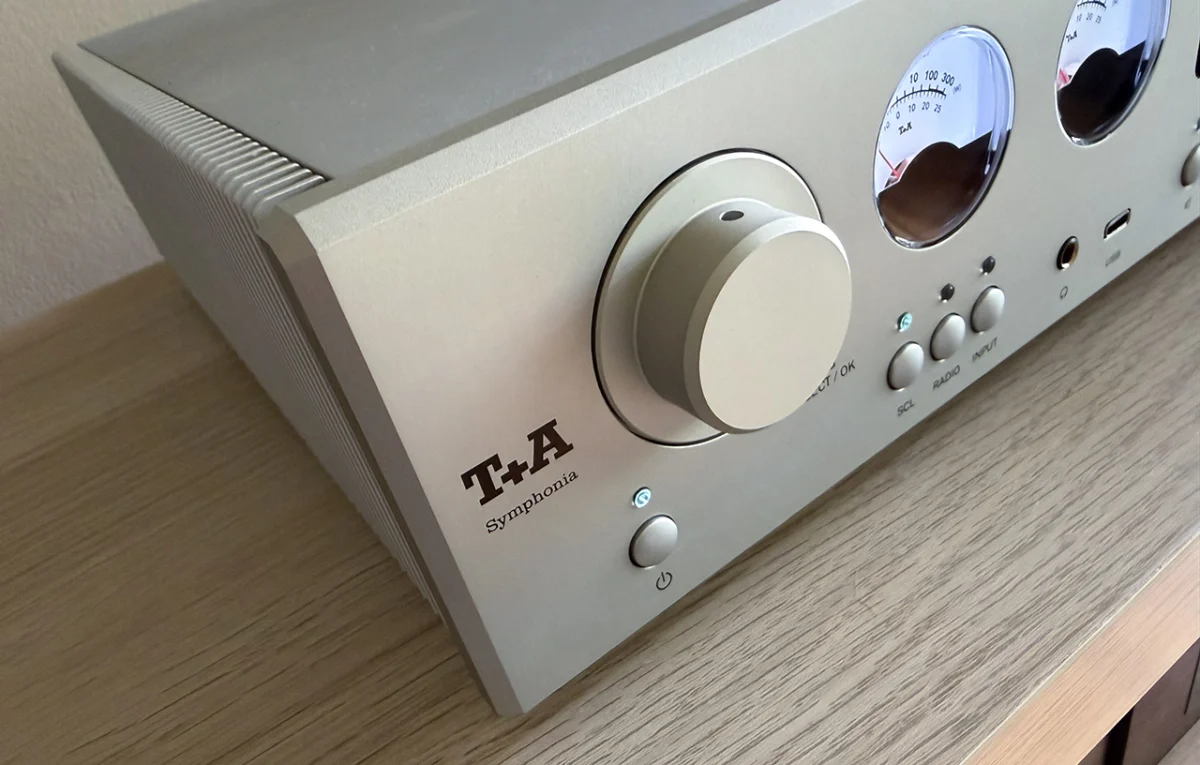
Priced at $10,995, the Symphonia is explicitly not an entry-level piece of equipment. However, high-end audio journalism has increasingly recognized that true value in the upper echelons of the market is defined by consolidation, engineering pedigree, and versatile execution. At its core, the Symphonia is a high-performance, single-chassis integrated streaming amplifier that packs an astonishing array of features into a visually striking, minimal footprint.
Powered by a heavily customized iteration of the highly respected Purifi Eigentakt chipset—paired with T+A’s proprietary high-voltage power supply technology and wide-bandwidth throughput—the Symphonia delivers a robust 125 watts per channel into 8 ohms, effectively doubling that figure into a 4-ohm load. Beyond sheer amplification, it functions as a Roon-Ready network streamer, a high-resolution USB DAC, a multi-format digital and analog preamplifier, an MM phono stage, a traditional FM/DAB radio tuner, and a comprehensive Bluetooth/Wi-Fi/Ethernet hub.
For the audiophile seeking reference-grade sound without the traditional aesthetic and spatial burden of separates, the T+A Symphonia represents a masterclass in modern acoustic engineering.
Chronology and Development: The Evolution of T+A’s All-in-One Philosophy
To understand how the T+A Symphonia came to fruition, it is helpful to look at the broader timeline of high-end audio design over the past decade, as well as German manufacturer T+A elektroakustik’s trajectory in the digital-analog convergence space.
- The Shift Toward Integration (Mid-2010s): As streaming protocols matured and class-D amplification matured past its early dry, analytical reputation, high-end brands began recognizing that modern consumers—even wealthy enthusiasts—demanded fewer boxes. T+A introduced advanced multi-source systems like their Caruso and R-Series lines, proving that compact systems could compete with separates.
- The Rise of Eigentakt Technology (2019–2022): Purifi Audio’s introduction of the Eigentakt (self-clocking) amplifier module sent shockwaves through the audio industry. Offering vanishingly low distortion and load-independent frequency response, it became the gold standard for efficient, high-fidelity amplification.
- T+A’s Proprietary Engineering Phase (2023–2025): Rather than simply dropping an off-the-shelf class-D module into a chassis, T+A’s engineering team spent years developing custom circuit boards around the Eigentakt core. Their goal was to marry the efficiency and linearity of the chipset with T+A’s legendary high-voltage (HV) analog topology and power supply designs.
- The Unveiling of the Symphonia (Mid-2026): Formally announced in August 2026, the Symphonia represents the culmination of this R&D cycle. Positioned as a do-it-all powerhouse for contemporary living spaces, it bridges the gap between traditional purist audio values and modern lifestyle integration. Early critical evaluation units have begun rolling out to premier audio publications, setting the stage for widespread industry adoption.
Supporting Data and Technical Specifications
The T+A Symphonia punches well above its physical dimensions through a meticulously engineered suite of hardware and software features. Below is a detailed breakdown of its specifications, connectivity options, and architectural highlights:
Amplification and Power
- Amplifier Topology: Custom-designed T+A implementation of the Purifi Eigentakt chipset.
- Power Output: 125 watts per channel into 8 ohms; 250 watts per channel into 4 ohms.
- Power Supply: Proprietary T+A high-voltage power supply technology designed to ensure massive dynamic headroom and low noise floors.
- Bandwidth: Wide-bandwidth throughput capable of handling high-resolution transients and ultra-wide frequency responses.
Digital Capabilities & Streaming
- Streaming Engine: Fully integrated network streaming client supporting high-resolution services.
- Ecosystem Integration: Roon Ready, ensuring seamless integration into multi-room and advanced network audio environments.
- DAC Section: High-performance USB DAC capable of handling modern high-res PCM and DSD file formats.
- Digital Inputs: Coaxial RCA/SPDIF and optical TOSLINK inputs for legacy digital sources such as CD transports or televisions.
- Wireless Connectivity: Bluetooth and high-speed Wi-Fi, alongside a hardwired Ethernet port (recommended for optimal jitter reduction and data stability).
Analog and Physical Media Inputs
- Line-Level Input: A dedicated single RCA analog input, ideal for connecting legacy sources like a reel-to-reel tape deck or external line-level components.
- Phono Stage: Built-in Moving Magnet (MM) phono preamplifier, allowing vinyl enthusiasts to plug a turntable directly into the system without an outboard box.
- Radio Tuner: On-board FM and DAB (Digital Audio Broadcasting) tuner for terrestrial radio lovers.
- Outputs: Includes a dedicated subwoofer output (line-level) for easy integration into 2.1 channel systems or full bass-management setups.
Build and Aesthetics
- Chassis: Minimalist, beautifully machined aluminum enclosure designed to blend seamlessly into high-end architectural and interior design environments.
- Footprint: Highly compact, reducing rack space requirements to a single shelf.
Official Perspectives and Early Critical Reception
While comprehensive, long-term review cycles are currently underway across major audio journals, early hands-on impressions from industry critics have highlighted the Symphonia’s uncanny ability to drive difficult reference loads without breaking a sweat.
Early evaluation notes from listening sessions paired the Symphonia with reference-grade YG Acoustics Summit speakers—transducers notoriously demanding of an amplifier’s grip, current delivery, and resolution. Reviewers noted that the Symphonia drove the loudspeakers "flawlessly," maintaining composure during complex orchestral crescendos and thunderous bass passages.
"The audio performance is what we’ve come to expect from T+A," notes early production commentary. "Dynamic, detailed, open, and musical."
Industry analysts have also praised T+A’s strategic decision to build a custom board around the Eigentakt architecture rather than settling for a generic implementation. By combining their proprietary high-voltage power supply heritage with modern ultra-low-distortion amplification, T+A has managed to sidestep the sterile, clinical reputation that sometimes plagues class-D designs, injecting warmth, harmonic richness, and organic fluidity into the playback.
Implications for the High-End Audio Market
The release of the T+A Symphonia at the $10,995 price point carries several significant implications for manufacturers, retailers, and audiophiles alike:
1. The Death of the "Complexity Tax"
In traditional high-end audio, building a system requires purchasing components from multiple brands—or multiple tiers within a single brand—and matching them with expensive cabling. A system requiring a streamer, DAC, preamplifier, amplifier, phono stage, and power conditioner requires at least four sets of high-end interconnects and multiple heavy-duty power cords.
When calculated holistically, the cost of high-end cabling, vibration-control platforms, and rack space can easily rival or exceed the cost of the electronics themselves. By condensing all of this into a single chassis, the T+A Symphonia eliminates the "complexity tax." Buyers save thousands of dollars on auxiliary accessories while dramatically simplifying their signal path.
2. Design-Forward Audio and Domestic Harmony
High-end audio has historically battled the "WAF" (Wife Acceptance Factor)—or more broadly, interior design compatibility. Massive monoblocks and tangled webs of cables are frequently banished to dedicated listening rooms because they clash with modern aesthetic sensibilities.
The Symphonia addresses the growing demographic of affluent consumers who demand uncompromising sonic performance but refuse to turn their living rooms into electronic showrooms. Its minimal box count and elegant aluminum chassis allow it to sit proudly on a credenza—with or without a turntable resting nearby.
3. The Maturation of Class-D and Custom Hybrid Topologies
For years, purists resisted class-D amplification, viewing it as a compromise meant for budget-conscious consumers or architectural multi-room audio. The success of custom implementations like T+A’s board design proves that class-D topology, when paired with elite power delivery and proprietary analog stages, can sit comfortably at the absolute pinnacle of high-end performance. This trend is likely to influence other legacy high-end manufacturers as they race to meet consumer demand for efficient, cool-running, high-power electronics.
Conclusion
The T+A Symphonia is more than just a powerful integrated amplifier; it is a statement piece that reflects where the high-end audio industry is heading. By refusing to compromise on sound quality while aggressively streamlining form factor, connectivity, and usability, T+A has crafted a compelling masterwork.
At nearly $11,000, it demands serious consideration from anyone shopping in the upper-middle tier of audio gear. When factoring in the savings on redundant cabling, power cords, and rack space—coupled with its reference-level synergy with elite loudspeakers—the Symphonia emerges not as an extravagance, but as a remarkably cohesive, high-value investment in lifelong musical enjoyment.