NEW YORK — In the rarefied air of world-class acoustic spaces, capturing the ephemeral magic of a live jazz performance is as much an exercise in philosophy as it is in engineering. For Todd Whitelock—a 13-time Grammy-winning recording engineer and owner of Amplified Art & Sound—the core objective is simple yet profoundly demanding: sonic honesty.
Since taking over archival recording, studio production, broadcast, and streaming operations for Jazz at Lincoln Center (JALC) in 2021, Whitelock and his team have maintained an unwavering commitment to this philosophy. Operating out of the prestigious institution’s New York home at Frederick P. Rose Hall, Amplified Art & Sound has relied heavily on Schoeps Colette Series microphones, featuring MK 2 and MK 4 capsules, to translate the raw power and subtle nuances of jazz royalty onto stage-adjacent hardware, broadcast feeds, and immersive mixes.
Main Facts: The Blueprint of JALC’s Sound
The partnership between Amplified Art & Sound and Jazz at Lincoln Center represents a meeting of acoustic titans. JALC hosts some of the most celebrated jazz musicians on the planet across its two premier performance spaces: the 1,233-seat Rose Theater and the intimate, glass-walled Appel Room, which overlooks Central Park and Columbus Circle.
To document performances of this caliber, standard multi-mic close-miking techniques fall short. According to Whitelock, whose extensive engineering pedigree includes formative stints at the legendary Power Station and Sony Music Studios, capturing an orchestra or an explosive jazz ensemble requires a delicate balance of direct instrument sound and rich, room-filling ambience.
- The Core Array: Amplified Art & Sound utilizes a main hanging array consisting of seven Schoeps Colette Series microphones equipped with MK 2 omnidirectional capsules, suspended from the stage catwalks in both Rose Theater and The Appel Room.
- The Philosophy: Whitelock champions "sonic honesty"—the ability of a microphone to capture the true acoustic characteristics of an instrument and room without imposing unwanted artificial coloration.
- The Scale: For massive, high-profile productions—such as Wynton Marsalis’s All Rise broadcast for PBS—the team scales up dramatically, deploying over 80 Schoeps MK 4 cardioid capsules supplemented by rental inventory from Boston-based mobile recording leader Sound Mirror.
Chronology: From Sony Classical to the Catwalks of Lincoln Center
A Proven Pedigree (Pre-2021)
Todd Whitelock’s relationship with Schoeps microphones is far from new. During his tenure at Sony Classical, Whitelock and his fellow engineers routinely turned to the German manufacturer’s precision transducers for their exceptional transparency, natural off-axis response, and remarkably compact physical footprint. In classical and acoustic recording environments, where visual distraction must be minimized and transparency is paramount, Schoeps became a trusted industry standard.
When Whitelock established Amplified Art & Sound and subsequently assumed technical oversight of JALC’s audio operations in 2021, the Schoeps Colette Series was the first piece of equipment he requested.
Establishing the JALC Standard (2021–Present)
Upon taking the reins at Lincoln Center, Whitelock immediately implemented an ambient-forward recording approach modeled after his past work with Sony. Rather than relying solely on spot microphones glued to every instrument—an approach that can yield a sterile, two-dimensional mix—Whitelock aimed to reintroduce the natural air, depth, and three-dimensional soundstage of the room.
The seven-microphone MK 2 hanging array was instantly installed in the catwalks of Rose Theater and The Appel Room. This array became the sonic anchor for virtually every live performance, archival session, and broadcast stream emanating from the facility.
The All Rise Milestone
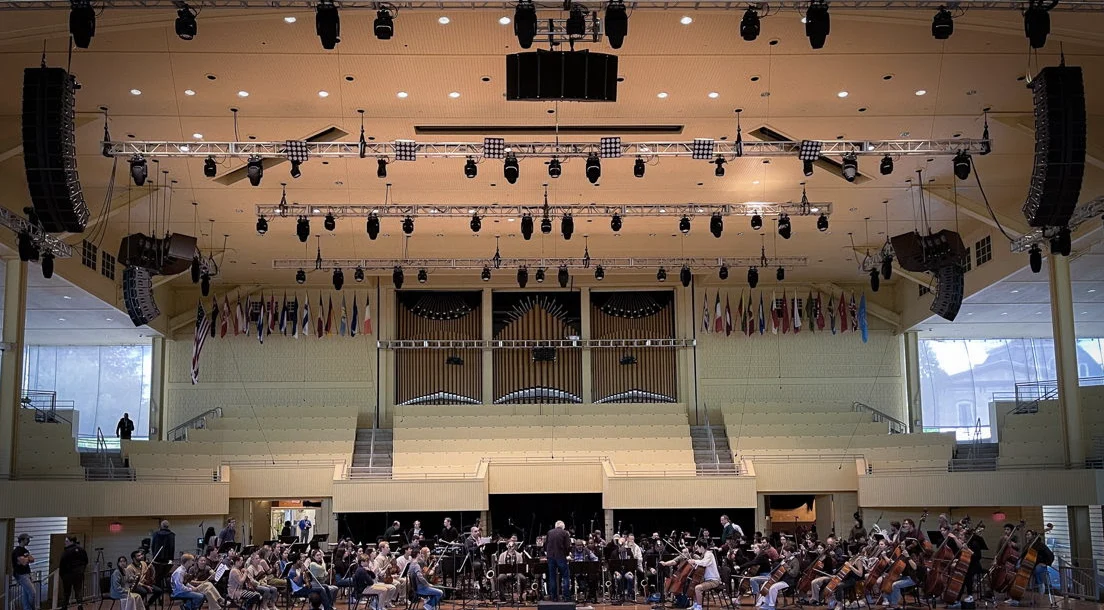
One of the most rigorous tests of this methodology came during a massive live production of Wynton Marsalis’s ambitious masterwork, All Rise. Taped for PBS to mark the 150th anniversary of the Chautauqua Institution, the production required capturing a full symphony orchestra alongside a 100-voice choir.
Collaborating with mobile recording veterans Sound Mirror—who supplied their entire stock of Schoeps inventory for the event—Whitelock’s team deployed over 80 MK 4 microphones across the stage and elevated choir loft. The resulting broadcast achieved critical acclaim, cementing the production value of JALC’s external media partnerships and validating Whitelock’s heavy reliance on Schoeps hardware for large-scale acoustic events.
Supporting Data & Technical Architecture
The technical demands of modern jazz broadcasting are multifaceted. Engineers must deliver mixes that translate effectively across a wide spectrum of consumer listening environments—ranging from high-end multi-channel home theaters and immersive audio formats to standard television speakers and mobile devices.
The MK 2 Omnidirectional Capsule
Suspended high above the stage in Rose Theater and The Appel Room, the seven-microphone array utilizing Schoeps MK 2 capsules serves as the primary perspective for listeners. Omnidirectional capsules are prized in high-end acoustic recording for several distinct reasons:
- Extended Low-Frequency Response: Unlike directional microphones, omnis do not suffer from the proximity effect, allowing them to capture the true, uncolored low-end weight of a double bass or a grand piano’s lower registers.
- Phase Coherency: Omnidirectional patterns offer smoother off-axis linear frequency responses, resulting in a more cohesive, natural-sounding stereo and surround image when blended with spot microphones.
- Room Integration: By capturing the diffuse soundfield of the hall accurately, the MK 2 capsules provide the crucial spatial cues that trick the human brain into feeling present in the physical room.
The MK 4 Cardioid Capsule for Choral and Ensemble Work
When scaling up for massive ensembles like the 100-voice choir featured in All Rise, Whitelock bypassed traditional large-diaphragm condensers in favor of the Schoeps MK 4 cardioid capsule.
"The MK 4 capsule is especially great for capturing choral elements, and I honestly prefer them to large diaphragm condensers for choirs," Whitelock notes.
The advantages of the MK 4 in dense staging environments include:
- Off-Axis Rejection: The cardioid polar pattern effectively controls bleeding from neighboring orchestral sections, maintaining clarity in complex arrangements.
- Compact Form Factor: In televised or professionally filmed broadcasts, maintaining a clean visual aesthetic is mandatory. The small footprint of the Schoeps modular system allows placement directly in front of performers without cluttering camera sightlines or distracting the live audience.
- Consistent Tonal Response: Even at wide angles of incidence, the MK 4 maintains frequency linearity, preventing the "muddy" or phase-smeared highs that frequently plague lesser condenser designs under high SPL (Sound Pressure Level) conditions.
Official Responses and Engineering Philosophy
Todd Whitelock’s commentary on his craft reveals a deeply analytical approach to acoustic engineering. He draws a direct parallel between the visual arts and audio capture:
"The mark of a great microphone is their sonic honesty, in my opinion," Whitelock states. "The ability to capture the true characteristics of an instrument is always a challenge, and you want the microphone to do that without imparting too much unnecessary coloration on the results. I equate that to a photographer choosing the right lens for a closeup versus a landscape."
This perspective underpins the operational ethos at Amplified Art & Sound. Because Jazz at Lincoln Center serves as a global incubator and showcase for the genre, compromise is entirely off the table.
"The greatest performers in the world play on our stages, and as such, we take our responsibility to livestream and capture those performances very seriously," Whitelock explains. "Close mic-ing alone doesn’t adequately capture the power of the orchestra in full swing."
This commitment extends to high-profile broadcast environments where visual aesthetics clash directly with acoustic requirements. Addressing the logistical hurdles of capturing massive productions like All Rise, Whitelock highlights the flexibility provided by his partnership with Sound Mirror:
"When we are recording for a live broadcast, especially on the scale required for All Rise, the visual element really does come into play in a big way. You really don’t want to see microphones on stage, but with an ensemble that big… you simply cannot compromise on the sound. This is where Schoeps always shines because you can place them exactly where you need without them drawing attention away from the performers and get the sound that you need."
Reflecting on the final product of the Chautauqua Institution recording, Whitelock expresses profound satisfaction:
"They’re always asking us if we really need that many microphones, but when they hear the results, it’s clear that the effort is worth it. We’re very proud of the audio production on that performance, and Wynton [Marsalis] felt we did justice to the maestro’s work."
Implications for the Future of Live Jazz Production
The enduring marriage between Amplified Art & Sound, Jazz at Lincoln Center, and Schoeps microphones points toward broader industry trends in live performance capture, streaming, and immersive audio.
- The Rise of Immersive and Spatial Audio: As consumer platforms increasingly adopt Dolby Atmos and other spatial audio formats, the demand for natural, high-resolution ambient capture has skyrocketed. Microphones that excel at spatial fidelity—such as the Schoeps Colette Series—are no longer luxury items for classical halls; they are essential tools for contemporary jazz and cross-genre broadcasts.
- The Convergence of Live Broadcast and Studio Quality: Audiences consuming livestreams from venues like JALC no longer tolerate sub-par "board mix" audio. The standard has shifted toward fully mixed, master-quality audio delivered in real-time. By deploying high-end acoustic arrays as standard infrastructure, venues can guarantee broadcast streams that rival commercial studio albums.
- Aesthetics vs. Acoustics: As video production values continue to rise for live arts organizations, the physical footprint of sound reinforcement hardware will face increasing scrutiny. The engineering community’s reliance on compact, modular high-end capsules demonstrates that pristine sonic capture and minimalist visual design can successfully coexist.
Ultimately, capturing jazz—an art form rooted in improvisation, acoustic dynamics, and human interaction—requires tools that respect the integrity of the source. Through the meticulous application of Schoeps technology by Todd Whitelock and the team at Amplified Art & Sound, Jazz at Lincoln Center ensures that the vibrant, breathing reality of every note played on its stages is preserved for history, broadcast to the world, and delivered with absolute sonic honesty.