By Audio Journal Technology Desk
Published: August 2026
Main Facts: The Anatomy of a High-End Micro-Component
In the hyper-competitive world of ultra-high-end audio, the prevailing industry bias has long favored massive, rack-dominating chassis adorned with oversized heat sinks, dual-mono linear power supplies, and complex multi-layered front panels. Swiss audio legend Nagra—a brand historically synonymous with pristine broadcast field recorders, legendary reel-to-reel decks, and reference-grade tube electronics—is challenging this paradigm.
With the introduction of the new Nagra Compact Player, the manufacturer has proven that world-class digital-to-analog conversion and network streaming do not require a footprint the size of a small amplifier. Measuring an astonishingly modest 7.2 x 6.5 x 1.6 inches, this diminutive digital marvel matches the exact physical dimensions of its sibling, the Nagra Compact Phono stage.
Designed for audiophiles who demand uncompromising sonic transparency without the associated spatial footprint, the Compact Player delivers a pure, unadulterated high-resolution streaming experience. Out of the box, it operates via a streamlined external power supply, though it retains upgrade paths compatible with Nagra’s high-end modular power ecosystem—including the dedicated Nagra Compact PSU, as well as the advanced MPS and Classic PSU units.
Despite its scaled-down physical stature, the device makes zero compromises regarding internal engineering or sonic philosophy. Equipped with full DSD (Direct Stream Digital) playback capabilities and seamless Roon Ready integration, the Compact Player represents a masterclass in minimalist audio design. By stripping away extraneous inputs, complex user interfaces, and mechanical switches, Nagra has channeled its decades of precision engineering directly into signal purity, achieving performance levels that rival—and occasionally surpass—DACs commanding significantly higher price tags.
Chronology: From Field Recorders to Micro-Streaming Excellence
To fully understand the significance of the Nagra Compact Player, one must examine the chronological evolution of Nagra’s design ethos, tracing a direct line from analog field recording to contemporary digital architecture.
The Foundation: Precision in Miniature (1951–1990s)
Founded in 1951 by Stefan Kudelski in Lausanne, Switzerland, Nagra earned its global reputation by building portable, battery-powered analog tape recorders for film and radio journalists. The iconic Nagra III and its successors became industry standards because they packed breathtaking mechanical and electrical precision into portable enclosures. Kudelski’s core design philosophy was simple: eliminate redundancy, maximize reliability, and respect the integrity of the original waveform.
Transition to High-End Consumer Audio (1997–2010s)
As the professional recording industry shifted toward digital media, Nagra applied its uncompromising engineering standards to the consumer high-end audio market. Launching legendary components like the PL-P preamplifier and the CDC (Compact Disc Compact) player, the company proved that tube technology and solid-state precision could coexist harmoniously. During this period, Nagra developed its signature aesthetic: industrial chic featuring the iconic modulometer (modulation meter), rotary control wheels, and a silver chassis finish that screamed Swiss mechanical horology.
The Modern Digital Shift and the Compact Series (2020–Present)
As music streaming and network audio eclipsed physical media, Nagra adapted by releasing high-end reference digital-to-analog converters, such as the HD DAC X. However, recognizing a growing market segment of audiophiles seeking minimalist systems for office setups, secondary listening spaces, or space-conscious urban apartments, Nagra conceptualized the "Compact" series.
Following the successful launch of the Compact Phono stage, the development team turned its attention to the digital domain. The project focused on distilling the core processing algorithms and discrete analog output stages of Nagra’s flagship digital gear into a chassis small enough to fit on a desktop. The result is the Compact Player: a device that requires less than 30 seconds to set up, yet inherits over seven decades of Swiss acoustic research.
Supporting Data: Technical Specifications and Performance Metrics
While a full, extended technical review is forthcoming, early testing and initial specifications provide a clear picture of how the Nagra Compact Player performs under real-world conditions.
Physical and Electrical Specifications
- Dimensions: 7.2 inches (Width) x 6.5 inches (Depth) x 1.6 inches (Height)
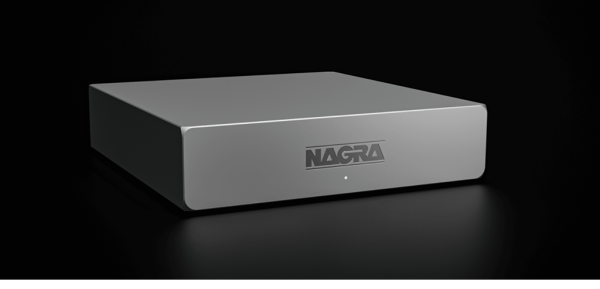
- Chassis Design: Solid-grade aluminum extrusion, matching the Compact Phono aesthetic.
- Power Supply (Stock): High-efficiency external switch-mode power supply.
- Power Supply Upgrades: Compatible with the Nagra Compact PSU, Nagra MPS, and Classic PSU.
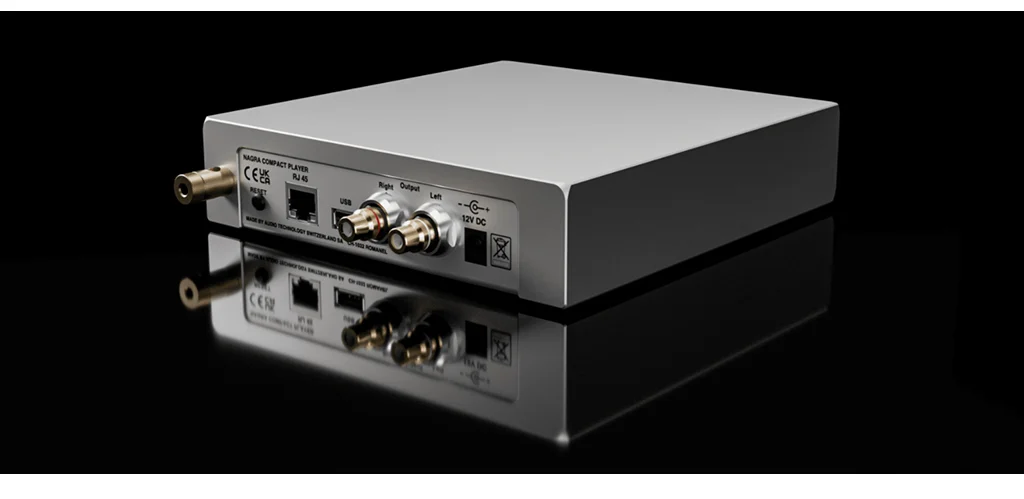
- Power Switch: None. Designed to remain permanently powered on for optimal thermal and electrical stability. A single, discrete LED indicator confirms operational status.
- Warm-up Period: Stable instantly, though optimal sonic equilibrium is achieved after approximately 24 hours of continuous power-on operation.
Connectivity and Digital Architecture
- Network Input: 1x RJ-45 Ethernet port.
- Protocol Support: Roon Ready (optimized for seamless integration into Roon ecosystems).
- Local Storage Input: 1x USB Type-A port for external hard drives, thumb drives, and local music storage.
- Resolution Support: Full native DSD playback alongside standard PCM resolutions ranging from 16-bit/44.1kHz up to high-resolution 24-bit/192kHz streams.
- Analog Outputs: Premium single-ended (and/or balanced, depending on final regional configuration) output stages derived from Nagra’s proprietary discrete topology.
Performance Observations (Initial Evaluation)
During initial listening sessions utilizing Roon via Ethernet input, the Compact Player demonstrated exceptional versatility across various recording genres. Streaming standard CD-quality files (16-bit/44.1kHz) up to high-resolution master tracks (24-bit/192kHz), the unit exhibited a distinctive sonic signature:
- Transient Speed: Lightning-fast transient response that captures the initial attack of acoustic instruments, percussion, and plucked strings without artificial etching or hardness.
- Tonal Accuracy: Remarkable neutrality. There is no perceived midrange bloom, bloated bass, or artificially shelved-up high frequencies.
- Noise Floor: Thanks to the separation of the power supply and the ultra-short internal signal paths, the background is exceptionally black, allowing micro-details and ambient decay to emerge naturally.
Official Perspectives and Industry Reception
Reactions from industry veterans and early beta testers highlight the disruptive nature of the Nagra Compact Player. Rather than positioning the device as a "budget" entry point, industry analysts view it as a strategic exercise in functional purity.
The Philosophy of Subtraction
In statements regarding the design methodology behind the Compact series, Nagra’s engineering team emphasized the concept of subtractive design. In high-end audio, the temptation is always to add features: multiple digital inputs (optical, coaxial, AES/EBU, I2S), onboard digital signal processing (DSP), headphone amplifiers, and complex display screens.
However, every added circuit board, internal switching relay, and digital interface introduces potential sources of noise, jitter, and signal degradation. By deliberately restricting the Compact Player to an Ethernet network input and a USB port for local storage, Nagra eliminated entire layers of potential digital interference.
Reviewer Impressions: The "Tudor Black Bay" of Audio
Industry critic Jeff Dorgay of TONEAudio offered an insightful analogy when evaluating the device, comparing its positioning to the luxury watch market:
"Think of the Compact Player as the Tudor Black Bay of digital players. It’s built with every bit of care and precision that every Nagra is built with. The Compact series is not watered down in any way… This DAC delivers performance rivaling much more expensive DACs we’ve used—but again, no functionality."
This sentiment underscores a crucial shift in consumer expectations. Modern audiophiles are increasingly willing to trade redundant physical inputs—such as legacy S/PDIF coaxial or optical connections—in exchange for pure, uncompromised network streaming architecture managed through sophisticated software interfaces like Roon.
Implications: What the Nagra Compact Player Means for the High-End Market
The release of the Nagra Compact Player carries significant implications for the broader high-end audio industry, touching on market trends, consumer habits, and the future of component architecture.
1. The Redefinition of High-End Aesthetics
For decades, high-end audio has operated under the psychological assumption that "bigger is better." Massive monoblock amplifiers and sprawling digital front-ends served as status symbols in dedicated listening rooms. The success of ultra-compact, ultra-performance components like the Nagra Compact series signals a demographic and spatial evolution. As high-end audio integrates into modern urban living spaces, high-net-worth consumers increasingly demand gear that delivers reference-grade sonic performance without dominating domestic architecture.
2. The Dominance of Network-Centric Ecosystems
By omitting legacy digital inputs like S/PDIF and focusing exclusively on network streaming (Ethernet/Roon) and local USB storage, Nagra is making a bold statement about how modern audiophiles consume music. Physical disc transports are rapidly becoming secondary sources, replaced entirely by network-attached storage (NAS) and streaming services. By streamlining the input stage, manufacturers can allocate a higher percentage of the Bill of Materials (BOM) budget toward critical components where it matters most: the digital clocking mechanisms, the conversion chips, and the discrete analog output stages.
3. Modular Upgrade Paths as a Sustainable Business Model
The inclusion of power supply upgrade paths—allowing users to transition from the stock wall-wart style power supply to the Compact PSU, MPS, or Classic PSU—highlights a sophisticated approach to consumer longevity. Buyers can enter the Nagra digital ecosystem at a lower baseline price point, enjoying world-class conversion immediately, with a clear, manufacturer-supported upgrade ladder that enhances performance over time without requiring the complete replacement of the core unit.
4. Setting a New Benchmark for Desktop and Secondary Systems
While traditional flagship DACs often cost tens of thousands of dollars and require dedicated equipment racks, the Compact Player opens up new possibilities for high-end desktop audio, bedroom systems, and minimalist living room setups. It proves that uncompromising micro-dynamics, tonal realism, and holographic soundstaging are no longer the exclusive domain of massive, multi-chassis systems.
Conclusion
The Nagra Compact Player is not trying to be all things to all listeners. It lacks the endless feature lists, complex menu systems, and physical connection arrays found on mainstream all-in-one network players. Instead, it focuses entirely on executing a single task with absolute perfection: converting high-resolution network data into an emotionally engaging, tonally accurate, and breathtakingly transparent analog signal.
For audiophiles seeking uncompromised Swiss engineering in a form factor that defies traditional expectations, the Nagra Compact Player sets a towering new standard. Backed by Nagra’s legendary heritage and a design philosophy rooted in pure acoustic truth, this micro-masterpiece is poised to become one of the most talked-about and admired digital components of the decade. As extended reviews roll out in the coming months, the high-end audio community will undoubtedly be watching—and listening—very closely.