Main Facts
The high-end audio market has long faced a persistent tension between uncompromised sonic performance and domestic livability. Traditional audiophile setups often require a sprawling labyrinth of separate chassis—monoblock power amplifiers, dedicated line-stage preamplifiers, external digital-to-analog converters, standalone phono stages, and network streamers—interconnected by expensive cabling and housed in heavy-duty equipment racks.
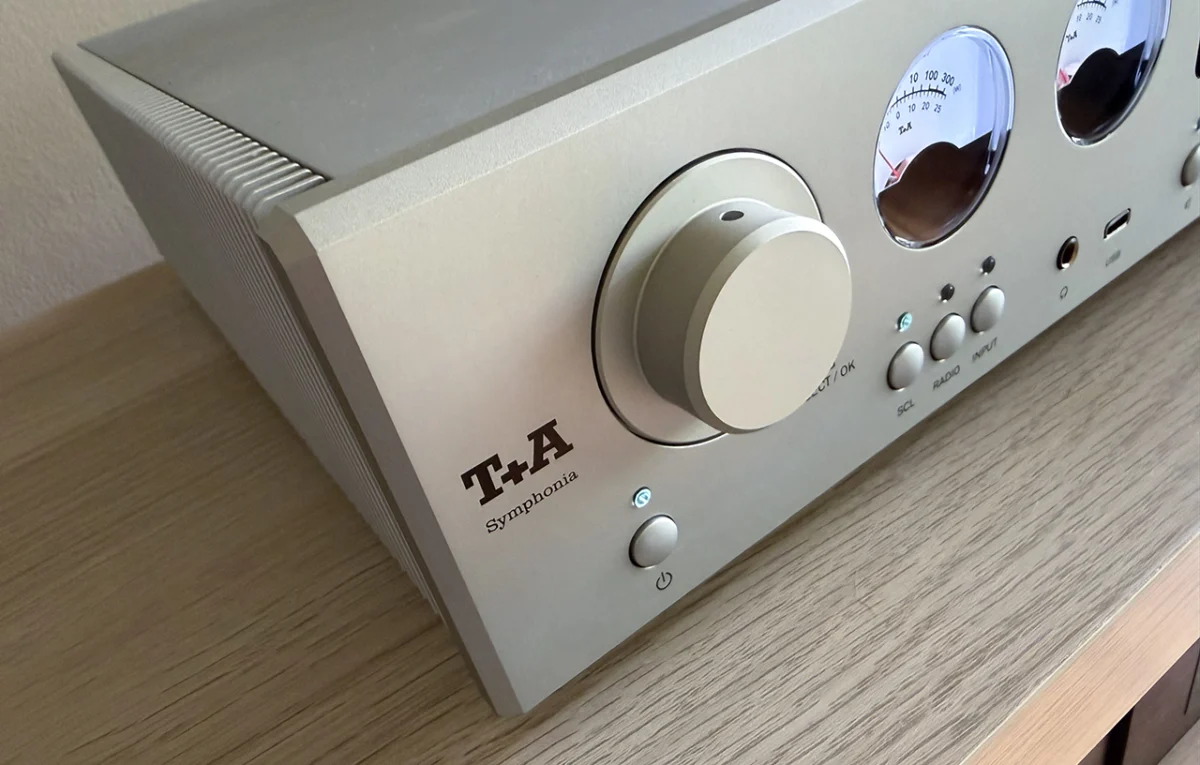
Enter the T+A Symphonia, a component engineered to resolve this dichotomy without compromises. Priced at $10,995, the Symphonia is squarely positioned in the high-end tier, yet it seeks to redefine the category by offering a comprehensive, single-chassis solution. At its core, the device leverages advanced Eigentakt amplification technology, heavily customized by T+A’s engineering team to incorporate the German manufacturer’s proprietary high-voltage power supply design and wide-bandwidth throughput architecture.
The Symphonia outputs a robust 125 watts per channel into an 8-ohm load, doubling down to 250 watts into 4 ohms, allowing it to effortlessly drive demanding reference loudspeakers. Beyond raw amplification, it integrates a high-resolution USB DAC, Roon-ready network streaming capabilities, Bluetooth, Wi-Fi, Ethernet connectivity, digital optical and coaxial inputs, a traditional analog line-level RCA input, an onboard moving magnet (MM) phono stage, and legacy digital/terrestrial radio options including FM and DAB tuners. A dedicated subwoofer output rounds out the connectivity suite, making the Symphonia a remarkably versatile hub for both modern digital ecosystems and legacy analog sources.
Chronology of Development and Release
The journey toward the T+A Symphonia reflects a multi-year evolutionary cycle within the high-performance audio industry, mirroring the shifting demands of audiophiles and contemporary interior architecture alike.
The Genesis of Modern All-in-One High-End Audio
For decades, high-end audio manufacturers maintained a strict ideological separation between components. Separate chassis were deemed essential to prevent electromagnetic interference (EMI) and radio frequency interference (RFI) between sensitive low-level analog circuits and noisy digital processing or high-current power supplies.
However, by the late 2010s and early 2020s, advancements in component miniaturization, circuit layout isolation, and class-D topologies began to challenge this dogma. Brands realized that affluent consumers and music lovers desired uncompromising sound quality paired with minimalist aesthetics. T+A (Theorie und Anwendung), renowned for its uncompromising engineering pedigree based in Herford, Germany, began quietly investigating how to pack its flagship-level engineering philosophies into a single, cohesive chassis.
The Eigentakt Integration and Custom Engineering Phase
The turning point for the Symphonia’s development arrived with the maturation of ultra-low-distortion amplifier modules, specifically the Eigentakt technology. Rather than merely dropping off-the-shelf modules into a chassis—a common shortcut in the industry—T+A’s engineering division initiated a deep customization program.
Over a multi-year R&D cycle, the team developed a custom proprietary motherboard around the core amplification topology. This allowed them to merge the high-efficiency, load-independent distortion characteristics of the Eigentakt platform with T+A’s signature high-voltage (HV) circuit topologies. The HV technology, originally trickled down from the brand’s elite HV Series, operates internal transistors at significantly higher voltages, resulting in superior linearity, extended bandwidth, and an expansive dynamic headroom that avoids the clinical sterility sometimes associated with class-D amplification.
Final Prototyping, Global Reveal, and Market Launch
By early 2026, final production prototypes of the Symphonia were undergoing rigorous acoustic and stress testing in T+A’s German laboratories, as well as blind evaluations in high-end listening rooms worldwide. Early reviewers and international distributors were given private demonstrations, highlighting the unit’s ability to drive complex, low-impedance loudspeaker loads without strain.
In mid-2026, T+A officially announced the Symphonia to the global market, setting an MSRP of $10,995. The launch marked a strategic pivot for the brand, targeting not only traditional audiophiles looking to downsize their systems without sacrificing fidelity, but also design-conscious consumers entering the high-end market for the first time. Early critical reception immediately singled out its build quality, minimalist visual footprint, and surprising capacity to partner effortlessly with reference-grade floorstanding speakers.
Supporting Data and Technical Specifications
To truly understand the value proposition of the T+A Symphonia at its $10,995 price point, one must examine the hard metrics and engineering specifications that distinguish it from standard lifestyle audio products.
| Feature / Specification | T+A Symphonia Details |
|---|---|
| Retail Price | $10,995 USD |
| Power Output (8 Ohms) | 125 Watts per channel |
| Power Output (4 Ohms) | 250 Watts per channel |
| Amplification Topology | Custom T+A implementation of Eigentakt architecture with High-Voltage (HV) power supply |
| Digital-to-Analog Conversion | High-resolution USB DAC, Roon Ready |
| Streaming Protocols | Ethernet (recommended), Wi-Fi, Bluetooth |
| Digital Inputs | USB, Optical (SPDIF), Coaxial (RCA/SPDIF) |
| Analog Inputs | 1x Line-Level RCA, 1x Dedicated MM Phono Stage |
| Radio Tuners | FM and DAB / DAB+ onboard |
| Outputs | Speaker binding posts, Subwoofer line-level output |
| Chassis Construction | Low-resonance, heavy-gauge brushed aluminum with minimalist aesthetic footprint |
Economic and Spatial Analysis
At nearly $11,000, the Symphonia requires an initial financial commitment that places it well above entry-level gear. However, a comparative financial breakdown reveals its underlying cost-efficiency within an ultra-high-end context:
- Interconnect and Power Cable Savings: In a traditional separates system comprising a streamer, DAC, preamplifier, and power amplifier, a user must purchase at least three to four pairs of high-end interconnects (XLR or RCA) and multiple high-grade power cords. In high-end audio, these cables easily aggregate to thousands of dollars. The Symphonia internalizes these signal paths, eliminating passive connection losses and cable expenses.
- Rack Space Footprint: High-end audio racks are expensive and take up significant floor space in living areas. The Symphonia condenses a four-box stack into a single, elegant chassis that can easily sit on a credenza or minimalist media console.
- Power Supply Efficiency: By utilizing a shared, oversized high-voltage power supply architecture, T+A achieves economies of scale within the chassis, providing massive current delivery without the redundant transformer costs of separate enclosures.
Official Responses and Industry Commentary
The announcement and subsequent rollout of the T+A Symphonia have generated substantial discussion within the audiophile community, drawing commentary from industry executives, reviewers, and audio designers.
T+A Engineering Philosophy
In statements released alongside the product launch, T+A’s engineering leadership emphasized that the Symphonia was not designed as a "compromise" product for casual listeners, but as a genuine high-end instrument built to uncompromising standards.
"We refused to treat the Symphonia as a lifestyle product that happens to play music," noted a senior T+A product developer during an engineering brief. "Our goal was to take our decades of research into high-voltage amplification and digital signal processing and distill it into an architecture that respects both the purity of the music and the realities of modern living spaces. The music lover should never have to choose between interior harmony and absolute sonic transparency."
Early Critical Observations
Early evaluation units sent to premier audio publications have yielded enthusiastic feedback. Reviewers focusing on system matching noted that the Symphonia’s ability to drive difficult loads—such as multi-driver YG Acoustics reference floorstanders—dispels the myth that all-in-one systems lack authoritative bass control or transient snap.
One prominent reviewer remarked:
"If you’ve been looking for a high-performance component that can do everything—with a minimal and very attractive footprint—we highly suggest the T+A Symphonia. The level of performance, refinement, versatility, and execution deliver tremendous value… Dynamic, detailed, open, and musical. It drives our reference speakers flawlessly."
Furthermore, industry analysts have praised the inclusion of legacy formats alongside cutting-edge streaming. While many modern manufacturers have completely abandoned physical radio tuners and analog tape loops, T+A’s retention of an FM/DAB tuner and an analog RCA input acknowledges that many high-end enthusiasts maintain diverse, multi-decadal media libraries spanning vinyl, tape, digital files, and broadcast radio.
Implications for the High-End Audio Market
The introduction of the T+A Symphonia carries broader implications for the trajectory of the high-end consumer audio market, signaling a maturation in how manufacturers approach luxury sound reproduction.
The Shift Toward "Simplification Without Subtraction"
Historically, high-end audio marketing was predicated on the "more boxes are better" philosophy. Each upgrade path required adding another chassis, creating visual clutter and operational complexity. The success and engineering ambition of components like the Symphonia suggest that the market is pivoting toward a paradigm of "simplification without subtraction." Consumers are increasingly unwilling to turn their living rooms into electronic laboratories, yet their sonic expectations remain as demanding as ever.
By proving that class-leading digital streaming, phono stages, and high-voltage amplification can coexist harmoniously within a single chassis, T+A has established a benchmark that competing luxury audio brands will likely feel compelled to follow.
Bridging Generational Divides in Listening Habits
The Symphonia also serves as a cultural bridge between older and younger generations of music enthusiasts. For traditional audiophiles who cherish their vinyl collections and legacy tuner broadcasts, the unit offers familiar touchpoints via its MM phono stage and FM/DAB capabilities. Simultaneously, for digital-first listeners who rely on Roon, high-resolution streaming services, and wireless device pairing, the Symphonia operates as a seamless, state-of-the-art network hub.
This versatility broadens the addressable market for high-end audio, appealing to younger, design-forward professionals who value architectural integration just as much as harmonic accuracy and soundstage depth.
Conclusion
As full reviews continue to roll out and consumers experience the T+A Symphonia in home environments, the component is poised to influence product development cycles across the luxury audio sector. At $10,995, it challenges the status quo of separates-dominated systems, proving definitively that supreme musicality, aesthetic minimalism, and exhaustive feature sets can exist under one exquisitely crafted aluminum roof.