Main Facts
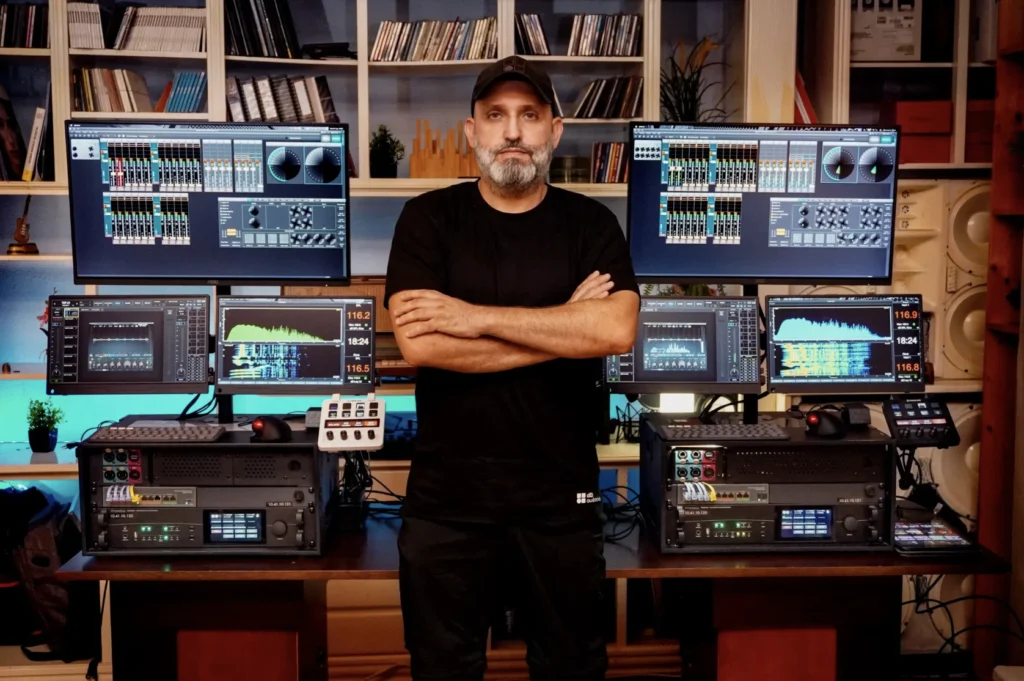
At the annual, community-led Waking Life Festival near Crato, Portugal, veteran sound and system engineer Fernando Rodrigues (widely known as "Nando") successfully deployed a streamlined, highly resilient audio architecture anchored by dual DirectOut PRODIGY.MP multifunction audio processors. Serving as the technical backbone for the festival’s two premier electronic music stages—Floresta and Outro Lado—the PRODIGY.MP units performed a triple-threat role previously requiring multiple distinct hardware devices: functioning simultaneously as advanced stageboxes, digital mixing consoles, and comprehensive Public Address (PA) system processors.
Faced with punishing environmental conditions, including heavy ambient dust, continuous multi-day operations, and tight turnover schedules, Rodrigues designed a workflow that eliminated traditional hardware mixers. Instead, he utilized the PRODIGY.MP units controlled via globcon software paired with an innovative Elgato Stream Deck Plus physical control surface.
The technical implementation leveraged high-end d&b audiotechnik loudspeaker systems, including KSL array modules and SL-SUBS. By integrating DirectOut’s robust modular hardware—complete with Sample Rate Conversion (SRC), Waves SoundGrid integration for dynamic equalization, and dual-network Dante/MILAN capabilities—Rodrigues achieved unprecedented stability, a drastically reduced footprint, and zero tolerance for single points of failure in an environment where thousands of electronic music fans dance around the clock.
Chronology: The Evolution of a Paradigm-Shifting Workflow
From Concept to Festival Grounds: The Genesis of the Setup
The journey toward this innovative festival audio design began years prior. Rodrigues, whose professional roots lie heavily in d&b audiotechnik systems, has managed audio production across multiple stages at the Waking Life Festival since its inception in 2019. Over successive editions, the grueling operational demands of the festival exposed the limitations of traditional touring mixing workflows.
While discussing the perennial challenge of streamlining console integration and minimizing signal chain vulnerabilities with fellow sound engineer Georges Abiaad, a pivotal question was raised: "Why not use the PRODIGY.MP as a mixer?"
Placing trust in Abiaad’s conceptual spark, and collaborating closely with Chadi El Masri and the 7Hertz team for card selection and system configuration, Rodrigues began prototyping a radical departure from conventional live sound engineering. He realized that the modular architecture of the DirectOut PRODIGY.MP could be pushed far beyond its standard routing and conversion capabilities to become the central nervous system of festival-grade stage production.
Rigging the Stages: Floresta and Outro Lado
For the 2024 edition of Waking Life, the stakes were exceptionally high. The festival’s two main electronic music stages presented grueling operational schedules:
- Outro Lado demanded relentless 24-hour continuous operation.
- Floresta ran nearly non-stop, closing for a mere four to five hours each day to allow for rapid stage resets, artist sound checks, and system maintenance.
The Floresta stage was outfitted with a formidable d&b audiotechnik KSL array and SL-SUBS neatly deployed directly beneath the DJ table across the front of the stage. With fast-paced DJ changeovers occurring day and night, any technological hiccup could derail the festival experience.
Rodrigues engineered the signal chains for both stages around a dedicated PRODIGY.MP unit acting as the master system clock locked at 96 kHz. Rather than routing DJ consoles through traditional large-format mixing consoles, every artist’s multi-channel kit—comprising up to eight channels of digital, analog, monitoring, and live recording feeds—was connected directly into the PRODIGY.MP stagebox modules.
Custom Control and Fail-Safe Engineering
To mix the shows without a physical mixing console, Rodrigues configured the PRODIGY.MP units via globcon software, mapping mixing parameters to an Elgato Stream Deck Plus as a custom physical control surface.
For PA processing, the setup utilized Waves plugins hosted on a dedicated external computer connected through the PRODIGY.MP’s SoundGrid module. This allowed Rodrigues to apply subtle, transparent dynamic equalization directly on the matrix outputs, keeping the large-format PAs impeccably controlled and balanced without altering the foundational mixes delivered by the performing artists.
Recognizing the risk of plugin or computer crashes in a high-stress live environment, Rodrigues engineered a custom GPIO-triggered fail-safe system utilizing Quick Recall snapshots within the hardware:
- Primary State: Signals processed actively through the external Waves plugin host.
- Fail-Safe State: A secondary snapshot capable of instantly bypassing the plugin host upon hardware or software failure, ensuring uninterrupted audio flow.
- Recovery State: A seamless transition back to processed audio once stability was verified.
Finally, the processed audio signals were distributed simultaneously in analog and AES3 formats to the amplifiers, guaranteeing hardware-level redundancy for both the main PA outputs and the DJ monitoring systems. Additional flexibility was secured via the dual-network DANTE.MILAN.SRC.IO modules, which routed multi-track feeds via Dante Virtual Soundcard (DVS) and Reaper for archival recording, while simultaneously maintaining native compatibility with Milan-ready network infrastructures.
Supporting Data & Technical Specifications
To fully understand the engineering triumph at Waking Life, it is essential to examine the technical specifications and hardware capabilities that made Rodrigues’ workflow possible:
- Core Processing Hardware: 2x DirectOut PRODIGY.MP multifunction audio processors.
- Master Clock Frequency: Locked stable at 96 kHz across both stage environments.
- Loudspeaker Infrastructure: d&b audiotechnik KSL line array modules paired with SL-SUBS.
- Input Capacity per DJ Kit: Up to 8 discrete channels handling digital, analog, monitoring, and recording feeds.
- Clock Independence: Dedicated Sample Rate Converters (SRCs) integrated via AES4.SRC.IO modules, insulating the master system clock from external or unstable DJ console clocks.
- Control Surface Integration: globcon remote control software operating in tandem with an Elgato Stream Deck Plus for tactile parameter control.
- DSP & Dynamics: External computer running Waves plugins via a dedicated SoundGrid hardware module, executing real-time dynamic EQ on master matrix outputs.
- Network & Archiving Protocols:
DANTE.MILAN.SRC.IOmodules routing to Reaper DAWs via Dante Virtual Soundcard (DVS), alongside future-proof Milan network readiness. - Redundancy Features: Dual redundant power supplies, hardware-level backup snapshots via GPIO triggering, and mirrored analog/AES3 distribution to amplifiers.
Official Responses and Testimonials
The success of the deployment elicited strong praise from Fernando Rodrigues, who highlighted both the versatility of the hardware and the collaborative support ecosystem that made the project possible:
"The PRODIGY.MP’s versatility and reliability were the main reasons behind my choice. With DirectOut’s support in configuring globcon and integrating the Stream Deck Plus, I was able to use it beyond its conventional applications as a fully customized digital mixing console. Its processing, routing, redundancy and clocking capabilities allow me to adapt the system to the specific requirements of every production."
Reflecting on the long-term impact of the PRODIGY.MP on his professional career as a sound and system engineer, Rodrigues emphasized that the device has transitioned from a specialized tool to an absolute industry standard for his work:
"For me, as a system engineer, the PRODIGY.MP is by far one of the most important pieces of equipment in any professional toolkit. It is not simply an optional piece of equipment; it has become a mandatory part of my workflow. This is also why I decided to invest in two units."
Rodrigues also made a point to credit the mentors and engineering partners who helped bring his vision to life:
"I am grateful to Georges Abi Aad for the original idea and to Chadi El Masri and the 7Hertz team. Chadi was instrumental in helping me select the right cards and configure the system, giving me the confidence to build the entire setup around DirectOut solutions."
Implications for the Future of Live Event Production
The deployment of DirectOut PRODIGY.MP processors at the Waking Life Festival carries profound implications for the future of electronic music sound design and large-scale live event production.
For decades, live sound engineering has relied on a heavily stratified hierarchy of equipment: individual stageboxes running to massive digital mixing consoles, which in turn feed external or internal DSP processors before finally reaching amplifiers. While effective, this traditional workflow introduces numerous potential points of failure, extensive cabling requirements, heavy logistical footprints, and significant power draws—all of which pose severe challenges in outdoor festival environments plagued by dust, heat, and round-the-clock operating hours.
By proving that a modular multifunction processor like the PRODIGY.MP can successfully assume the simultaneous duties of stagebox, digital mixer, and PA processor, Rodrigues has demonstrated a leaner, more resilient engineering model. Key takeaways for the broader live production industry include:
- Reduction of Hardware Footprint: Consolidating multiple devices into a single 2RU hardware chassis drastically reduces truck-pack volume, setup times, and physical failure points.
- Enhanced Signal Integrity: By eliminating unnecessary analog-to-digital conversions and utilizing dedicated Sample Rate Conversion on input modules, overall audio fidelity is preserved right from the source.
- Custom, Scalable Control Interfaces: The marriage of industrial-grade audio routing hardware with flexible software platforms (globcon) and affordable, accessible control surfaces (like the Elgato Stream Deck Plus) challenges the hegemony of expensive, proprietary mixing console surfaces.
- Mission-Critical Redundancy: In environments like Waking Life—where thousands of patrons expect uninterrupted musical immersion—hardware-level fail-safes, dual-network Dante/MILAN paths, and GPIO-triggered snapshot backups set a new benchmark for system reliability.
As festival organizers and audio engineers face increasing pressure to deliver pristine, high-fidelity sound under punishing environmental and logistical constraints, the workflow pioneered by Fernando Rodrigues offers a compelling blueprint. The DirectOut PRODIGY.MP has proven that flexibility, processing power, and absolute reliability can coexist within a compact, elegantly engineered solution—signaling a shift toward smarter, more streamlined live sound architectures worldwide.