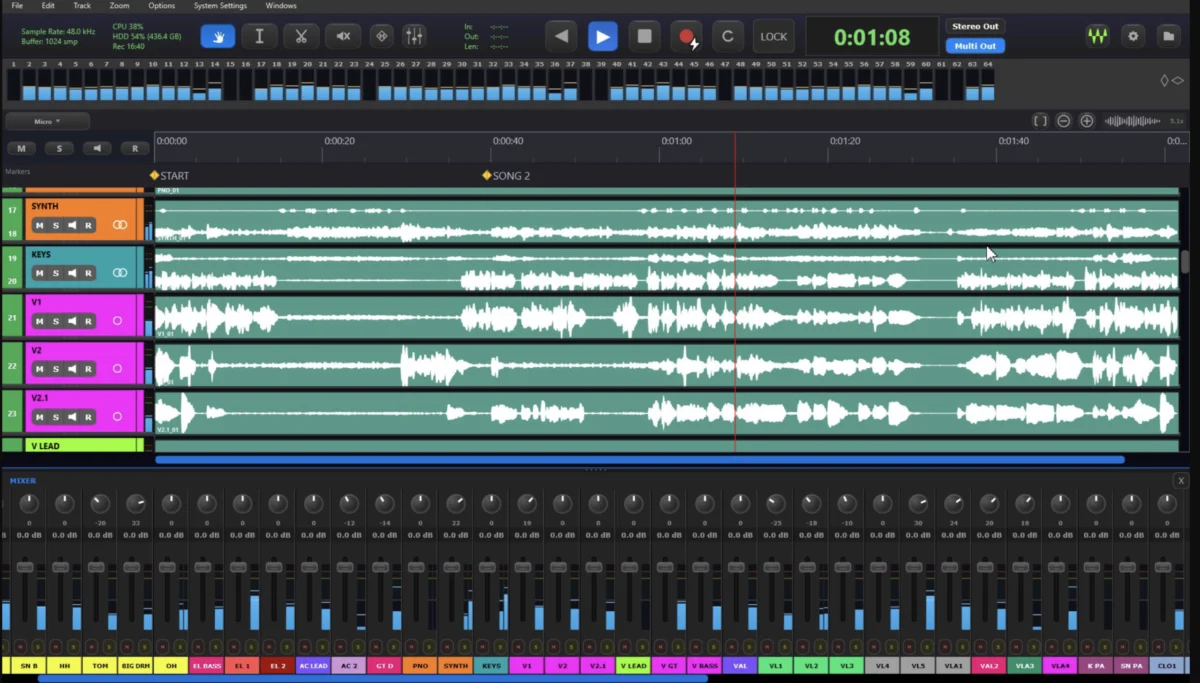
September 2026 — In an announcement that promises to streamline workflows for live sound engineers around the globe, Waves Audio has officially launched Tracks Live 2.0. Engineered specifically for the demanding environments of concert tours, theater productions, houses of worship, and broadcast events, the new software provides up to 128 channels of robust multitrack capture.
By combining reliable live recording, virtual soundcheck capabilities, fundamental editing tools, and seamless DAW export into a single, cohesive workflow, Tracks Live 2.0 aims to remove the technical friction traditionally associated with capturing complex live performances. Operating seamlessly across standard Core Audio and ASIO I/O hardware configurations on both macOS (including native support for Apple Silicon processors) and Windows platforms, the software positions itself as an indispensable utility for modern audio professionals.
Main Facts: What is Tracks Live 2.0?
At its core, Tracks Live 2.0 is a dedicated multitrack recording application built from the ground up to endure the rigorous reliability demands of live sound production.
- High-Channel Capacity: The software supports up to 128 channels of simultaneous multitrack capture, ensuring it can handle massive festival stages, complex orchestral arrangements, and high-input-count concert productions.
- Universal Compatibility: Designed to function fluidly with any standard Core Audio or ASIO-compatible live sound hardware interface, giving engineers the freedom to pair it with their preferred preamps and stage boxes.
- Cross-Platform Performance: Full optimization for modern operating systems, featuring dedicated performance architecture for both Windows and macOS—including full native optimization for Apple Silicon chips.
- Comprehensive Workflow Integration: The application does not just record; it covers the entire lifecycle of a live audio capture project, providing tools for multitrack recording, virtual soundcheck playback, quick in-app editing, quick stereo bouncing, and full session export to a wide variety of external Digital Audio Workstations (DAWs).
- Deep eMotion LV1 Ecosystem Integration: For users of Waves’ flagship eMotion LV1 live mixing consoles, Tracks Live 2.0 offers unprecedented hardware-software synergy, automating tedious setup tasks and syncing crucial console data automatically.
Chronology: The Evolution of Waves Live Recording Tools
To understand the significance of Tracks Live 2.0, it helps to examine the trajectory of live sound recording technology over the past decade.
The Original Tracks Live Legacy
When Waves originally introduced the first iteration of Tracks Live, it quickly became a go-to standard for engineers looking for a rock-solid, crash-resistant multitrack recorder. Designed explicitly for live environments where software stability is paramount, the original version offered high-channel audio capture without the bloat of traditional studio-centric DAWs. However, while reliable, it remained largely a standalone recording utility—meaning engineers still had to manually map out track names, routings, and markers when transitioning between their mixing consoles and the recording rig.
The Shift Toward Ecosystem Synergy
As live productions grew larger and more technically intricate, the demand for tighter integration between mixing environments and recording systems intensified. Engineers running complex digital mixing systems—particularly networked console environments like the Waves eMotion LV1—spent valuable pre-soundcheck time configuring patches, naming tracks identically across devices, and manually inserting markers for different songs or scene changes.
The Development and Launch of Version 2.0
Recognizing these workflow bottlenecks, Waves Audio directed its Live Sound division to overhaul the platform. The result is Tracks Live 2.0, a modernized software suite designed not just to record audio, but to talk intelligently to the mixing console. By bridging the gap between live mixing, virtual soundchecks, and post-show exporting, version 2.0 represents a major evolutionary leap from a simple utility recorder into a fully integrated node within the modern live production ecosystem.
Supporting Data & Technical Deep Dive
For front-of-house (FOH) and monitor engineers, system stability, CPU overhead, and data integrity are non-negotiable metrics. Tracks Live 2.0 has been engineered with several distinct technical advantages to meet these professional benchmarks.
eMotion LV1 Console Integration Mechanics
The standout technical achievement of Tracks Live 2.0 is its advanced synchronization capabilities with Waves eMotion LV1 mixing consoles. Instead of spending 15 to 30 minutes manually re-entering channel names, patching inputs, and color-coding tracks on both the console and the recording software, LV1 users can now execute a single Sync command.

Upon activation, the software automatically imports:
- Fully routed channel configurations
- Precise track names corresponding to the console strip labels
- Custom patching structures
- Mono and stereo input assignments
- Designated channel color codings
This degree of automation drastically cuts down setup times during tight festival changeovers or rapid soundchecks.
Automated Scene Markers and Playback Following
One of the most tedious aspects of running a virtual soundcheck has historically been navigating the timeline to match specific songs, acts, or scene changes executed during the live show. Tracks Live 2.0 introduces automated timeline referencing via eMotion LV1 scene changes.
Whenever an engineer recalls a scene on the LV1 console during a live performance, Tracks Live 2.0 automatically drops a marker on the timeline. Later, during a virtual soundcheck, the software actively follows these scene recalls during playback. This allows the engineer to evaluate how specific processing presets, routing changes, and mix snapshots respond across different sections of the performance without manually hunting for timestamps on a sprawling multitrack grid.
Post-Performance Editing and Export Capabilities
Once the concert concludes, the work is rarely finished. Tracks Live 2.0 equips engineers with basic in-app editing capabilities, allowing them to trim files, manage takes, and perform quick stereo bounces directly on-site. When deeper mixing, tuning, or commercial post-production is required, the software allows users to export the entire session seamlessly into standard DAW project formats, ensuring compatibility with platforms like Pro Tools, Logic Pro, Cubase, Reaper, and Nuendo.
Official Responses and Industry Perspective
Industry leaders and product developers at Waves Audio have emphasized that the primary design philosophy behind Tracks Live 2.0 is to alleviate cognitive fatigue for working engineers.
Noam Raz, General Manager of Waves’ Live Sound division, offered direct insight into the motivations driving the new software release:
"Recording a show shouldn’t become another complicated task for the engineer; it should simply be part of the live workflow," states Raz. "With Tracks Live 2.0, our goal was to create a tool engineers can trust to capture the performance while they stay focused on mixing it."
Raz further elaborated on the deep integration capabilities built into the software, particularly concerning the company’s hardware ecosystem:

"And for LV1 users, the level of integration takes that even further: your routing, channel information, and scene changes are already connected to the recording, which makes everything from setup to virtual soundcheck faster and more intuitive. It’s another important step toward giving live sound professionals a connected Waves environment for mixing, recording, system optimization, and the other critical parts of running a show."
By positioning Tracks Live 2.0 alongside its existing ecosystem of live mixing plugins, processing tools, and system measurement/calibration utilities, Waves is actively building a unified operational environment where every component of a live audio rig communicates intelligently with the next.
Implications for the Live Sound Industry
The release of Tracks Live 2.0 carries several notable implications for live event production professionals, tour personnel, and venue technicians.
1. Radically Reduced Setup and Soundcheck Times
In the fast-paced world of live touring, time is money. Festival stages operate on strict, minutes-long changeover schedules. By eliminating the manual administrative tasks of track labeling, routing verification, and marker placement through the single-command eMotion LV1 sync, Tracks Live 2.0 gives production teams valuable minutes back into their day—time that can be better spent on system tuning and artist collaboration.
2. Enhanced Reliability for Virtual Soundchecks
Virtual soundchecks have transformed modern live mixing, allowing engineers to dial in EQ, compression, and spatial effects in an empty venue using actual multi-channel data from the artist. However, errors in routing or desynchronized playback scenes have historically caused frustrating workflow snags. By tying timeline markers directly to console scene recalls, Tracks Live 2.0 ensures that virtual soundchecks mirror the chronological and technical reality of the actual live performance with pinpoint accuracy.
3. Strengthening the Waves Ecosystem
For years, audio hardware manufacturers have attempted to lock users into proprietary closed loops. Waves, conversely, has carved out a unique space by offering flexible software-driven solutions that work across diverse hardware platforms (via Core Audio and ASIO), while simultaneously offering deeply integrated proprietary synergy for users of their own eMotion LV1 systems. Tracks Live 2.0 reinforces this strategy, making the LV1 ecosystem an increasingly attractive proposition for mobile engineers, mid-to-large-scale rental houses, and permanent installations alike.
4. Democratizing High-Channel Live Recording
Supporting up to 128 channels of robust multitrack capture means that even smaller regional production companies and mid-tier venues now have access to enterprise-grade recording stability. Whether capturing a local jazz ensemble, a corporate keynote event, or a massive multi-stage music festival, engineers can deploy the software with confidence, knowing their system will capture every transient without buffer underruns, dropouts, or catastrophic crashes.
Conclusion
Waves Audio has long been a titan in the realm of audio processing, but with the launch of Tracks Live 2.0, the company demonstrates a profound understanding of the holistic live sound workflow. By addressing the tedious administrative overhead of session preparation, tightening the bond between mixing console and recording software, and ensuring unwavering stability across up to 128 channels, Tracks Live 2.0 is poised to become an essential companion for live sound engineers worldwide.
As live productions continue to grow in complexity, tools like Tracks Live 2.0 ensure that the technology remains invisible, empowering engineers to keep their ears on the music and their focus squarely on the mix.