
When Snap Inc. first unveiled its latest iteration of “Specs” earlier this year, the response was nothing short of a public relations catastrophe. Priced at a staggering $2,200 and boasting a design aesthetic that critics likened to heavy-duty scuba gear, the augmented reality (AR) glasses were met with immediate derision. The rollout was viewed by many as a disconnect between Silicon Valley ambition and consumer reality, leading to a sharp nosedive in the company’s stock and even vocal calls for CEO Evan Spiegel to step down.
In the months following that disastrous debut, Snap has been operating under a cloud of skepticism, desperately searching for a narrative that could justify the existence of such an expensive, bulky piece of hardware. This week, during a high-profile event in Los Angeles, the company finally made its case. By pivoting the focus from mere hardware to a robust ecosystem of “anticipatory AI” and enterprise-grade utility, Snap is attempting to rebrand its polarizing glasses as an essential tool for the future of human-centric computing.
The Chronology of a Corporate Gamble
To understand the weight of this week’s announcement, one must look at the timeline of Snap’s recent struggles. The original reveal in early 2026 was intended to be a watershed moment for the company—a declaration that Snap was no longer just a social media app, but a hardware pioneer. Instead, the $2,200 price tag became a punchline.
By mid-year, the market had spoken. Snap’s stock performance mirrored the frustration of its investors, who viewed the device as an over-engineered niche product with no clear market fit. The company faced a dual challenge: it had to refine the software experience to make the glasses functional, and it had to find a way to make the device palatable to a public that was already wary of “face computers” following the failures of similar products in the industry.
The event in Los Angeles this week served as the “re-reveal.” After a promotional video that left many attendees scratching their heads—described by some as feeling like an abstract, psychedelic experience—Spiegel took the stage to demonstrate how the company plans to integrate Specs into the daily lives of both enterprise users and casual consumers.
The Architecture of "Specs Intelligence"
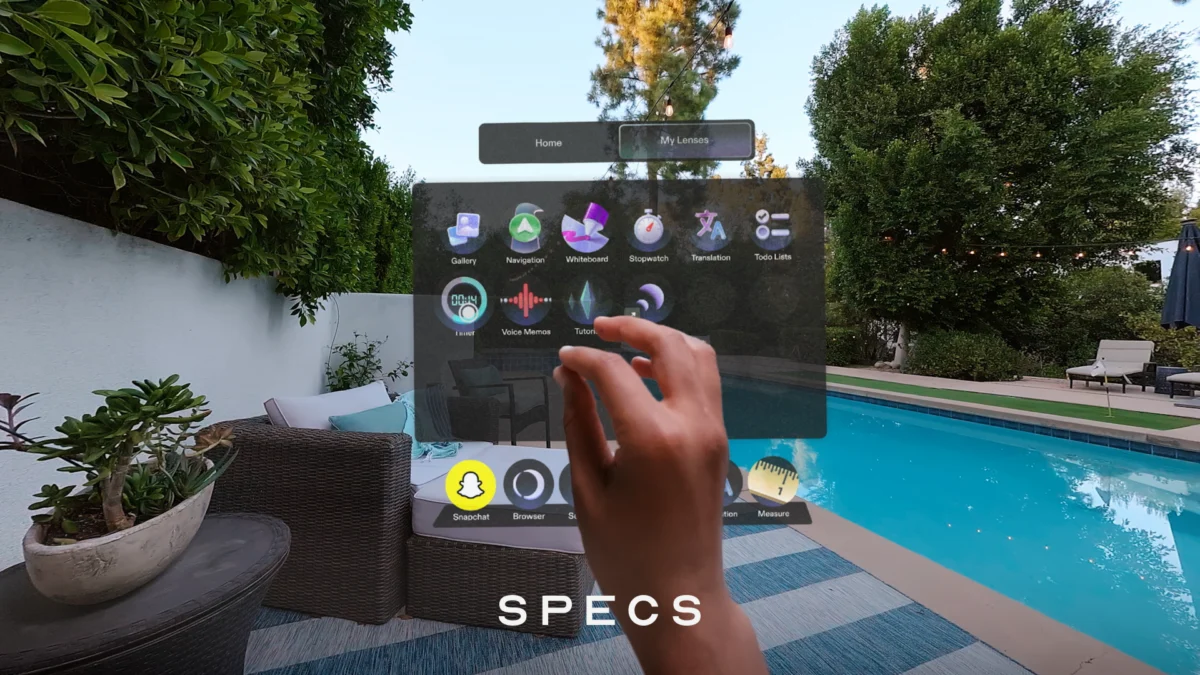
The cornerstone of Snap’s new strategy is "Specs Intelligence," a system the company is marketing as an “anticipatory AI.” Unlike traditional AI assistants that wait for a prompt, Snap claims this system is designed to understand the user’s goals, relationships, and routines by pulling data from connected apps across iPhones, Macs, and the glasses themselves.
Spiegel described the platform as an “AI-native operating system.” The goal, according to Snap, is to “connect the dots” across the company’s signature AR Lenses, allowing users to move fluidly between their phones and their eyewear. However, a critical takeaway from the presentation was that this AI framework is not strictly hardware-dependent; it functions as a productivity suite that users can interact with via their existing devices, potentially lowering the barrier to entry for the software even if the hardware remains out of reach.

Expanding the Utility: Enterprise and Beyond
While the consumer-facing features were a major focus, Snap made a concerted effort to court the enterprise sector with “Specs for Enterprise.” By partnering with industry titans such as Amazon, Salesforce, and Nvidia, Snap is betting that the path to profitability lies in professional workflows.
The use case for enterprise remains somewhat experimental, but the company is leaning into the "remote assistance" model. A demo video presented during the event showcased an IT technician using the glasses to troubleshoot hardware repairs, with AR overlays providing real-time guidance. Snap is currently building out the necessary infrastructure—mobile device management, robust security protocols, and scalable deployment tools—to make this a viable option for corporate IT departments. Whether this provides enough value to justify a $2,200 price point for thousands of employees remains the primary question for investors.
Entertainment and Connectivity: The "Fun" Factor
Beyond the boardroom and the office, Snap is attempting to infuse the device with a sense of play. By integrating streaming services like HBO Max and Spotify, the company is attempting to establish a baseline of "interactive fun" that has been largely missing from the smart glasses market.
However, some announcements leaned into the bizarre. One standout example was a partnership with the NBA and WNBA, which introduced an AR experience allowing users to practice their basketball form. While technically impressive, it raised significant questions regarding user comfort and social optics: the sight of a user wearing heavy, futuristic goggles while attempting to shoot hoops in a driveway is exactly the kind of imagery that critics argue will keep the product in the realm of a novelty item.
For users who wish to take the device on the go, Snap also introduced a standalone connectivity package. Recognizing that a tether to home Wi-Fi limits the utility of a wearable, Snap is offering a charging case with integrated cellular capabilities. In partnership with Verizon, this adds yet another layer of cost: $10 per month for existing Verizon customers and $20 for others.
Official Responses and the Philosophical Pivot
Throughout the event, Evan Spiegel framed the launch not as a desperate hardware push, but as a philosophical stand against the current trajectory of the tech industry. In an era dominated by fears of AI-driven job displacement and the isolating nature of the metaverse, Spiegel offered a different vision.
“It’s an interesting time to be launching a new computer because things in tech are pretty weird right now,” Spiegel told the audience. “We’re being told that AI will take our jobs, that virtual worlds will replace the real one. Well, no, thank you. We do not accept that future. Making people irrelevant is not progress, and computers should make us more important, not less.”

This framing is central to Snap’s strategy: characterizing the glasses as a "human-centric" tool. The company continues to justify the high price point by insisting that this is not just a gadget, but a sophisticated, wearable computer.
Market Implications and Future Outlook
The implications for Snap are profound. The company is effectively betting its future on the idea that the "weirdness" of the current tech landscape can be resolved by a more integrated, AI-driven experience that keeps the user grounded in the real world.
However, the path forward is fraught with obstacles. A pop-up event in Los Angeles is scheduled for October to allow consumers to experience the device firsthand before the official shipping date later this fall. For many, this will be the "make or break" moment. If the hardware feels cumbersome or if the AI features fail to provide tangible, everyday value, the negative sentiment that plagued the initial launch may prove impossible to shake.
Furthermore, the competition is not standing still. With major tech conglomerates also eyeing the AR and wearable space, Snap must prove that its "anticipatory AI" and enterprise partnerships offer a unique advantage that other, more established players cannot match.
As we look toward the final quarter of 2026, the question is no longer just about whether the glasses are a disaster—it is whether they can transition from a social media company’s experimental "toy" into a necessary tool for the modern professional. Snap has certainly provided a more coherent argument for the device’s existence than it did months ago, but in the brutal, high-stakes world of consumer hardware, a good argument is only the beginning. The company now faces the much harder task of converting skeptics into customers, one $2,200 pair of glasses at a time.