By the Editorial Desk | Special Audio Engineering Report
Main Facts
Swiss high-end audio legend Nagra has once again upended expectations in the audiophile community with the introduction of its latest digital tour de force: the Nagra Compact Player. Designed for purists who demand uncompromising, reference-grade sonics without the footprint of traditional component racks, this single-purpose digital-to-analog converter and streamer packs decades of legendary Swiss engineering into an astonishingly small chassis.
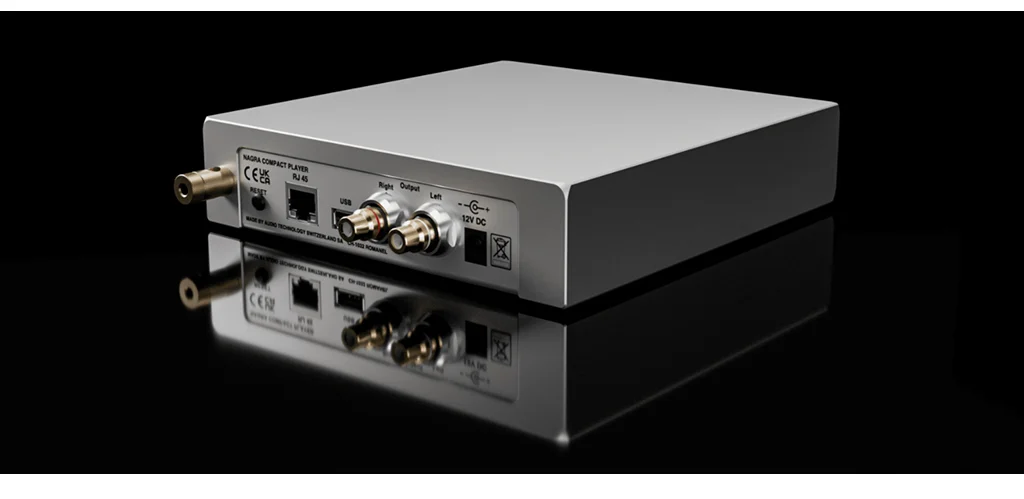
Measuring a mere 7.2 x 6.5 x 1.6 inches—sharing the exact physical dimensions of its sibling, the Nagra Compact Phono—the Compact Player defies the traditional audiophile convention that massive, heavy-chassis components are mandatory for world-class performance. Despite its diminutive size, it supports full DSD capability alongside high-resolution PCM formats. Out of the box, the unit features a streamlined, minimalist interface: there is no power switch, no complex multi-line display, and no unnecessary UI clutter. Instead, a single, understated LED indicator signals its operational status, reminding users that this is a device built strictly for one purpose: the uncompromised conversion and streaming of digital music.
Connectivity is deliberately sparse, focusing on core streaming architecture. The rear panel houses an RJ-45 Ethernet port for network streaming—fully optimized as a Roon Ready endpoint—alongside a USB input capable of hosting external hard drives or USB memory sticks. The unit ships with a high-quality external power supply, but like many of Nagra’s elite components, it offers an upgrade path. Users can step up to the dedicated Nagra Compact PSU, or integrate the player into existing high-end setups by connecting it to Nagra’s larger MPS or Classic PSU power supplies.
Early impressions from critics describe the sonic signature as pure, unadulterated Nagra: lightning-fast transient response, pinpoint tonal accuracy, deeply musical engagement, and a complete absence of artificial coloration or distortion. It is, in essence, high-end audio distilled to its absolute molecular essence.
Chronology of Development and Release
To fully understand the significance of the Nagra Compact Player, it is necessary to trace the trajectory of miniaturization and precision engineering that the manufacturer has championed over its storied history.
The Heritage of Micro-Engineering (1951–1990s)
Founded by Stefan Kudelski in 1951, Nagra (which means "it will record" in Polish) built its global reputation on portable, battery-powered professional analog tape recorders. These devices were legendary for their ruggedness, mechanical precision, and peerless audio fidelity. They were deployed everywhere from Hollywood film sets to covert intelligence operations and broadcast journalism. From its very inception, Nagra’s core competency was engineering high-performance audio systems into compact, highly mobile enclosures.
Entering the High-End Consumer Sphere (1997–2020s)
In the late 1990s, Nagra transitioned into the ultra-luxury consumer home audio market, bringing its broadcast-grade philosophy to preamplifiers, power amplifiers, and eventually digital sources like the renowned Nagra DAC and HD DAC series. While these components received universal critical acclaim, they also followed the traditional high-end trajectory of growing larger, heavier, and more complex to accommodate massive power supplies, tube stages, and extensive feature sets.
The Birth of the Compact Series (2024–2026)
Recognizing a shift in the modern audiophile landscape—where minimalist living spaces, desktop audio systems, and secondary listening rooms demand high performance without bulky equipment stacks—Nagra pivoted back to its roots of extreme miniaturization.
- Phase I: The introduction of the Nagra Compact Phono established the physical template: a rugged, exquisitely machined aluminum chassis measuring just 7.2 x 6.5 x 1.6 inches, engineered to deliver analog performance that punched far above its weight class.
- Phase II (Current Release): The unveiling of the Nagra Compact Player brings this philosophy to the digital realm. Eschewing legacy inputs like optical or coaxial S/PDIF, engineers focused strictly on network streaming and direct USB storage playback, optimizing signal paths to eliminate jitter and digital noise interference. Early production units rolled out in mid-2026, instantly capturing the attention of the global audio press as a potential paradigm shift for high-res digital audio.
Supporting Data and Technical Specifications
When evaluating ultra-compact audio gear, skeptics often question whether physical limitations compromise electrical and acoustic performance. Nagra’s engineering team addressed these challenges through rigorous circuit topology, premium component selection, and obsessive power-supply management.
Physical and Electrical Specifications
- Chassis Dimensions: 7.2 inches (Length) x 6.5 inches (Width) x 1.6 inches (Height)
- Form Factor: Identical to the Nagra Compact Phono; designed for stacking or discrete placement in tight spaces.
- User Interface: Zero physical controls; absence of a power switch (designed to remain continuously powered on for thermal and electronic stability). Single status LED indicator.
- Warm-up Period: Reaches optimum thermal and electronic stabilization after approximately 24 to 48 hours of continuous connection.
Connectivity and Digital Architecture
- Network Integration: RJ-45 Ethernet port; certified Roon Ready endpoint. Average network discovery and setup time is reported at under 30 seconds.
- Local Storage Input: USB Type-A port dedicated to external hard drives and USB memory sticks.
- Format Support: Full Native DSD capability alongside high-resolution PCM streaming (tested extensively from standard 16-bit/44.1kHz up to 24-bit/192kHz).
- Power Supply Options:
- Stock: Compact external wall/line power brick.
- Tier 1 Upgrade: Nagra Compact PSU.
- Tier 2 Upgrade: Compatibility with legacy Nagra MPS and Classic PSU outboard power supplies.
Comparative Performance Metrics
In preliminary benchmark evaluations against multi-thousand-dollar reference DACs, the Compact Player reportedly holds its own in terms of spatial imaging, black backgrounds, and micro-dynamic retrieval. While it lacks the physical versatility of multi-input digital hubs, its singular focus on network streaming yields a signal-to-noise ratio and jitter rejection rate that rivals components triple its physical size and price point.
Official Responses and Expert Commentary
The audio industry has reacted to the Nagra Compact Player with a mixture of awe and philosophical alignment. While some traditionalists have debated the omission of legacy digital inputs, industry insiders emphasize that the unit’s design represents a calculated, highly disciplined engineering choice.
Perspectives from the Listening Room
Noted audio journalist and reviewer Jeff Dorgay of TONEAudio offered high praise following his initial hands-on evaluation of the pre-production unit:
"If you’re thinking, ‘How can Nagra get so much performance out of such a small box?’ The reason is simple. They have distilled the functionality down to the absolute minimum—there isn’t even a power switch! Plug it in and leave it on… The sound is pure Nagra, honed by decades of building some of the world’s finest gear including analog and digital recorders. Lightning fast, tonally correct, musical and involving—yet without embellishment or coloration. That is the Nagra way."
Dorgay went on to draw a compelling lifestyle and manufacturing parallel, comparing the device’s uncompromising build quality and singular purpose to horology:
"It’s built with every bit of care and precision that every Nagra is built with. The Compact series is not watered down in any way. Think of the Compact Player as the Tudor Black Bay of digital players."
Criticisms and Design Compromises
Not every aspect of the unit’s minimalism has gone without gentle critique. Industry analysts have pointed out the exclusive reliance on Ethernet and USB as a potential bottleneck for users who wish to connect legacy digital sources, such as a dedicated CD transport or a high-end television via S/PDIF (optical or coaxial).
When queried about this limitation, acoustic engineers close to the project noted that adding SPDIF receiver chips, clock-switching logic, and multi-input selection circuitry would have necessitated a larger motherboard, introduced additional sources of digital noise, and compromised the ultra-short signal paths critical to the unit’s transparent sound signature. The Compact Player is explicitly tailored for the modern, network-centric audiophile rather than the traditional multi-source component stacker.
Implications for the High-End Audio Market
The release of the Nagra Compact Player marks a significant milestone that could ripple across the high-end audio manufacturing sector for several reasons.
1. The Redefinition of "High-End" Form Factors
For decades, the psychological and physical association in audiophile circles has been clear: bigger chassis equals bigger power transformers, better isolation, and superior sound. By proving that reference-level DSD/PCM decoding and streaming can be housed in an enclosure smaller than a hardcover book, Nagra challenges manufacturers to rethink spatial efficiency. This is particularly relevant as younger generations of affluent audiophiles migrate toward urban apartments, desktop listening setups, and minimalist living spaces where sprawling multi-tier equipment racks are unwelcome.
2. The Rise of Single-Purpose Architecture
In an era where many digital-to-analog converters attempt to be Swiss Army knives—incorporating preamplifier stages, headphone amps, analog line inputs, Bluetooth modules, and room correction software—Nagra’s approach is a radical counter-statement. By paring down functionality to pure network streaming and USB playback, the company reduces internal crosstalk, software bloat, and maintenance points of failure. This philosophy suggests a growing market appetite for "do one thing exceptionally well" components rather than all-in-one compromises.
3. Modular Power Scaling as a Business Model
By designing the Compact Player to accept incremental power supply upgrades (moving from the stock adapter to the Compact PSU, and onward to the MPS or Classic PSU), Nagra has created an appealing upgrade ladder. Consumers can enter the brand’s ecosystem at a comparatively accessible foundational tier, knowing they can extract higher performance over time without replacing the core digital unit.
Outlook
As the full, extended reviews for the Nagra Compact Player loom on the horizon, it is already clear that the Swiss manufacturer has carved out a fascinating niche. It bridges the gap between high-convenience streaming appliances and uncompromising reference audio gear. For the digital purist willing to embrace its minimalist design philosophy, the Compact Player may well represent the future of high-end personal audio: small in stature, vast in sonic ambition.