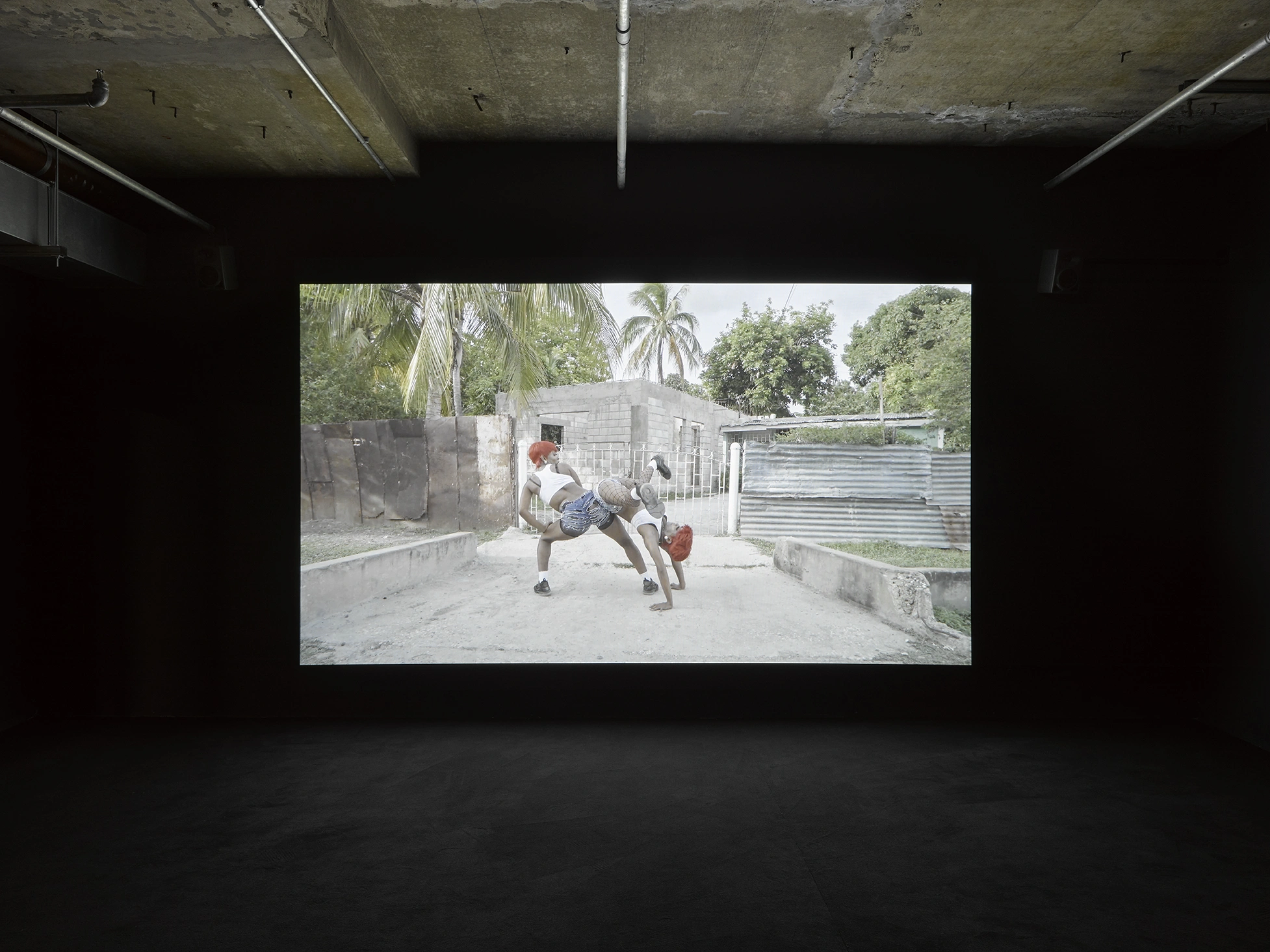
In the cavernous, industrial expanse of 180 Studios, a heartbeat emanates from the walls—a rhythmic, percussive vibration that feels distinctly Jamaican. As part of The Vinyl Factory: Reverb, the expansive exhibition currently transforming the basement of 180 The Strand, Argentinian artist and choreographer Cecilia Bengolea has unveiled Shelly Belly Inna Real Life.
The video installation is more than a film; it is a sensory immersion into the visceral world of dancehall. Shot on location in Jamaica between 2015 and 2019, the work acts as both a documentary archive and a kinetic sculpture, capturing the intricate language of a movement style that serves as a profound social barometer for the island. In a wide-ranging new interview, Bengolea deconstructs the project, offering a rare window into the tensions, triumphs, and complexities of a genre often misunderstood by the global mainstream.
The Genesis of a Movement: Capturing Dancehall’s Intimacy
Dancehall is frequently reduced to its aesthetic output—the high-octane, gravity-defying moves that have permeated global pop culture. However, for Bengolea, the genre is fundamentally a socio-political apparatus. Shelly Belly Inna Real Life centers on the eponymous dancehall icon, a figure whose physical vernacular is matched only by his deep integration into the community fabric of Kingston.
"The camera does not observe from a distance," Bengolea explains. By shadowing Shelly Belly, the artist gains access to the domestic and public spheres where dancehall is incubated. The film eschews the "tourist gaze," opting instead for a collaborative methodology. Bengolea, a trained dancer herself, does not merely film the choreography; she engages with it, translating the spatial politics of the dancehall—the way bodies occupy space, the hierarchy of the circle, and the unspoken rules of the "bashment"—into a visual narrative.
The installation invites viewers to confront the raw energy of the street. It documents the evolution of dancehall as a tool of survival, a form of protest, and a vital method of storytelling in neighborhoods where institutional support is frequently absent.
A Chronology of Collaboration: From Bom Bom to Shelly Belly
The current exhibition at 180 Studios represents the culmination of a decade-long fascination with Jamaican street culture for the artist. To understand the depth of Shelly Belly Inna Real Life, one must look back at the trajectory of Bengolea’s collaborative practice.
2015–2016: The Bom Bom’s Dream Era
Bengolea’s relationship with The Vinyl Factory dates back to 2016, when she partnered with renowned British artist Jeremy Deller to produce Bom Bom’s Dream. Commissioned for The Infinite Mix exhibition, the work was a kaleidoscopic journey into the imagination of a Japanese dancehall devotee known as "Bom Bom."

The project was pivotal. It demonstrated that dancehall had become a global lingua franca, capable of bridging disparate cultures—from the streets of Kingston to the clubs of Tokyo. It was during this period that Bengolea’s working relationship with Shelly Belly solidified, setting the stage for the more intimate, long-form study that would eventually become the current 180 Studios installation.
2017–2019: The Extended Fieldwork
Between 2015 and 2019, Bengolea engaged in a prolonged period of fieldwork. This was not a traditional film shoot; it was a process of immersion. During these years, she spent months at a time in Jamaica, moving away from the conceptual abstraction of her earlier gallery works toward a more grounded, ethnographic approach. This period allowed her to witness the cyclical nature of dancehall—the seasonal trends in fashion, the constant innovation of new steps, and the inevitable friction between the dance community and local authorities.
2024–2025: Reverb at 180 Studios
The current presentation at 180 Studios is the first time this body of work has been curated as a definitive, immersive environment. The exhibition space has been specifically engineered to amplify the sonic frequency of the dancehall soundtrack, ensuring that the viewer feels the percussion in their chest—a necessity for understanding the visceral nature of the genre.
The Social Geography of Dance: Dancehall and the State
One of the most compelling aspects of Bengolea’s interview is her analysis of the fraught relationship between the Jamaican police and the dancehall scene. In many Caribbean urban centers, the dancehall is treated with suspicion by the state. Historically, these gatherings have been subjected to strict noise ordinances and curfew laws, which critics argue are designed to stifle the agency of the working-class youth.
Bengolea frames dancehall as a form of "spatial resistance." When the state attempts to silence the music or curtail the hours of a dance, the community adapts, migrating to new spaces or altering the choreography to remain relevant.
"The police presence is a constant shadow," she notes. In the film, one can observe the subtle shifts in atmosphere when authority figures appear—a tension that dictates the flow of the movement. Yet, dancehall remains defiant. Through the lens of the camera, we see how the dancers use their bodies to reclaim public space, turning parking lots, street corners, and makeshift venues into cathedrals of expression. This is not just dancing; it is the assertion of the right to exist in the public square.
Implications for Contemporary Art and Ethnography
The inclusion of Shelly Belly Inna Real Life in The Vinyl Factory: Reverb signals a shift in how major institutions are engaging with global street culture. By presenting this work within a high-profile London venue, the exhibition challenges the traditional divide between "high art" and "popular street culture."

The Preservation of Ephemeral Knowledge
Dancehall is an ephemeral medium. Choreography, slang, and fashion trends disappear as quickly as they emerge. By documenting the work of figures like Shelly Belly, Bengolea is performing an act of cultural preservation. She is ensuring that the nuances of this specific era—the specific, idiosyncratic movements that define 2015–2019—are archived for future generations of historians and choreographers.
The Ethics of Representation
Bengolea is acutely aware of the complexities surrounding an Argentinian artist filming Jamaican culture. Throughout her interview, she emphasizes the importance of "mutual exchange" rather than "extraction." She views her role not as a documentarian capturing a subject, but as a facilitator providing a platform for the dancers to articulate their own stories. This reflects a growing trend in contemporary art toward "participatory ethics," where the relationship between the artist and the subject is as significant as the finished work itself.
Exhibition Logistics and Visiting Information
For those wishing to engage with this masterwork of video installation, The Vinyl Factory: Reverb provides a rare opportunity to witness the synthesis of sound, movement, and social commentary.
- Venue: 180 Studios, 180 The Strand, London, WC2R 1EA.
- Exhibition Dates: Running now through March 2, 2025.
- Important Note: The exhibition will be closed for the holiday season between December 23, 2024, and January 8, 2025.
- Opening Hours:
- Wednesday to Saturday: 12:00 PM – 7:00 PM
- Sunday: 12:00 PM – 6:00 PM
- Tickets: Advance booking is highly recommended via the official 180 Studios website. Given the popularity of the Reverb exhibition, visitors are encouraged to secure their slots well in advance to avoid disappointment.
Conclusion: A Living Archive
Cecilia Bengolea’s Shelly Belly Inna Real Life stands as a testament to the enduring power of the body as a site of history. It reminds us that behind every viral dance step lies a complex, often struggle-filled reality. As the exhibition at 180 Studios continues into 2025, it invites us not just to look, but to feel the vibrations of a culture that refuses to be silenced. Whether you are a scholar of dance, an enthusiast of Caribbean culture, or simply a seeker of profound artistic experiences, this work offers a portal into a world where movement is the ultimate act of liberation.
For those interested in exploring the broader context of the exhibition, be sure to view the accompanying series, including Es Devlin: Screenshare, which is currently being showcased alongside Bengolea’s work, further emphasizing the exhibition’s commitment to the intersection of sound, light, and performance.