For the automotive enthusiast, the factory audio experience often represents the most significant weak point in an otherwise well-engineered vehicle. While head units are increasingly sophisticated, the physical limitations of integrated amplification remain a constant hurdle for those seeking high-fidelity sound. Recent technical discussions within the audiophile community have highlighted a common misconception regarding head unit output capabilities, specifically concerning 2-ohm stability and real-world power delivery.
This report serves as a guide for enthusiasts looking to bridge the gap between mediocre factory sound and a high-performance, immersive listening environment.
The Power Myth: Understanding Real-World Head Unit Output
A pervasive myth in car audio circles is the belief that aftermarket head units—even those that are CTA-2006 compliant—can effectively drive high-performance components to their full potential without external amplification. Many users mistakenly assume their head units are 2-ohm stable or capable of delivering upwards of 100 watts per channel.
The Reality of CTA-2006 Standards
The Consumer Technology Association (CTA-2006) provides a rigorous standard for measuring amplifier power. However, even within these parameters, the math often falls short of user expectations. While a standard factory head unit might provide approximately 22 watts per channel, high-end aftermarket units are generally rated at 45 watts per channel at 4 ohms.
Crucially, these units are rarely designed to handle 2-ohm loads. Attempting to force a head unit to drive 2-ohm components is a recipe for hardware failure; the increased current draw creates excessive heat, which will inevitably lead to thermal shutdown or permanent damage to the unit’s internal circuitry. To unlock the potential of high-quality speakers, an external amplifier is not merely a suggestion—it is a technical requirement.
Chronology of an Audio Upgrade Strategy
Achieving a professional-grade sound stage requires a methodical approach. The following roadmap outlines the necessary stages for a successful audio transformation.
Phase 1: Assessment and Component Preservation
The first step is identifying the quality of existing drivers. Often, users underestimate the capability of their current speakers. When properly fed, high-quality component sets can produce a sound stage that rivals home studio setups. Before discarding your existing hardware, evaluate whether the issue lies in the speakers themselves or the lack of clean, consistent power.
Phase 2: Choosing Your Topology—Active vs. Passive
Once the power issue is addressed, the user must choose between two primary signal delivery methods:
- Passive Configuration: This is the industry standard for most installations. It utilizes a crossover (a capacitor/coil network) attached to the mid-bass driver to filter frequencies. In this setup, you feed a full-range signal to the passive crossover, which then distributes the appropriate frequencies to the tweeter and woofer.
- Active Configuration: This involves bypassing the physical crossovers and using the head unit’s internal processing to send specific frequency ranges directly to each individual driver. While this offers superior tuning precision and imaging, it requires more complex wiring and a deep understanding of crossover points (e.g., 3.5kHz at a 24dB slope).
Supporting Data: Technical Considerations for System Integration
To design a robust system, one must understand how to leverage the pre-out capabilities of a modern head unit. Most high-end units feature multiple 5V pre-outs.
Leveraging Pre-Outs for Maximum Fidelity
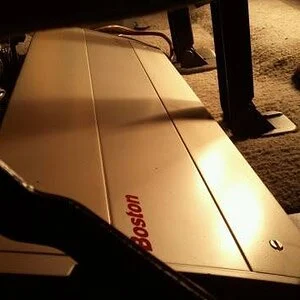
For a standard passive setup, the primary Left/Right front and rear pre-outs should be routed directly to a 4-channel amplifier. This keeps the signal clean, high-voltage, and free from the distortion associated with high-level speaker wire inputs. With a 4-channel amplifier (ideally outputting between 100W and 150W RMS per channel), you provide the headroom necessary for the speakers to operate without clipping.
The Subwoofer Equation
A common mistake in system design is forgetting the low-frequency foundation. Once the 4-channel amp is occupied by the door components, you are left with two dedicated subwoofer pre-outs. This leaves the user with three distinct paths for low-frequency management:
- The Self-Powered Subwoofer: The easiest entry point. These units include a built-in amplifier and a pre-matched driver, minimizing installation complexity.
- The Dedicated Subwoofer Amp: Utilizing a separate mono-block amplifier to drive a passive subwoofer enclosure. This provides the most power and flexibility.
- The 5-Channel Solution: For those looking to simplify their footprint, a high-quality 5-channel amplifier can handle both the door components and the subwoofer, provided the unit is sized appropriately for the load.
Expert Perspectives on Implementation
Technical experts emphasize that the choice between active and passive setups often comes down to the installer’s skill level and time investment.
"The passive option will, in many configurations, provide a more cohesive stage for the average user," notes one industry specialist. "It simplifies the wiring significantly. However, if you are comfortable with fabrication and complex signal routing, an active setup allows for a level of precision—specifically in time alignment and frequency control—that passive crossovers simply cannot replicate."
The Importance of Infrastructure
Beyond the hardware, the "hidden" costs of an installation must be accounted for. These include:
- Wiring: Upgrading to high-quality oxygen-free copper (OFC) speaker wire is essential for maintaining signal integrity.
- Fabrication: Are you planning to build a custom fiberglass enclosure for a subwoofer, or will you utilize a pre-fabricated, sealed/ported box? Your choice here impacts both the physical installation space and the final acoustic response of the subwoofer.
- Budgeting: A balanced system should allocate funds not just for the amplifier and sub, but for the necessary wiring kits, sound deadening (dynamat or equivalent), and potential mounting adapters for the speakers.
Implications: Building for Longevity and Quality
The decision to move away from head-unit-powered audio has long-term implications for both the equipment and the listener. By offloading the thermal stress of power amplification to a dedicated unit, you extend the lifespan of your head unit and eliminate the mid-range distortion that plagues underpowered systems.
Addressing the "Budget vs. Skill" Dilemma
Ultimately, the success of an audio upgrade is defined by the user’s ability to define their goals. If the objective is a plug-and-play experience, a 4-channel amplifier paired with a pre-loaded powered subwoofer is the gold standard. If the goal is "competition-level" clarity, the path moves toward a 5-channel amplifier system with custom-built enclosures and an active crossover configuration.
Final Recommendations for the Enthusiast
- Stop searching for 2-ohm stability in head units. It does not exist in a viable, reliable form factor.
- Prioritize the Amplifier. Your components are likely better than you think; they are simply starving for current.
- Plan your wiring. Before purchasing any gear, map out how the cables will run through the vehicle. A clean install is the difference between a system that hums and one that sings.
- Define your budget. A $500 budget requires a different approach than a $2,000 budget. Be realistic about what you can fabricate versus what you need to purchase pre-assembled.
In conclusion, the path to a superior audio experience is paved with proper amplification and an understanding of system topology. Whether you choose the path of ease via passive crossovers and powered subwoofers, or the path of technical mastery via active signal processing, the transition from head-unit power to dedicated amplification is the single most effective upgrade you can make. Your speakers are capable of brilliance—it is time to provide them with the power they require to prove it.