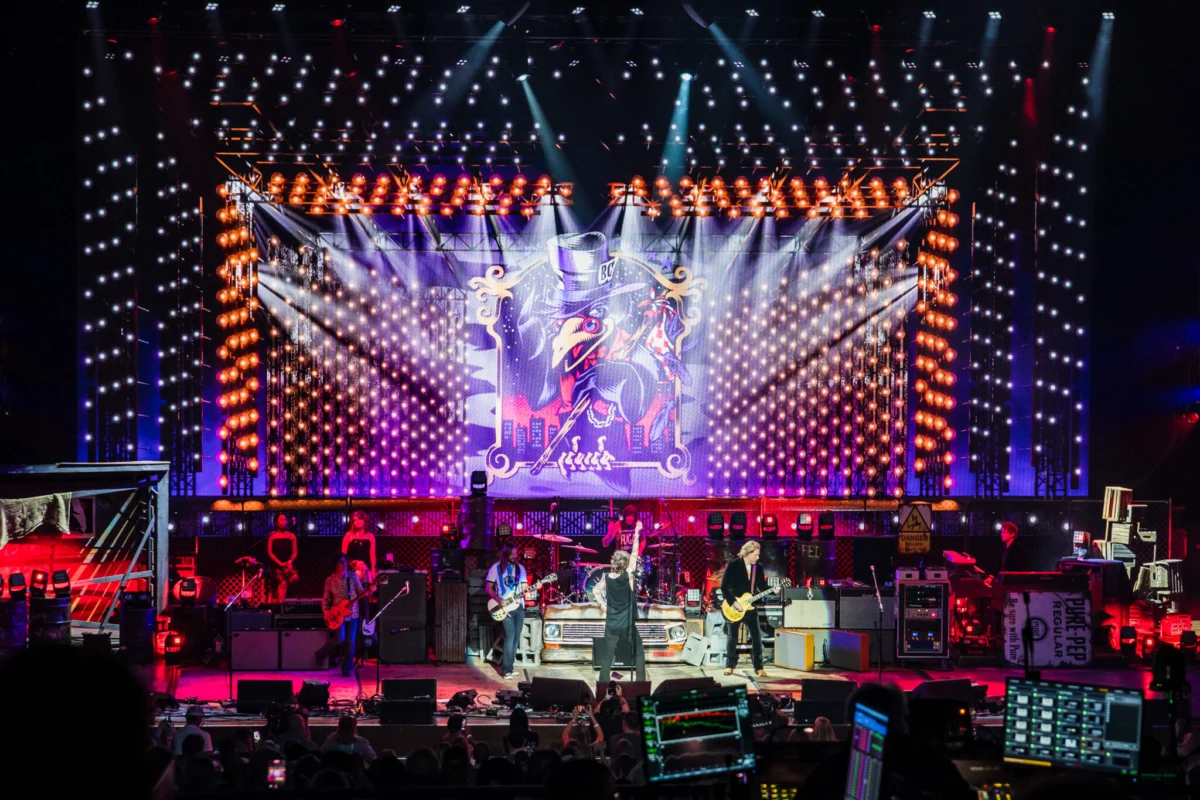
The intersection of classic rock-and-roll grit and cutting-edge acoustic technology has found its latest expression in The Black Crowes’ "Southern Hospitality Tour." As the legendary band traverses North America in support of their tenth studio album, A Pound of Feathers, the tour has become a masterclass in modern sound reinforcement. Leveraging the formidable power of the Meyer Sound Panther line array system—provided by the renowned Bay Area integrator UltraSound—the tour is currently navigating a grueling 41-city schedule that spans from intimate arenas to massive outdoor amphitheaters.
Main Facts: A Symphony of Power and Portability
The "Southern Hospitality Tour" represents a significant milestone for both The Black Crowes and the live sound industry. At the heart of the operation is the Meyer Sound Panther system, a flagship technology designed to deliver high-output performance with a footprint that challenges the traditional limitations of heavy-duty touring rigs.
The tour’s audio architecture is managed by UltraSound, a company with a storied history of providing bespoke audio solutions for high-profile acts. For this run, the primary challenge was versatility. The tour’s itinerary includes venues ranging from 3,000-seat theaters to 30,000-seat stadiums. To address this, the engineering team deployed a scalable system centered around 36 Panther line array loudspeakers (18 per side).
Key technical highlights of the tour include:
- Primary Arrays: 18 Meyer Sound Panther loudspeakers per side.
- Out-fills: 16 Lyon line array loudspeakers per side to ensure consistent coverage for wide-angle seating.
- Low-Frequency Management: A sophisticated cardioid configuration featuring six 1100-LFC elements flown per side and 12 ground-stacked units.
- Front-fill: Six Leopard line array loudspeakers to bridge the gap between the stage and the front rows.
- Software Integration: Extensive use of Meyer Sound’s MAPP 3D for predictive acoustic modeling.
Chronology: From Studio Concept to Stadium Reality
The journey to the "Southern Hospitality Tour" began with the creative resurgence of the Robinson brothers. Following the critical success of A Pound of Feathers, the band sought a touring solution that could replicate the album’s rich, analog-inspired textures in diverse live environments.

The Planning Phase
In early 2024, UltraSound project coordinator Jason Mills began collaborating with the band’s production team to design a system that could "flex" without losing its sonic identity. The goal was to create a "one-size-fits-all" rig that could be stripped down for smaller halls or fully deployed for major festivals without requiring a total reconfiguration of the signal processing or rigging hardware.
Launch and Deployment
The tour kicked off with a series of high-energy performances where the Panther system was immediately put to the test. The lightweight nature of the Panther cabinets allowed the rigging crews to meet tight load-in schedules, a critical factor in a 41-city run.
The Mid-Tour Evolution
As the tour progressed through the humid amphitheaters of the South and the dry arenas of the North, systems engineer David Williams utilized real-time data to refine the system’s output. By mid-tour, the team had established a streamlined workflow, using UltraSound’s extensive archive of MAPP 3D files from previous tours at the same venues to jump-start their daily calibrations.
The Final Stretch
The tour is currently in its final leg, culminating in a massive performance on August 20 at the Shoreline Amphitheatre in Mountain View, California—a venue known for its challenging acoustics, where the Panther system’s precision will be paramount.
Supporting Data: The Science of the "Quake"
The technical success of the "Southern Hospitality Tour" is rooted in the specific engineering choices made by the UltraSound team. One of the most critical aspects of the design is the management of low-frequency energy.

The Cardioid Advantage
In traditional setups, subwoofers radiate energy in an omnidirectional pattern, which can lead to "stage bleed"—a buildup of low-end energy on the stage that interferes with the performers’ monitors. To combat this, Jason Mills and his team utilized a cardioid configuration for the 1100-LFC elements. By strategically delay-timing and reversing the polarity of specific sub-units, they created a "null" zone on the stage.
According to Mills, the subwoofers were even turned outward rather than facing directly downstage. This adjustment further refined the rejection zone, specifically protecting lead singer Chris Robinson from the overwhelming sub-energy that can often muddy a vocal performance.
Predictive Modeling with MAPP 3D
The use of Meyer Sound’s MAPP 3D software has been a game-changer for the tour’s logistics. The software allows David Williams to visualize how sound will interact with the specific geometry of a venue before a single speaker is hoisted.
- Efficiency: By using archived files, the team can predict "slap-back" echoes from distant walls and adjust the array angles accordingly.
- Consistency: MAPP 3D ensures that a fan in the 30,000th seat of an amphitheater experiences the same tonal balance as someone in the front row of a 3,000-seat club.
Official Responses: Perspectives from the Console
The philosophy behind the tour’s sound is driven by Tim “Quake” Mark, the band’s Front of House (FOH) Engineer and Production Manager. Mark’s approach to mixing is one of transparency and reinforcement rather than artificial creation.
"My job as a front-of-house guy is not to create," Mark stated during a mid-tour interview. "Mine is to interpret and reinforce you in the room. After I do that, then I sit down and I can mix."

Mark, whose nickname "Quake" hints at his preference for powerful low-end, emphasized that the Meyer Sound system allows him to achieve a visceral impact without sacrificing clarity. "I don’t look for a punch. I want to shake your pant legs. I drive the band with a bass player all the time," he explained. The Panther system’s ability to handle high SPL (Sound Pressure Level) while maintaining a linear frequency response allows Mark to push the "shake" without distorting the band’s intricate blues-rock arrangements.
Jason Mills of UltraSound highlighted the logistical benefits from a provider’s perspective. "The band is playing a smattering of arenas, and then mostly amphitheaters," Mills noted. "It’s easier for the guys on tour to scale back than it is to scale up. The Panther system is easy to deploy, it’s easy to scale, and the riggers have no problems with it."
Implications: The Future of Large-Scale Rock Touring
The success of The Black Crowes’ "Southern Hospitality Tour" carries several implications for the broader live music industry.
1. The Death of the "Heavy" Rig
The Panther system represents a shift toward "power-to-weight" efficiency. For years, massive tours required fleets of trucks to transport heavy line array cabinets. Panther’s reduced weight means lower fuel costs and a smaller carbon footprint, all while delivering the output required for stadium-level rock. This tour proves that sustainability and high-decibel rock are no longer mutually exclusive.
2. Enhanced Artist Comfort
By prioritizing the "on-stage" environment through cardioid sub-configurations, the production team has highlighted a growing trend: the FOH mix is only as good as the band’s comfort. When performers like Chris Robinson are not battling a "wash" of low-end energy, their performances are more nuanced, which in turn provides a better raw signal for the FOH engineer to reinforce.

3. Data-Driven Touring
The reliance on MAPP 3D and archived venue data suggests a future where "winging it" during soundcheck is a thing of the past. As acoustic modeling becomes more precise, the consistency of the concert-going experience will continue to rise, regardless of the venue’s architectural quirks.
4. The Resilience of Classic Rock
Finally, the tour underscores the enduring viability of classic rock acts in the modern era. By investing in top-tier audio technology, The Black Crowes are ensuring that their legacy is not just seen, but felt. As they head toward the tour finale at Shoreline Amphitheatre, the "Southern Hospitality Tour" stands as a testament to the power of tradition when it is backed by the finest technology the 21st century has to offer.
In an era where live performances are the lifeblood of the music industry, the collaboration between The Black Crowes, UltraSound, and Meyer Sound has set a high bar for what fans—and engineers—should expect from a premier touring production. As the last notes of A Pound of Feathers ring out through the Panther arrays this August, the industry will undoubtedly be looking to this tour as the blueprint for the next generation of live sound excellence.